

Barres de cereales
Health
Nutrition
Nutri-Score
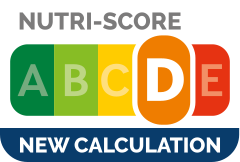 Lower nutritional quality
Nutri-Score data warning
Nutrient levels
Fat in moderate quantity (5.8%)
Saturated fat in moderate quantity (2.7%)
Sugars in high quantity (30%)
Salt in moderate quantity (0.37%)
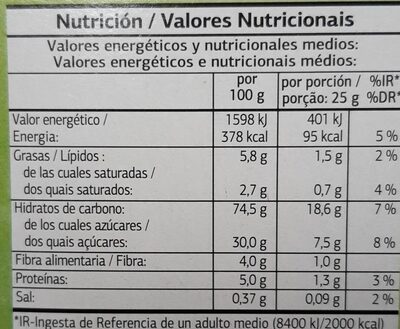
Nutrition label
Nutrition facts
| Nutrition facts | As sold for 100 g / 100 ml | Compared to: Cereal bars |
|---|---|---|
| Energy | 1598 kJ (378 kcal) | 1,751.547 kJ (412 kcal) (-9%) |
| Fat | 5.8 g | 14.361 g (-60%) |
| Saturated fat | 2.7 g | 4.699 g (-43%) |
| Carbohydrates | 74.5 g | 59.982 g (+24%) |
| Sugars | 30 g | 24.239 g (+24%) |
| Dietary fiber | 4 g | ? |
| Proteins | 5 g | 8.194 g (-39%) |
| Salt | 0.37 g | 0.398 g (-7%) |
| Sodium | 0.148 g | 0.159 g (-7%) |
| Fruits, vegetables and legumes | ~ 11.5 % | ? |
Nutrition facts (Detailed data)
| Nutrition facts | As sold for 100 g / 100 ml | As sold Per 100 g (packaging) | As sold Per 100 g (estimate) |
|---|---|---|---|
| Energy | 1598 kJ (378 kcal) | 1598 kJ (378 kcal) | ? |
| Fat | 5.8 g | 5.8 g | ? |
| Saturated fat | 2.7 g | 2.7 g | ? |
| Carbohydrates | 74.5 g | 74.5 g | ? |
| Sugars | 30 g | 30 g | ? |
| Dietary fiber | 4 g | 4 g | ? |
| Proteins | 5 g | 5 g | ? |
| Salt | 0.37 g | 0.37 g | ? |
| Sodium | 0.148 g | 0.148 g | ? |
| Fruits, vegetables and legumes | ~ 11.5 % | ? | ~ 11.5 % |
Ingredients
Ingredients image

Ingredients list
Ingredient information
Added sugars
Allergens
Traces
Ingredients analysis
Contains ingredients containing palm oil.
Vegan status unknown
Unrecognized: es:albaricoque-harina-de-arroz, es:aceite-vegetal-de-algodon
Vegetarian status unknown
Unrecognized: es:albaricoque-harina-de-arroz, es:aceite-vegetal-de-algodon
Food Processing
NOVA group
 Ultra-processed food and drink products
Elements that indicate the product is in NOVA group 4
How NOVA works
Additives
E330 - Citric acidAntioxidantSequestrant
Citric acid is a natural organic acid found in citrus fruits such as lemons, oranges, and limes.
It is widely used in the food industry as a flavor enhancer, acidulant, and preservative due to its tart and refreshing taste.
Citric acid is safe for consumption when used in moderation and is considered a generally recognized as safe (GRAS) food additive by regulatory agencies worldwide.
E420 - SorbitolHumectantSequestrantStabiliserSweetenerThickener
Sorbitol (), less commonly known as glucitol (), is a sugar alcohol with a sweet taste which the human body metabolizes slowly. It can be obtained by reduction of glucose, which changes the aldehyde group to a hydroxyl group. Most sorbitol is made from corn syrup, but it is also found in nature, for example in apples, pears, peaches, and prunes. It is converted to fructose by sorbitol-6-phosphate 2-dehydrogenase. Sorbitol is an isomer of mannitol, another sugar alcohol; the two differ only in the orientation of the hydroxyl group on carbon 2. While similar, the two sugar alcohols have very different sources in nature, melting points, and uses.
E473 - Sucrose esters of fatty acids EFSA overexposure risk: highEmulsifierStabiliser
No additive description is available yet.
E524 - Sodium hydroxide
Sodium hydroxide, also known as lye and caustic soda, is an inorganic compound with the formula NaOH. It is a white solid ionic compound consisting of sodium cations Na+ and hydroxide anions OH−. Sodium hydroxide is a highly caustic base and alkali that decomposes proteins at ordinary ambient temperatures and may cause severe chemical burns. It is highly soluble in water, and readily absorbs moisture and carbon dioxide from the air. It forms a series of hydrates NaOH·nH2O. The monohydrate NaOH·H2O crystallizes from water solutions between 12.3 and 61.8 °C. The commercially available "sodium hydroxide" is often this monohydrate, and published data may refer to it instead of the anhydrous compound. As one of the simplest hydroxides, it is frequently utilized alongside neutral water and acidic hydrochloric acid to demonstrate the pH scale to chemistry students.Sodium hydroxide is used in many industries: in the manufacture of pulp and paper, textiles, drinking water, soaps and detergents, and as a drain cleaner. Worldwide production in 2004 was approximately 60 million tonnes, while demand was 51 million tonnes.
Environment
Green-Score, origins bonus, and transportation impact are shown for Worldwide .
Green Score
Overall grade
 Unknown environmental impact
About Green-Score
Current scope
Green-Score availability
Bonuses and maluses
Declared origins
Threatened species risk
Packaging impact
Packaging
Packaging impact
Data precision
Transportation
Declared origins
Forest footprint
Forest footprint
Deforestation risk details
Data Source
Product data comes from Open Food Facts. Food Benchmark also adds translations, category comparisons and explanatory calculations.
The database is licensed under ODbL 1.0, individual contents under DbCL 1.0, and product photos under CC BY-SA 3.0.
Product added on May 29, 2018 at 3:30:14 PM UTC by kiliweb .
Last edit on March 17, 2026 at 11:24:25 PM UTC by new-nutrition-bot .
Product page also edited by 5m4u9, cfati, elcoco, kiliweb, luz14, marie-cleyrat, moon-rabbit, musarana, new-nutrition-bot, october-food-facts, openfoodfacts-contributors, roboto-app, teolemon, thaialagata, yuka.C75vO-ylRe09EN_z45Jtgj-HM9_KIaADPEYsog, yuka.WTU0aFNMc3hvZlFEd2ZROHBTM3M2UHNwNllLT0FEK3BOL0FjSVE9PQ, yuka.sY2b0xO6T85zoF3NwEKvlnZLa9fZpjnmMw7nuW7Tyu-hNLDHUIsi_JnIaqs.