

Paprika doux
Health
Nutrition
Nutri-Score data warning
Nutrition facts
| Nutrition facts | As sold for 100 g / 100 ml | Compared to: Paprika |
|---|---|---|
| Energy | ? | 948.846 kJ (201 kcal) |
| Fat | ? | 9.294 g |
| Saturated fat | ? | 1.461 g |
| Carbohydrates | ? | 20.54 g |
| Sugars | ? | 6.091 g |
| Dietary fiber | ? | ? |
| Proteins | ? | 9.788 g |
| Salt | ? | 0.261 g |
| Fruits, vegetables and legumes | ~ 0 % | ? |
Nutrition facts (Detailed data)
| Nutrition facts | As sold for 100 g / 100 ml | As sold Per 100 g (estimate) |
|---|---|---|
| Energy | ? | ? |
| Fat | ? | ? |
| Saturated fat | ? | ? |
| Carbohydrates | ? | ? |
| Sugars | ? | ? |
| Dietary fiber | ? | ? |
| Proteins | ? | ? |
| Salt | ? | ? |
| Fruits, vegetables and legumes | ~ 0 % | ~ 0 % |
Ingredients
Ingredients image
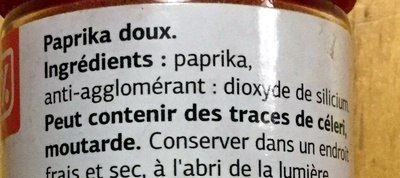
Ingredients list
Ingredient information
Traces
Ingredients analysis
No ingredients containing palm oil.
No non-vegan ingredients.
No non-vegetarian ingredients.
Food Processing
NOVA group
 Ultra-processed food and drink products
Elements that indicate the product is in NOVA group 4
How NOVA works
Additives
E551 - Silicon dioxideCarrier
Silicon dioxide, also known as silica, silicic acid or silicic acid anydride is an oxide of silicon with the chemical formula SiO2, most commonly found in nature as quartz and in various living organisms. In many parts of the world, silica is the major constituent of sand. Silica is one of the most complex and most abundant families of materials, existing as a compound of several minerals and as synthetic product. Notable examples include fused quartz, fumed silica, silica gel, and aerogels. It is used in structural materials, microelectronics (as an electrical insulator), and as components in the food and pharmaceutical industries. Inhaling finely divided crystalline silica is toxic and can lead to severe inflammation of the lung tissue, silicosis, bronchitis, lung cancer, and systemic autoimmune diseases, such as lupus and rheumatoid arthritis. Uptake of amorphous silicon dioxide, in high doses, leads to non-permanent short-term inflammation, where all effects heal.
Environment
Green-Score, origins bonus, and transportation impact are shown for Worldwide .
Green Score
Overall grade
 Very high environmental impact
About Green-Score
Current scope
Life cycle analysis
Average impact of the category
 Paprika • Score: 30/100
Life-cycle reference
Overall environmental impact by stage (PEF)
The overall environmental impact figure (PEF) comes from ADEME's Agribalyse database, for the category: Paprika. Source: ADEME Agribalyse Database.
| Stage | Impact |
|---|---|
| Agriculture | 81.5 % |
| Processing | 3.3 % |
| Packaging | 10.8 % |
| Transportation | 4.2 % |
| Distribution | 0.4 % |
| Consumption | 0.0 % |
Bonuses and maluses
Declared origins
Packaging impact
Green-Score for this product
Green-Score for this product
Final score: 22/100Final score breakdown
Carbon footprint
Carbon footprint
Climate impact by stage (CO2e)
The carbon emission figure comes from ADEME's Agribalyse database, for the category: Paprika. Source: ADEME Agribalyse Database.
| Stage | Impact |
|---|---|
| Agriculture | 75.5 % |
| Processing | 4.6 % |
| Packaging | 14.9 % |
| Transportation | 4.7 % |
| Distribution | 0.2 % |
| Consumption | 0.0 % |
Packaging
Packaging impact
Packaging components
| Shape | Material | Recycling | Impact |
|---|---|---|---|
| POT | Glass | Unknown | Low |
| Bottle CAP | Plastic | Unknown | High |
Declared packaging
Transportation
Declared origins
Forest footprint
Forest footprint
Deforestation risk details
Data Source
Product data comes from Open Food Facts. Food Benchmark also adds translations, category comparisons and explanatory calculations.
The database is licensed under ODbL 1.0, individual contents under DbCL 1.0, and product photos under CC BY-SA 3.0.
Product added on November 23, 2015 at 6:07:43 PM UTC by aleene .
Last edit on March 17, 2026 at 11:38:38 PM UTC by new-nutrition-bot .
Product page also edited by aleene, kiliweb, new-nutrition-bot, packbot, roboto-app, yuka.YkxvYlBxY3hwOEEzd2NJUHowcnl5TmxMeDZhdGIxcm9FODg3SVE9PQ, yuka.sY2b0xO6T85zoF3NwEKvlhxrSIqFpSr5FSTUgxSB74m_JL_QPux005D3Aqs.