

Soja kit
Health
Nutrition
Nutri-Score
 Lower nutritional quality
Nutri-Score data warning
Nutrient levels
Fat in low quantity (0.6%)
Saturated fat in low quantity (0%)
Sugars in low quantity (0%)
Salt in high quantity (12%)
Nutrition label
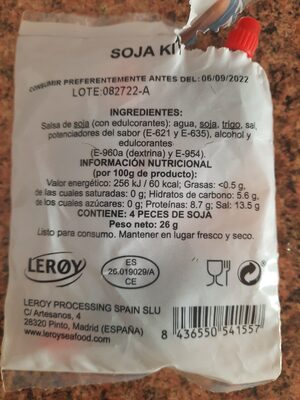
Nutrition facts
| Nutrition facts | As sold for 100 g / 100 ml | Compared to: Soy sauces |
|---|---|---|
| Energy | ~ 265.29999601841 kJ (60 kcal) | 372.462 kJ (91 kcal) (-29%) |
| Fat | 0.60000002384186 g | 0.12 g (+400%) |
| Saturated fat | 0 g | 0.025 g (-100%) |
| Carbohydrates | 5.5999999046326 g | 13.694 g (-59%) |
| Sugars | 0 g | 8.278 g (-100%) |
| Dietary fiber | ? | ? |
| Proteins | 8.6999998092651 g | 6.397 g (+36%) |
| Salt | 12 g | 12.456 g (-4%) |
| Sodium | 4.8 g | 4.991 g (-4%) |
| Fruits, vegetables and legumes | ~ 0 % | ? |
Nutrition facts (Detailed data)
| Nutrition facts | As sold for 100 g / 100 ml | As sold Per 100 g (packaging) | As sold Per 100 g (estimate) |
|---|---|---|---|
| Energy | ~ 265.29999601841 kJ (60 kcal) | ? (60 kcal) | ? |
| Fat | 0.60000002384186 g | 0.60000002384186 g | ? |
| Saturated fat | 0 g | 0 g | ? |
| Carbohydrates | 5.5999999046326 g | 5.5999999046326 g | ? |
| Sugars | 0 g | 0 g | ? |
| Dietary fiber | ? | ? | ? |
| Proteins | 8.6999998092651 g | 8.6999998092651 g | ? |
| Salt | 12 g | 12 g | ? |
| Sodium | 4.8 g | 4.8 g | ? |
| Fruits, vegetables and legumes | ~ 0 % | ? | ~ 0 % |
Serving size
Ingredients
Ingredients image

Ingredients list
Ingredient information
Allergens
Ingredients analysis
No ingredients containing palm oil.
Vegan status unknown
Vegetarian status unknown
Food Processing
NOVA group
 Ultra-processed food and drink products
Elements that indicate the product is in NOVA group 4
How NOVA works
Additives
E1400 - DextrinCarrierEmulsifierStabiliserThickener
Dextrins are a group of low-molecular-weight carbohydrates produced by the hydrolysis of starch or glycogen. Dextrins are mixtures of polymers of D-glucose units linked by α-(1→4) or α-(1→6) glycosidic bonds. Dextrins can be produced from starch using enzymes like amylases, as during digestion in the human body and during malting and mashing, or by applying dry heat under acidic conditions (pyrolysis or roasting). The latter process is used industrially, and also occurs on the surface of bread during the baking process, contributing to flavor, color and crispness. Dextrins produced by heat are also known as pyrodextrins. The starch hydrolyses during roasting under acidic conditions, and short-chained starch parts partially rebranch with α-(1,6) bonds to the degraded starch molecule. See also Maillard Reaction. Dextrins are white, yellow, or brown powders that are partially or fully water-soluble, yielding optically active solutions of low viscosity. Most of them can be detected with iodine solution, giving a red coloration; one distinguishes erythrodextrin (dextrin that colours red) and achrodextrin (giving no colour). White and yellow dextrins from starch roasted with little or no acid are called British gum.
E621 - Monosodium glutamate EFSA overexposure risk: highFlavour Enhancer
Monosodium glutamate (MSG), or E621, is the sodium salt of glutamic acid, an amino acid found naturally in many foods.
It is widely used as a flavor enhancer to provide an "umami" or savory taste to a variety of processed foods, including soups, snack chips, and frozen meals.
MSG is generally recognized as safe (GRAS) by food authorities. However, some people report sensitivity to MSG, experiencing short-term symptoms like headaches and flushing, though scientific studies have not shown a consistent link.
E635 - Disodium 5'-ribonucleotide
No additive description is available yet.
E954 - saccharin and its saltsSweetener
Sodium saccharin (benzoic sulfimide) is an artificial sweetener with effectively no food energy. It is about 300–400 times as sweet as sucrose but has a bitter or metallic aftertaste, especially at high concentrations. Saccharin is used to sweeten products such as drinks, candies, cookies, and medicines.
E960 - Steviol glycosides EFSA overexposure risk: moderateSweetener
Steviol glycosides are the chemical compounds responsible for the sweet taste of the leaves of the South American plant Stevia rebaudiana (Asteraceae) and the main ingredients (or precursors) of many sweeteners marketed under the generic name stevia and several trade names. They also occur in the related species Stevia phlebophylla (but in no other species of Stevia) and in the plant Rubus chingii (Rosaceae).Steviol glycosides from Stevia rebaudiana have been reported to be between 30 and 320 times sweeter than sucrose, although there is some disagreement in the technical literature about these numbers. They are heat-stable, pH-stable, and do not ferment. Additionally, they do not induce a glycemic response when ingested, because humans can not metabolize stevia. This makes them attractive as natural sugar substitutes for diabetics and other people on carbohydrate-controlled diets. Steviol glycosides stimulate the insulin secretion through potentiation of the β-cell, preventing high blood glucose after a meal. The acceptable daily intake (ADI) for steviol glycosides, expressed as steviol equivalents, has been established to be 4 mg/kg body weight/day, and is based on no observed effects of a 100 fold higher dose in a rat study.
Environment
Green-Score, origins bonus, and transportation impact are shown for Worldwide .
Green Score
Overall grade
 Very low environmental impact
About Green-Score
Current scope
Life cycle analysis
Average impact of the category
 Soy sauce, prepacked • Score: 95/100
Life-cycle reference
Overall environmental impact by stage (PEF)
The overall environmental impact figure (PEF) comes from ADEME's Agribalyse database, for the category: Soy sauce, prepacked. Source: ADEME Agribalyse Database.
| Stage | Impact |
|---|---|
| Agriculture | 10.6 % |
| Processing | 22.7 % |
| Packaging | 44.3 % |
| Transportation | 13.2 % |
| Distribution | 7.3 % |
| Consumption | 1.9 % |
Bonuses and maluses
Declared origins
Packaging impact
Green-Score for this product
Green-Score for this product
Final score: 75/100Final score breakdown
Carbon footprint
Carbon footprint
Climate impact by stage (CO2e)
The carbon emission figure comes from ADEME's Agribalyse database, for the category: Soy sauce, prepacked. Source: ADEME Agribalyse Database.
| Stage | Impact |
|---|---|
| Agriculture | 12.9 % |
| Processing | 15.9 % |
| Packaging | 41.6 % |
| Transportation | 24.0 % |
| Distribution | 4.8 % |
| Consumption | 0.7 % |
Packaging
Packaging impact
Data precision
Transportation
Declared origins
Forest footprint
Forest footprint
Deforestation risk details
Data Source
Product data comes from Open Food Facts. Food Benchmark also adds translations, category comparisons and explanatory calculations.
The database is licensed under ODbL 1.0, individual contents under DbCL 1.0, and product photos under CC BY-SA 3.0.
Product added on August 9, 2018 at 6:04:23 PM UTC by kiliweb .
Last edit on March 17, 2026 at 9:36:03 AM UTC by new-nutrition-bot .
Product page also edited by ecoscore-impact-estimator, elcoco, inf, kiliweb, marionmoseby, musarana, naruyoko, new-nutrition-bot, openfoodfacts-contributors, roboto-app, yuka.AbpQO9TSRdEnDvDZ8bAx5ACfCuzsDs5ZG0IHog, yuka.KrpMP_XbIPIEFfbu4bIpgwiVFuPOMcYEPkAVoQ, yuka.ZmZ3dkFZaGRvY2cweThVeXdBemw5dnRPeDQ2cFJrZTdKdlk3SVE9PQ.