
Oeufs De Lompe Rouge
Health
Nutrition
Nutri-Score
 Lower nutritional quality
Nutri-Score data warning
Nutrient levels
Fat in moderate quantity (3.7%)
Saturated fat in low quantity (0.7%)
Sugars in low quantity (0.5%)
Salt in high quantity (4%)
Nutrition label
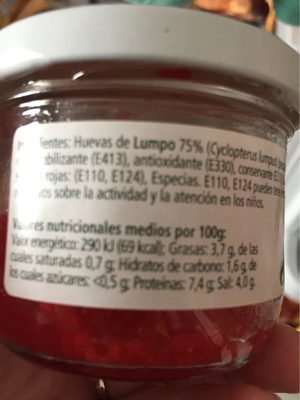
Nutrition facts
| Nutrition facts | As sold for 100 g / 100 ml | Compared to: fr:oeufs de lompes rouges |
|---|---|---|
| Energy | ~ 289.9 kJ (69 kcal) | 328.303 kJ (78 kcal) (-12%) |
| Fat | 3.7 g | 3.703 g (~0%) |
| Saturated fat | 0.7 g | 0.799 g (-12%) |
| Carbohydrates | 1.6 g | 1.142 g (+40%) |
| Sugars | 0.5 g | 0.228 g (+119%) |
| Dietary fiber | ? | ? |
| Proteins | 7.4 g | 10.017 g (-26%) |
| Salt | 4 g | 4.432 g (-10%) |
| Sodium | 1.6 g | 1.773 g (-10%) |
| Fruits, vegetables and legumes | ~ 0 % | ? |
Nutrition facts (Detailed data)
| Nutrition facts | As sold for 100 g / 100 ml | As sold Per 100 g (packaging) | As sold Per 100 g (estimate) |
|---|---|---|---|
| Energy | ~ 289.9 kJ (69 kcal) | ? (69 kcal) | ? |
| Fat | 3.7 g | 3.7 g | ? |
| Saturated fat | 0.7 g | 0.7 g | ? |
| Carbohydrates | 1.6 g | 1.6 g | ? |
| Sugars | 0.5 g | 0.5 g | ? |
| Dietary fiber | ? | ? | ? |
| Proteins | 7.4 g | 7.4 g | ? |
| Salt | 4 g | 4 g | ? |
| Sodium | 1.6 g | 1.6 g | ? |
| Fruits, vegetables and legumes | ~ 0 % | ? | ~ 0 % |
Ingredients
Ingredients image
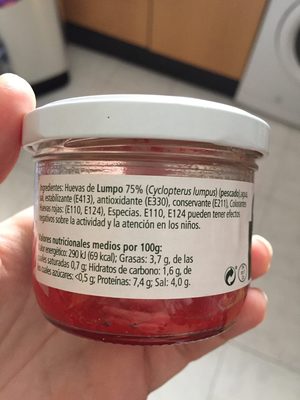
Ingredients list
Ingredient information
Ingredients analysis
No ingredients containing palm oil.
Unrecognized: es:huevas-de-lumpo, es:cyclopterus-lumpus, es:qi-l, es:huevas-rojas, es:el-10, es:el-24, es:el-1-0, es:el-24-pueden-tenerefectos-negativossobre-la-actividad-y-la-atencion-en-los-nifios
Vegan status unknown
Unrecognized: es:cyclopterus-lumpus, es:qi-l, es:el-10, es:el-24, es:el-1-0, es:el-24-pueden-tenerefectos-negativossobre-la-actividad-y-la-atencion-en-los-nifios
Vegetarian status unknown
Unrecognized: es:cyclopterus-lumpus, es:qi-l, es:el-10, es:el-24, es:el-1-0, es:el-24-pueden-tenerefectos-negativossobre-la-actividad-y-la-atencion-en-los-nifios
Food Processing
NOVA group
 Ultra-processed food and drink products
Elements that indicate the product is in NOVA group 4
How NOVA works
Additives
E330 - Citric acidAntioxidantSequestrant
Citric acid is a natural organic acid found in citrus fruits such as lemons, oranges, and limes.
It is widely used in the food industry as a flavor enhancer, acidulant, and preservative due to its tart and refreshing taste.
Citric acid is safe for consumption when used in moderation and is considered a generally recognized as safe (GRAS) food additive by regulatory agencies worldwide.
E413 - TragacanthEmulsifierStabiliserThickener
Tragacanth is a natural gum obtained from the dried sap of several species of Middle Eastern legumes of the genus Astragalus, including A. adscendens, A. gummifer, A. brachycalyx, and A. tragacantha. Some of these species are known collectively under the common names "goat's thorn" and "locoweed". The gum is sometimes called Shiraz gum, shiraz, gum elect or gum dragon. The name derives from the Greek words tragos (meaning "goat") and akantha ("thorn"). Iran is the biggest producer of this gum. Gum tragacanth is a viscous, odorless, tasteless, water-soluble mixture of polysaccharides obtained from sap that is drained from the root of the plant and dried. The gum seeps from the plant in twisted ribbons or flakes that can be powdered. It absorbs water to become a gel, which can be stirred into a paste. The major fractions are known as tragacanthin, highly water soluble as a mucilaginous colloid, and the chemically related bassorin, which is far less soluble but swells in water to form a gel. The gum is used in vegetable-tanned leatherworking as an edge slicking and burnishing compound, and is occasionally used as a stiffener in textiles. The gum has been used historically as a herbal remedy for such conditions as cough and diarrhea. As a mucilage or paste, it has been used as a topical treatment for burns. It is used in pharmaceuticals and foods as an emulsifier, thickener, stabilizer, and texturant additive (E number E413). It is the traditional binder used in the making of artists' pastels, as it does not adhere to itself the same way other gums (such as gum arabic) do when dry. Gum tragacanth is also used to make a paste used in floral sugarcraft to create lifelike flowers on wires used as decorations for cakes, which air-dries brittle and can take colorings. It enables users to get a very fine, delicate finish to their work. It has traditionally been used as an adhesive in the cigar-rolling process used to secure the cap or "flag" leaf to the finished cigar body.Gum tragacanth is less common in products than other, usually cheaper, gums, such as gum arabic or guar gum. Different gums tend to be interchangeable across many uses, and production of tragacanth is far outpaced by these for reasons of economy, trade, agriculture and history, while tragacanth is mostly produced in traditional locations. However, gums are used in varied circumstances and there are many situations where tragacanth is considered superior. Common substitutions are methyl cellulose, sometimes marketed as "substitute gum tragacanth" in the food industry, and gum karaya. Gum karaya, also called "Indian tragacanth" or simply "tragacanth", might be fully or partially substituted for what appears to be genuine tragacanth. Gum tragacanth is also used in incense-making as a binder to hold all the powdered herbs together. Its water solubility is ideal for ease of working and an even spread, and it is one of the stronger gums for holding particles in suspension. Only half as much is needed, compared to gum arabic or something similar.In Saudi Arabia, a mixture of hydrated Tragacanth and ground dried Ziziphus spina-christi is used as a natural hair shampoo that is believed to promote hair growth.
Environment
Green-Score, origins bonus, and transportation impact are shown for Worldwide .
Green Score
Overall grade
 Unknown environmental impact
About Green-Score
Current scope
Green-Score availability
Bonuses and maluses
Declared origins
Packaging impact
Packaging
Packaging impact
Data precision
Transportation
Declared origins
Forest footprint
Forest footprint
Deforestation risk details
Data Source
Product data comes from Open Food Facts. Food Benchmark also adds translations, category comparisons and explanatory calculations.
The database is licensed under ODbL 1.0, individual contents under DbCL 1.0, and product photos under CC BY-SA 3.0.
Product added on January 5, 2018 at 12:13:26 PM UTC by kiliweb .
Last edit on March 17, 2026 at 10:08:18 PM UTC by new-nutrition-bot .
Product page also edited by chevalstar, kiliweb, new-nutrition-bot, openfoodfacts-contributors, teolemon, yuka.UzU0ZUNJNWMvNlVzaDhkajJ3ekV4WXd1M0lLbVJWN25OY1lNSWc9PQ.