

Fuet d'Olot extra
Labels
 Bad nutritional quality
 Ultra-processed food and drink products
 Very high environmental impact
Health
Nutrition
Label
Bad nutritional qualityNutrient levels
Fat in high quantity (31%)
Saturated fat in high quantity (12%)
Sugars in low quantity (3.2%)
Salt in high quantity (4.6%)
Nutrition label

Nutrition facts
| Nutrition facts | As sold for 100 g / 100 ml |
|---|---|
| Energy | 1,660 kJ (400 kcal) |
| FAT | 31 g |
| Saturated fat | 12 g |
| Carbohydrates | 3.2 g |
| Sugars | 3.2 g |
| Dietary fiber | 0.2 g |
| Proteins | 27 g |
| Salt | 4.6 g |
| Sodium | 1.84 g |
| Minerals | |
| Fruits, vegetables and legumes | ~ 0 % |
Nutrition facts (Detailed data)
| Nutrition facts | As sold for 100 g / 100 ml | As sold Per 100 g (packaging) | As sold Per 100 g (estimate) |
|---|---|---|---|
| Energy | 1,660 kJ (400 kcal) | 1,660 kJ (400 kcal) | ? |
| FAT | 31 g | 31 g | ? |
| Saturated fat | 12 g | 12 g | ? |
| Carbohydrates | 3.2 g | 3.2 g | ? |
| Sugars | 3.2 g | 3.2 g | ? |
| Added sugars | ~ 0 g | ? | ~ 0 g |
| Dietary fiber | 0.2 g | 0.2 g | ? |
| Proteins | 27 g | 27 g | ? |
| Salt | 4.6 g | 4.6 g | ? |
| Sodium | 1.84 g | 1.84 g | ? |
| Minerals | |||
| Fruits, vegetables and legumes | ~ 0 % | ? | ~ 0 % |
Estimated Activity Time
Approximate time needed to burn the energy in 100 g / 100 ml: 1,660 kJ. Reference adult weight: 70 kg. Energy density: Moderate.
Ingredients
Ingredients image
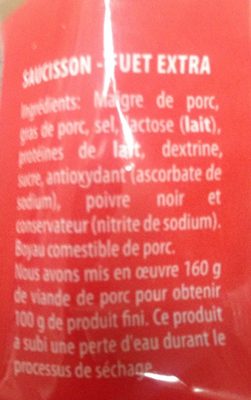
Ingredients list
Ingredient information
Allergens
Ingredients analysis
Palm oil content unknown
Unrecognized: fr:saucisson-fuet-extra-ngredients, fr:gas-de-porc, fr:actose, fr:poteines-de, fr:lat, fr:noe, fr:antiogydant, fr:ascorbate-de-sdum, fr:bayau-comestible-de-porc, fr:nous-avons-mis-en-ceuvre-160-g-de-viande-de-porc-pour-obtenir-100-g-de-produit-fini, fr:ce-produit-a-subi-une-perte-d-eau-durant-le-processus-de-sechage
Contains non-vegan ingredients.
Unrecognized: fr:gas-de-porc, fr:actose, fr:poteines-de, fr:lat, fr:noe, fr:ascorbate-de-sdum, fr:bayau-comestible-de-porc, fr:nous-avons-mis-en-ceuvre-160-g-de-viande-de-porc-pour-obtenir-100-g-de-produit-fini, fr:ce-produit-a-subi-une-perte-d-eau-durant-le-processus-de-sechage
Contains non-vegetarian ingredients.
Unrecognized: fr:gas-de-porc, fr:actose, fr:poteines-de, fr:lat, fr:noe, fr:ascorbate-de-sdum, fr:bayau-comestible-de-porc, fr:nous-avons-mis-en-ceuvre-160-g-de-viande-de-porc-pour-obtenir-100-g-de-produit-fini, fr:ce-produit-a-subi-une-perte-d-eau-durant-le-processus-de-sechage
Food Processing
NOVA group
Ultra-processed food and drink productsElements that indicate the product is in NOVA group 4
How NOVA works
Additives
E1400 - DextrinCarrierEmulsifierStabiliserThickener
Dextrins are a group of low-molecular-weight carbohydrates produced by the hydrolysis of starch or glycogen. Dextrins are mixtures of polymers of D-glucose units linked by α-(1→4) or α-(1→6) glycosidic bonds. Dextrins can be produced from starch using enzymes like amylases, as during digestion in the human body and during malting and mashing, or by applying dry heat under acidic conditions (pyrolysis or roasting). The latter process is used industrially, and also occurs on the surface of bread during the baking process, contributing to flavor, color and crispness. Dextrins produced by heat are also known as pyrodextrins. The starch hydrolyses during roasting under acidic conditions, and short-chained starch parts partially rebranch with α-(1,6) bonds to the degraded starch molecule. See also Maillard Reaction. Dextrins are white, yellow, or brown powders that are partially or fully water-soluble, yielding optically active solutions of low viscosity. Most of them can be detected with iodine solution, giving a red coloration; one distinguishes erythrodextrin (dextrin that colours red) and achrodextrin (giving no colour). White and yellow dextrins from starch roasted with little or no acid are called British gum.
E250 - Sodium nitritePreservative
Sodium nitrite (E250) is a salt used for curing and preserving meat products.
It plays a critical role in preventing the growth of Clostridium botulinum, the bacterium responsible for botulism, in cured meats like bacon, ham, and sausages. It also provides the characteristic pink color and flavor.
However, nitrites can react with amines in the stomach to form nitrosamines, which are potent carcinogens. High intake of processed meats containing nitrites is associated with an increased risk of colorectal cancer. Regulatory bodies have set strict limits on its use in food.
Environment
Green-Score, origins bonus, and transportation impact are shown for Worldwide .
Green Score
Overall grade
Very high environmental impactAbout Green-Score
Current scope
Life cycle analysis
Average impact of the category
 Dry sausage • Score: 33/100
Life-cycle reference
Overall environmental impact by stage (PEF)
The overall environmental impact figure (PEF) comes from ADEME's Agribalyse database, for the category: Dry sausage. Source: ADEME Agribalyse Database.
| Stage | Impact |
|---|---|
| Agriculture | 89.9 % |
| Processing | 5.9 % |
| Packaging | 0.9 % |
| Transportation | 2.0 % |
| Distribution | 1.0 % |
| Consumption | 0.3 % |
Bonuses and maluses
Declared origins
Packaging impact
Green-Score for this product
Green-Score for this product
Final score: 18/100Final score breakdown
Carbon footprint
Carbon footprint
Climate impact by stage (CO2e)
The carbon emission figure comes from ADEME's Agribalyse database, for the category: Dry sausage. Source: ADEME Agribalyse Database.
| Stage | Impact |
|---|---|
| Agriculture | 89.8 % |
| Processing | 4.7 % |
| Packaging | 1.4 % |
| Transportation | 3.4 % |
| Distribution | 0.6 % |
| Consumption | 0.1 % |
Packaging
Packaging impact
Packaging materials
| Material | % | Packaging weight | Packaging weight per 100 g of product |
|---|---|---|---|
| Plastic | |||
| Total |
Declared packaging
Transportation
Declared origins
Data Source
Data presented on this page is sourced from the Open Food Facts database. This platform does not alter the original dataset; its purpose is solely to enhance data visualization and user accessibility.
Product added on May 30, 2016 at 4:48:38 PM UTC by laurentinoo86 .
Last edit on March 17, 2026 at 9:04:06 PM UTC by new-nutrition-bot .
Product page also edited by charlesnepote, date-limite-app, ecoscore-impact-estimator, foodvisor, kiliweb, laurentinoo86, magasins-u, new-nutrition-bot, openfoodfacts-contributors, packbot, prisc010, quentinbrd, resano, stive24, yuka.FJRGIeCwQdYcRcPu85oq7TOfPvuwB-1LKFwDog, yuka.UUlVeUZyVmR2c1lTd01kanB4M3BxbzRvM0lieldFK3pLckkxSVE9PQ, yuka.sY2b0xO6T85zoF3NwEKvlkxJbtDspGLLLSHlsxfT6fHfcqLQXN1Xs5fLM6s.