

Frisk
Health
Nutrition
Nutri-Score
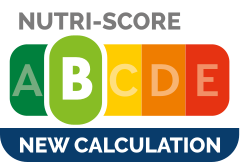 Good nutritional quality
Nutri-Score data warning
Nutrient levels
Fat in low quantity (0.5%)
Saturated fat in low quantity (0.4%)
Sugars in low quantity (0%)
Salt in low quantity (0%)
Nutrition label

Nutrition facts
| Nutrition facts | As sold for 100 g / 100 ml | Compared to: Candies |
|---|---|---|
| Energy | 976 kJ (234 kcal) | 1,498.357 kJ (349 kcal) (-35%) |
| Fat | 0.5 g | 1.556 g (-68%) |
| Saturated fat | 0.4 g | 0.871 g (-54%) |
| Carbohydrates | 95 g | 82.869 g (+15%) |
| Sugars | 0 g | 54.931 g (-100%) |
| Polyols | 95 g | ? |
| Dietary fiber | ? | ? |
| Proteins | 0 g | 2.154 g (-100%) |
| Salt | 0 g | 0.129 g (-100%) |
| Sodium | 0 g | 0.052 g (-100%) |
| Fruits, vegetables and legumes | ~ 0 % | ? |
Nutrition facts (Detailed data)
| Nutrition facts | As sold for 100 g / 100 ml | As sold Per 100 g (packaging) | As sold Per 100 g (estimate) |
|---|---|---|---|
| Energy | 976 kJ (234 kcal) | 976 kJ (234 kcal) | ? |
| Fat | 0.5 g | 0.5 g | ? |
| Saturated fat | 0.4 g | 0.4 g | ? |
| Carbohydrates | 95 g | 95 g | ? |
| Sugars | 0 g | 0 g | ? |
| Polyols | 95 g | 95 g | ? |
| Dietary fiber | ? | ? | ? |
| Proteins | 0 g | 0 g | ? |
| Salt | 0 g | 0 g | ? |
| Sodium | 0 g | 0 g | ? |
| Fruits, vegetables and legumes | ~ 0 % | ? | ~ 0 % |
Ingredients
Ingredients image

Ingredients list
Ingredient information
Ingredients analysis
Palm oil content unknown
Vegan status unknown
Vegetarian status unknown
Food Processing
NOVA group
 Ultra-processed food and drink products
Elements that indicate the product is in NOVA group 4
How NOVA works
Additives
E420 - SorbitolHumectantSequestrantStabiliserSweetenerThickener
Sorbitol (), less commonly known as glucitol (), is a sugar alcohol with a sweet taste which the human body metabolizes slowly. It can be obtained by reduction of glucose, which changes the aldehyde group to a hydroxyl group. Most sorbitol is made from corn syrup, but it is also found in nature, for example in apples, pears, peaches, and prunes. It is converted to fructose by sorbitol-6-phosphate 2-dehydrogenase. Sorbitol is an isomer of mannitol, another sugar alcohol; the two differ only in the orientation of the hydroxyl group on carbon 2. While similar, the two sugar alcohols have very different sources in nature, melting points, and uses.
E470b - Magnesium salts of fatty acidsEmulsifierStabiliserThickener
No additive description is available yet.
E551 - Silicon dioxideCarrier
Silicon dioxide, also known as silica, silicic acid or silicic acid anydride is an oxide of silicon with the chemical formula SiO2, most commonly found in nature as quartz and in various living organisms. In many parts of the world, silica is the major constituent of sand. Silica is one of the most complex and most abundant families of materials, existing as a compound of several minerals and as synthetic product. Notable examples include fused quartz, fumed silica, silica gel, and aerogels. It is used in structural materials, microelectronics (as an electrical insulator), and as components in the food and pharmaceutical industries. Inhaling finely divided crystalline silica is toxic and can lead to severe inflammation of the lung tissue, silicosis, bronchitis, lung cancer, and systemic autoimmune diseases, such as lupus and rheumatoid arthritis. Uptake of amorphous silicon dioxide, in high doses, leads to non-permanent short-term inflammation, where all effects heal.
E950 - Acesulfame kSweetener
Acesulfame potassium ( AY-see-SUL-faym), also known as acesulfame K (K is the symbol for potassium) or Ace K, is a calorie-free sugar substitute (artificial sweetener) often marketed under the trade names Sunett and Sweet One. In the European Union, it is known under the E number (additive code) E950. It was discovered accidentally in 1967 by German chemist Karl Clauss at Hoechst AG (now Nutrinova). In chemical structure, acesulfame potassium is the potassium salt of 6-methyl-1,2,3-oxathiazine-4(3H)-one 2,2-dioxide. It is a white crystalline powder with molecular formula C4H4KNO4S and a molecular weight of 201.24 g/mol.
E951 - Aspartame EFSA overexposure risk: noSweetener
Aspartame (E951) is a low-calorie artificial sweetener composed of two amino acids.
It is used as a sugar substitute in thousands of "sugar-free" or "diet" products, such as carbonated soft drinks, chewing gum, yogurts, and tabletop sweeteners, to provide sweetness without the calories of sugar.
Despite being one of the most rigorously tested food additives, its safety remains controversial. While major regulatory bodies like the FDA and EFSA deem it safe for the general public, the IARC has classified it as "possibly carcinogenic to humans" (Group 2B). It must also be avoided by individuals with the genetic condition phenylketonuria (PKU).
Environment
Green-Score, origins bonus, and transportation impact are shown for Worldwide .
Green Score
Overall grade
 Very low environmental impact
About Green-Score
Current scope
Life cycle analysis
Average impact of the category
Candies, all types • Score: 88/100Life-cycle reference
Overall environmental impact by stage (PEF)
The overall environmental impact figure (PEF) comes from ADEME's Agribalyse database, for the category: Candies, all types. Source: ADEME Agribalyse Database.
| Stage | Impact |
|---|---|
| Agriculture | 47.6 % |
| Processing | 28.1 % |
| Packaging | 17.3 % |
| Transportation | 4.5 % |
| Distribution | 2.3 % |
| Consumption | 0.0 % |
Bonuses and maluses
Origins of ingredients
Packaging impact
Green-Score for this product
Green-Score for this product
Final score: 80/100Final score breakdown
Carbon footprint
Carbon footprint
Climate impact by stage (CO2e)
The carbon emission figure comes from ADEME's Agribalyse database, for the category: Candies, all types. Source: ADEME Agribalyse Database.
| Stage | Impact |
|---|---|
| Agriculture | 46.7 % |
| Processing | 27.1 % |
| Packaging | 16.4 % |
| Transportation | 8.7 % |
| Distribution | 1.5 % |
| Consumption | 0.0 % |
Packaging
Packaging impact
Packaging components
| Shape | Material | Recycling | Impact |
|---|---|---|---|
| Unknown | Plastic | Unknown | High |
Declared packaging
Data precision
Transportation
Origins of ingredients
Origins breakdown
| Origin | Percent of ingredients | Impact |
|---|---|---|
| Belgium | 100 % | Medium |
Forest footprint
Forest footprint
Deforestation risk details
Data Source
Product data comes from Open Food Facts. Food Benchmark also adds translations, category comparisons and explanatory calculations.
The database is licensed under ODbL 1.0, individual contents under DbCL 1.0, and product photos under CC BY-SA 3.0.
Product added on July 9, 2013 at 1:08:03 PM UTC by jeanbono .
Last edit on March 17, 2026 at 2:51:08 AM UTC by new-nutrition-bot .
Product page also edited by ecoscore-impact-estimator, jeanbono, kiliweb, manu1400, new-nutrition-bot, openfoodfacts-contributors, packbot, quechoisir, roboto-app, sebleouf, spotter, tacite, yuka.F7dyOvOrBtMzQN3KyIst4B6FLvnEOeZXR0Vdog, yuka.NJBwMdqgHsElIPDt0L0o1h-CF-v_Pf1zFEwSoQ, yuka.SG9JbUNKb0ZyZnNUeE1Za3BoVEY4YzFVOXJuMkEwS1BGT1EvSUE9PQ, yuka.U5YfOoXTAJx4I8uN1aEp-WO7KMzlWeMHI10Rog, yuka.VDZWWk5Mb0UrZHNVcGNFVW9DdmUxNHhTbjRTM1oxbXdHdklMSVE9PQ, yuka.sY2b0xO6T85zoF3NwEKvlmJedtP-vi3NCiblxEGRx9KKKIblavZP06n7Kqs.