
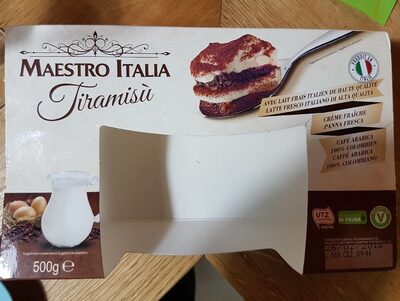
Tiramisu
Health
Nutrition
Nutri-Score
 Lower nutritional quality
Nutri-Score data warning
Nutrient levels
Fat in moderate quantity (12%)
Saturated fat in high quantity (7.5%)
Sugars in high quantity (24%)
Salt in low quantity (0.2%)
Nutrition label
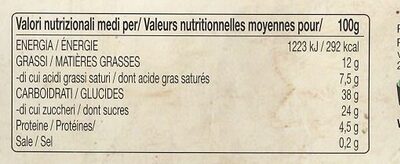
Nutrition facts
| Nutrition facts | As sold for 100 g / 100 ml | Compared to: Tiramisu |
|---|---|---|
| Energy | 1223 kJ (292 kcal) | 1,101.701 kJ (267 kcal) (+11%) |
| Fat | 12 g | 12.385 g (-3%) |
| Saturated fat | 7.5 g | 8.496 g (-12%) |
| Carbohydrates | 38 g | 32.149 g (+18%) |
| Sugars | 24 g | 21.257 g (+13%) |
| Dietary fiber | ? | ? |
| Proteins | 4.5 g | 4.168 g (+8%) |
| Salt | 0.2 g | 0.187 g (+7%) |
| Sodium | 0.08 g | 0.074 g (+8%) |
| Fruits, vegetables and legumes | ~ 0 % | ? |
Nutrition facts (Detailed data)
| Nutrition facts | As sold for 100 g / 100 ml | As sold Per 100 g (packaging) | As sold Per 100 g (estimate) |
|---|---|---|---|
| Energy | 1223 kJ (292 kcal) | 1223 kJ (292 kcal) | ? |
| Fat | 12 g | 12 g | ? |
| Saturated fat | 7.5 g | 7.5 g | ? |
| Carbohydrates | 38 g | 38 g | ? |
| Sugars | 24 g | 24 g | ? |
| Dietary fiber | ? | ? | ? |
| Proteins | 4.5 g | 4.5 g | ? |
| Salt | 0.2 g | 0.2 g | ? |
| Sodium | 0.08 g | 0.08 g | ? |
| Fruits, vegetables and legumes | ~ 0 % | ? | ~ 0 % |
Ingredients
Ingredients image
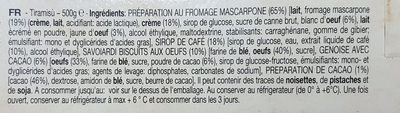
Ingredients list
Ingredient information
Added sugars
Allergens
Traces
Ingredients analysis
Palm oil content unknown
Contains non-vegan ingredients.
Vegetarian status unknown
Food Processing
NOVA group
 Ultra-processed food and drink products
Elements that indicate the product is in NOVA group 4
How NOVA works
Additives
E1510 - Ethanol
Ethanol, also called alcohol, ethyl alcohol, grain alcohol, and drinking alcohol, is a chemical compound, a simple alcohol with the chemical formula C2H5OH. Its formula can be also written as CH3−CH2−OH or C2H5−OH (an ethyl group linked to a hydroxyl group), and is often abbreviated as EtOH. Ethanol is a volatile, flammable, colorless liquid with a slight characteristic odor. It is a psychoactive substance and is the principal type of alcohol found in alcoholic drinks. Ethanol is naturally produced by the fermentation of sugars by yeasts or via petrochemical processes, and is most commonly consumed as a popular recreational drug. It also has medical applications as an antiseptic and disinfectant. The compound is widely used as a chemical solvent, either for scientific chemical testing or in synthesis of other organic compounds, and is a vital substance used across many different kinds of manufacturing industries. Ethanol is also used as a clean-burning fuel source.
E270 - Lactic acid
LACTIC ACID is an organic compound with the formula CH3CH(OH)CO2H. In the form of its conjugate base called lactate (this is thus different and kept as a separate ingredient). Lactic acid is chiral, consisting of two optical isomers. One is known as L-(+)-lactic acid or (S)-lactic acid and the other, its mirror image, is D-(−)-lactic acid or (R)-lactic acid in food the L-variant is used
E407 - Carrageenan EFSA overexposure risk: highCarrierEmulsifierHumectantStabiliserThickener
Carrageenan (E407), derived from red seaweed, is widely employed in the food industry as a gelling, thickening, and stabilizing agent, notably in dairy and meat products.
It can exist in various forms, each imparting distinct textural properties to food.
However, its degraded form, often referred to as poligeenan, has raised health concerns due to its potential inflammatory effects and its classification as a possible human carcinogen (Group 2B) by the International Agency for Research on Cancer (IARC).
Nevertheless, food-grade carrageenan has been deemed safe by various regulatory bodies when consumed in amounts typically found in food.
E410 - Locust bean gumEmulsifierStabiliserThickener
Locust bean gum (LBG, also known as carob gum, carob bean gum, carobin, E410) is a thickening agent and a gelling agent used in food technology.
E450 - Diphosphates EFSA overexposure risk: highEmulsifierHumectantSequestrantStabiliserThickener
Diphosphates (E450) are food additives often utilized to modify the texture of products, acting as leavening agents in baking and preventing the coagulation of canned food.
These salts can stabilize whipped cream and are also found in powdered products to maintain their flow properties. They are commonly present in baked goods, processed meats, and soft drinks.
Derived from phosphoric acid, they're part of our daily phosphate intake, which often surpasses recommended levels due to the prevalence of phosphates in processed foods and drinks.
Excessive phosphate consumption is linked to health issues, such as impaired kidney function and weakened bone health. Though diphosphates are generally regarded as safe when consumed within established acceptable daily intakes, it's imperative to monitor overall phosphate consumption to maintain optimal health.
E471 - Mono- and diglycerides of fatty acidsEmulsifierStabiliser
Mono- and diglycerides of fatty acids (E471), are food additives commonly used as emulsifiers in various processed foods.
These compounds consist of glycerol molecules linked to one or two fatty acid chains, which help stabilize and blend water and oil-based ingredients. E471 enhances the texture and shelf life of products like margarine, baked goods, and ice cream, ensuring a smooth and consistent texture.
It is generally considered safe for consumption within established regulatory limits.
Environment
Green-Score, origins bonus, and transportation impact are shown for Worldwide .
Green Score
Overall grade
 Very high environmental impact
About Green-Score
Current scope
Life cycle analysis
Average impact of the category
Tiramisu, refrigerated • Score: 22/100Life-cycle reference
Overall environmental impact by stage (PEF)
The overall environmental impact figure (PEF) comes from ADEME's Agribalyse database, for the category: Tiramisu, refrigerated. Source: ADEME Agribalyse Database.
| Stage | Impact |
|---|---|
| Agriculture | 79.0 % |
| Processing | 14.2 % |
| Packaging | 2.8 % |
| Transportation | 3.0 % |
| Distribution | 0.7 % |
| Consumption | 0.2 % |
Bonuses and maluses
Production system
Declared origins
Packaging impact
Green-Score for this product
Green-Score for this product
Final score: 21/100Final score breakdown
Carbon footprint
Carbon footprint
Climate impact by stage (CO2e)
The carbon emission figure comes from ADEME's Agribalyse database, for the category: Tiramisu, refrigerated. Source: ADEME Agribalyse Database.
| Stage | Impact |
|---|---|
| Agriculture | 69.4 % |
| Processing | 20.3 % |
| Packaging | 4.8 % |
| Transportation | 4.5 % |
| Distribution | 0.4 % |
| Consumption | 0.1 % |
Packaging
Packaging impact
Packaging components
| Shape | Material | Recycling | Impact |
|---|---|---|---|
| BOX | Plastic | Unknown | High |
| Sleeve | Cardboard | Unknown | Low |
Declared packaging
Transportation
Manufacturing locations
Declared origins
Forest footprint
Forest footprint
Ingredients linked to forest pressure
| Ingredient | Type | Percent in product | Forest footprint |
|---|---|---|---|
| EGG White | Oeufs Importés | 6.00 % | 0.00 |
| EGG Yolk | Oeufs Importés | 3.00 % | 0.00 |
| EGG | Oeufs Importés | 4.00 % | 0.00 |
| EGG | Oeufs Importés | 1.98 % | 0.00 |
Data Source
Product data comes from Open Food Facts. Food Benchmark also adds translations, category comparisons and explanatory calculations.
The database is licensed under ODbL 1.0, individual contents under DbCL 1.0, and product photos under CC BY-SA 3.0.
Product added on February 14, 2018 at 7:16:44 PM UTC by kiliweb .
Last edit on March 17, 2026 at 10:19:06 PM UTC by new-nutrition-bot .
Product page also edited by cyn, foodviewer, kiliweb, marmotte73, new-nutrition-bot, openfoodfacts-contributors, packbot, roboto-app, telperion87, youplaboum, yuka.SGZrSEFaMDRoYUl3eDhVczh6L2Y0ZjRxenFPWFhsMkdMK2tLSWc9PQ, yuka.Zkp3T0NvZ2NuTkFNbThVc3dUWGYyZFJyOWIyQ1FsNk9OZWhNSVE9PQ.