

Wine Gums
Health
Nutrition
Nutri-Score data warning
Nutrient levels
Fat in low quantity (0.417%)
Saturated fat in low quantity (0.417%)
Sugars in high quantity (58.3%)
Nutrition label
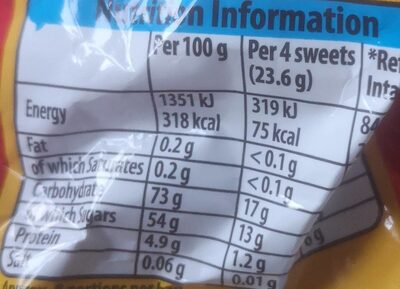
Nutrition facts
| Nutrition facts | As sold for 100 g / 100 ml | Compared to: Gummi candies |
|---|---|---|
| Energy | ~ 1368.32766666667 kJ (325 kcal) | 1,451.971 kJ (342 kcal) (-6%) |
| Fat | 0.416666666666667 g | 0.39 g (+7%) |
| Saturated fat | 0.416666666666667 g | 0.173 g (+141%) |
| Carbohydrates | 75 g | 80.321 g (-7%) |
| Sugars | 58.3333333333333 g | 55.644 g (+5%) |
| Dietary fiber | ? | ? |
| Proteins | 4.583 g | 3.477 g (+32%) |
| Salt | ? | 0.127 g |
| Fruits, vegetables and legumes | ~ 0 % | ? |
Nutrition facts (Detailed data)
| Nutrition facts | As sold for 100 g / 100 ml | As sold Per serving (24 g) (packaging) | As sold Per 100 g (estimate) |
|---|---|---|---|
| Energy | ~ 1368.32766666667 kJ (325 kcal) | ? (78 kcal) | ? |
| Fat | 0.416666666666667 g | 0.1 g | ? |
| Saturated fat | 0.416666666666667 g | 0.1 g | ? |
| Carbohydrates | 75 g | 18 g | ? |
| Sugars | 58.3333333333333 g | 14 g | ? |
| Dietary fiber | ? | ? | ? |
| Proteins | 4.583 g | 1.09992 g | ? |
| Salt | ? | ? | ? |
| Fruits, vegetables and legumes | ~ 0 % | ? | ~ 0 % |
Serving size
Ingredients
Ingredients image
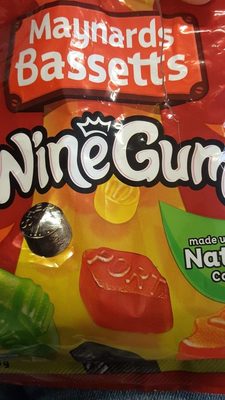
Ingredients list
Ingredient information
Allergens
Traces
Ingredients analysis
Palm oil content unknown
Unrecognized: fr:glucose-syrup, fr:sugar, fr:starch, fr:gelatine-acids, fr:colours, fr:anthocyanins, fr:paprika-extract, fr:lutein, fr:curcumin, fr:coconut-oil, fr:flavourings, fr:glazing-agent, fr:carnauba-wax
Vegan status unknown
Unrecognized: fr:glucose-syrup, fr:sugar, fr:starch, fr:anthocyanins, fr:paprika-extract, fr:lutein, fr:curcumin, fr:coconut-oil, fr:flavourings, fr:carnauba-wax
Vegetarian status unknown
Unrecognized: fr:glucose-syrup, fr:sugar, fr:starch, fr:anthocyanins, fr:paprika-extract, fr:lutein, fr:curcumin, fr:coconut-oil, fr:flavourings, fr:carnauba-wax
Food Processing
NOVA group
 Ultra-processed food and drink products
Elements that indicate the product is in NOVA group 4
How NOVA works
Additives
E100 - CurcuminColour
No additive description is available yet.
E153 - Vegetable carbon
No additive description is available yet.
E160c - Paprika extractColour
No additive description is available yet.
E161b - LuteinColour
LUTEIN is a xanthophyll and one of 600 known naturally occurring carotenoids. Lutein is extracted from the petals of African marigold (Tagetes erecta). It is approved for use in the EU and Australia and New Zealand. In the United States lutein may not be used as a food coloring for foods intended for human consumption, but can be added to animal feed.
E163 - AnthocyaninsColour
Anthocyanins (also anthocyans; from Greek: ἄνθος (anthos) "flower" and κυάνεος/κυανοῦς kyaneos/kyanous "dark blue") are water-soluble vacuolar pigments that, depending on their pH, may appear red, purple, or blue. Food plants rich in anthocyanins include the blueberry, raspberry, black rice, and black soybean, among many others that are red, blue, purple, or black. Some of the colors of autumn leaves are derived from anthocyanins.Anthocyanins belong to a parent class of molecules called flavonoids synthesized via the phenylpropanoid pathway. They occur in all tissues of higher plants, including leaves, stems, roots, flowers, and fruits. Anthocyanins are derived from anthocyanidins by adding sugars. They are odorless and moderately astringent. Although approved to color foods and beverages in the European Union, anthocyanins are not approved for use as a food additive because they have not been verified as safe when used as food or supplement ingredients. There is no conclusive evidence anthocyanins have any effect on human biology or diseases.
E260 - Acetic acidPreservative
ACETIC ACID, systematically named ethanoic acid, is a colourless liquid organic compound with the chemical formula CH3COOH (also written as CH3CO2H or C2H4O2).
E296 - Malic acid
MALIC ACID is an organic compound with the molecular formula C4H6O5. Malic acid has two stereoisomeric forms (L- and D-enantiomers), though only the L-isomer exists naturally.
E330 - Citric acidAntioxidantSequestrant
Citric acid is a natural organic acid found in citrus fruits such as lemons, oranges, and limes.
It is widely used in the food industry as a flavor enhancer, acidulant, and preservative due to its tart and refreshing taste.
Citric acid is safe for consumption when used in moderation and is considered a generally recognized as safe (GRAS) food additive by regulatory agencies worldwide.
E428 - Gelatine
No additive description is available yet.
E903 - Carnauba waxCarrier
Carnauba (; Portuguese: carnaúba [kaʁnɐˈubɐ]), also called Brazil wax and palm wax, is a wax of the leaves of the palm Copernicia prunifera (Synonym: Copernicia cerifera), a plant native to and grown only in the northeastern Brazilian states of Piauí, Ceará, Maranhão, Bahia, and Rio Grande do Norte. It is known as "queen of waxes" and in its pure state, usually comes in the form of hard yellow-brown flakes. It is obtained from the leaves of the carnauba palm by collecting and drying them, beating them to loosen the wax, then refining and bleaching the wax.
Environment
Green-Score, origins bonus, and transportation impact are shown for Worldwide .
Green Score
Overall grade
 Very low environmental impact
About Green-Score
Current scope
Life cycle analysis
Average impact of the category
 Jelly candy • Score: 90/100
Life-cycle reference
Overall environmental impact by stage (PEF)
The overall environmental impact figure (PEF) comes from ADEME's Agribalyse database, for the category: Jelly candy. Source: ADEME Agribalyse Database.
| Stage | Impact |
|---|---|
| Agriculture | 52.8 % |
| Processing | 18.2 % |
| Packaging | 18.3 % |
| Transportation | 8.1 % |
| Distribution | 2.5 % |
| Consumption | 0.0 % |
Bonuses and maluses
Declared origins
Packaging impact
Green-Score for this product
Green-Score for this product
Final score: 75/100Final score breakdown
Carbon footprint
Carbon footprint
Climate impact by stage (CO2e)
The carbon emission figure comes from ADEME's Agribalyse database, for the category: Jelly candy. Source: ADEME Agribalyse Database.
| Stage | Impact |
|---|---|
| Agriculture | 48.4 % |
| Processing | 20.3 % |
| Packaging | 15.5 % |
| Transportation | 14.2 % |
| Distribution | 1.4 % |
| Consumption | 0.0 % |
Packaging
Packaging impact
Packaging components
| Shape | Material | Recycling | Impact |
|---|---|---|---|
| Pouch Flask | Unknown | Unknown | High |
Declared packaging
Data precision
Transportation
Declared origins
Forest footprint
Forest footprint
Deforestation risk details
Data Source
Product data comes from Open Food Facts. Food Benchmark also adds translations, category comparisons and explanatory calculations.
The database is licensed under ODbL 1.0, individual contents under DbCL 1.0, and product photos under CC BY-SA 3.0.
Product added on March 1, 2018 at 12:23:08 PM UTC by kiliweb .
Last edit on March 17, 2026 at 11:02:44 PM UTC by new-nutrition-bot .
Product page also edited by archanox, clockwerx, ecoscore-impact-estimator, inf, kiliweb, macrofactor, musarana, new-nutrition-bot, openfoodfacts-contributors, org-database-usda, packbot, quechoisir, tacite-mass-editor, xaviour, yuka.R2JJS1Q1OFBsdXMwdmNRand5SGExOVI2eTRPamMyZWFFT01RSVE9PQ, yuka.sY2b0xO6T85zoF3NwEKvlmpYA4fQjCjBZi3gmEa61-qNFbHPMdtv77bbCKs.
Source List
- database-usda