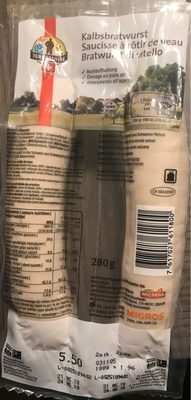
ProductsTerrasuisseKalbsbratwurst
Kalbsbratwurst
Barcode 7617027611800
Terrasuisse

Kalbsbratwurst

280g
BARCODE:7617027611800
CATEGORIES:Meats And Their Products, Prepared Meats, Sausages
LABELS:Made In Swiss, Terrasuisse
PACKAGING:Stuck
ORIGIN:Switzerland
COUNTRIES:France, Germany, Switzerland
STORES:Migros

Health

Nutrition

Nutri-Score

DLower nutritional quality

Nutri-Score data warning

Warning: the amount of fruits, vegetables and nuts is not specified on the label, it was estimated from the list of ingredients: 0

Nutrient levels

Fat in moderate quantity (20%)
What you need to know • A high consumption of fat, especially saturated fats, can raise cholesterol, which increases the risk of heart diseases. Recommendation: Limit the consumption of fat and saturated fat • Choose products with lower fat and saturated fat content. Source: National Health Service UK (NHS) - Fat: the facts
Saturated fat in high quantity (6%)
What you need to know • A high consumption of fat, especially saturated fats, can raise cholesterol, which increases the risk of heart diseases. Recommendation: Limit the consumption of fat and saturated fat • Choose products with lower fat and saturated fat content. Source: National Health Service UK (NHS) - Fat: the facts
Sugars in low quantity (1%)
What you need to know • A high consumption of sugar can cause weight gain and tooth decay. It also augments the risk of type 2 diabetes and cardio-vascular diseases. Recommendation: Limit the consumption of sugar and sugary drinks • Sugary drinks (such as sodas, fruit beverages, and fruit juices and nectars) should be limited as much as possible (no more than 1 glass a day). • Choose products with lower sugar content and reduce the consumption of products with added sugars. Source: National Health Service UK (NHS) - Sugar: the facts
Salt in high quantity (1.8%)
What you need to know • A high consumption of salt (or sodium) can cause raised blood pressure, which can increase the risk of heart disease and stroke. • Many people who have high blood pressure do not know it, as there are often no symptoms. • Most people consume too much salt (on average 9 to 12 grams per day), around twice the recommended maximum level of intake. Recommendation: Limit the consumption of salt and salted food • Reduce the quantity of salt used when cooking, and don't salt again at the table. • Limit the consumption of salty snacks and choose products with lower salt content. Source: World Health Organization (WHO) - Fact sheet - Salt reduction Source: National Health Service UK (NHS) - Salt: the facts

Nutrition facts

Nutrition factsAs sold for 100 g / 100 mlCompared to: Sausages
Energy980 kJ (236 kcal)1,096.963 kJ (265 kcal) (-11%)
Fat20 g21.469 g (-7%)
Saturated fat6 g8.071 g (-26%)
Carbohydrates1 g1.952 g (-49%)
Sugars1 g0.816 g (+23%)
Dietary fiber0.5 g?
Proteins13 g15.502 g (-16%)
Salt1.8 g2.134 g (-16%)
Sodium0.72 g0.854 g (-16%)
Fruits, vegetables and legumes~ 0 %?

Nutrition facts (Detailed data)

Nutrition factsAs sold for 100 g / 100 mlAs sold Per 100 g (packaging)As sold Per 100 g (estimate)
Energy980 kJ (236 kcal)980 kJ (236 kcal)?
Fat20 g20 g?
Saturated fat6 g6 g?
Carbohydrates1 g1 g?
Sugars1 g1 g?
Dietary fiber0.5 g0.5 g?
Proteins13 g13 g?
Salt1.8 g1.8 g?
Sodium0.72 g0.72 g?
Fruits, vegetables and legumes~ 0 %?~ 0 %

Serving size

140 g

Ingredients

Ingredients image

Kalbsbratwurst ingredients image

Ingredients list

Veal * 39%, pork *, water, lard *, pork rind *, iodized cooking salt, milk proteins (with lactose), spices, glucose, stabilizer: e450, antioxidant: citric acid, the shell, pork casing.* made in switzerland with swiss meat from an ip-swiss farm.

Ingredient information

Veal Meat
39.0%
Pork Meat
22.27% (estimate)
Water
17.77% (estimate)
Bacon
10.48% (estimate)
Pork Rind
5.24% (estimate)
Iodised Salt
0.9% (estimate)
Milk Proteins
0.9% (estimate)
Lactose
0.9% (estimate)
Spice
0.9% (estimate)
Glucose
0.9% (estimate)
Stabiliser
0.82% (estimate)
E450
0.82% (estimate)
Antioxidant
0.41% (estimate)
E330
0.41% (estimate)
Casing
0.41% (estimate)
Pork Collagen
0.21% (estimate)
Produite En Suisse Avec De La Viande Suisse Issue D Une Ferme Ip Suisse
0.21% (estimate)

Added sugars

Contains added sugars (0%) Added sugars: glucose Quantity of added sugars: 0%

Allergens

Milk

Ingredients analysis

Palm oil free
Yes

No ingredients containing palm oil.

Vegan
No

Contains non-vegan ingredients.

Unrecognized: fr:produite-en-suisse-avec-de-la-viande-suisse-issue-d-une-ferme-ip-suisse

Vegetarian
No

Contains non-vegetarian ingredients.

Unrecognized: fr:produite-en-suisse-avec-de-la-viande-suisse-issue-d-une-ferme-ip-suisse


Food Processing

NOVA group

4Ultra-processed food and drink products

Elements that indicate the product is in NOVA group 4

Additives
E450 - Diphosphates
Ingredients
Glucose
Ingredients
Lactose
Ingredients
Milk Proteins

How NOVA works

The NOVA classification assigns food products into 4 groups based on their degree of processing: 1. Unprocessed or minimally processed foods 2. Processed culinary ingredients 3. Processed foods 4. Ultra-processed food and drink products

Additives

E330 - Citric acidAntioxidantSequestrant

Citric acid is a natural organic acid found in citrus fruits such as lemons, oranges, and limes.

It is widely used in the food industry as a flavor enhancer, acidulant, and preservative due to its tart and refreshing taste.

Citric acid is safe for consumption when used in moderation and is considered a generally recognized as safe (GRAS) food additive by regulatory agencies worldwide.

E450 - Diphosphates EFSA overexposure risk: highEmulsifierHumectantSequestrantStabiliserThickener

Diphosphates (E450) are food additives often utilized to modify the texture of products, acting as leavening agents in baking and preventing the coagulation of canned food.

These salts can stabilize whipped cream and are also found in powdered products to maintain their flow properties. They are commonly present in baked goods, processed meats, and soft drinks.

Derived from phosphoric acid, they're part of our daily phosphate intake, which often surpasses recommended levels due to the prevalence of phosphates in processed foods and drinks.

Excessive phosphate consumption is linked to health issues, such as impaired kidney function and weakened bone health. Though diphosphates are generally regarded as safe when consumed within established acceptable daily intakes, it's imperative to monitor overall phosphate consumption to maintain optimal health.

Environment

Green-Score, origins bonus, and transportation impact are shown for Worldwide .

Green Score

Overall grade

UnknownUnknown environmental impact

About Green-Score

The Green-Score is an experimental score that summarizes the environmental impacts of food products.

Current scope

The Green-Score was initially developed for France and it is being extended to other European countries. The Green-Score formula is subject to change as it is regularly improved to make it more precise and better suited to each country. Select a country to include the full impact of transportation in the final score.

Green-Score availability

We could not compute the Green-Score of this product because some data is missing. A more precise category, ingredients list, origins or packaging data can unlock the computation.

Bonuses and maluses

Origins of ingredients

Declared origins: Switzerland Origins bonus: +5 Transportation (Worldwide): 0 Environmental policy adjustment: +5 Select a country to include the full impact of transportation.

Packaging impact

Packaging with a high impact Malus: -15 The information about the packaging of this product is not filled in.

Packaging

Kalbsbratwurst packaging image

Packaging impact

Packaging with a high impact Malus: -15 The information about the packaging of this product is not filled in.

Declared packaging

Stuck

Data precision

The packaging information is not sufficiently precise to compute the most accurate packaging impact. Exact shapes and materials of all packaging components help improve the Green-Score.

Transportation

Origins of ingredients

Declared origins: Switzerland Origins bonus: +5 Transportation (Worldwide): 0 Environmental policy adjustment: +5 Select a country to include the full impact of transportation.

Origins breakdown

OriginPercent of ingredientsImpact
Switzerland100 %Medium

Forest footprint

Forest footprint

Forest Footprint not computed Potential deforestation risk but not yet computed. Forest Footprint The Forest Footprint is a methodology developed by the association Envol Vert to estimate the risk of deforestation related to our consumption. → More information on the methodology Forest Footprint not computed Potential deforestation risk but not yet computed.

Deforestation risk details

Other risky ingredients These ingredients are not yet assessed for deforestation risk: veal meat pork meat bacon

Data Source

Product data comes from Open Food Facts. Food Benchmark also adds translations, category comparisons and explanatory calculations.

The database is licensed under ODbL 1.0, individual contents under DbCL 1.0, and product photos under CC BY-SA 3.0.

Product added on February 7, 2017 at 10:30:39 PM UTC by openfood-ch-import .

Last edit on March 17, 2026 at 10:08:42 PM UTC by new-nutrition-bot .

Product page also edited by alexfauquette, date-limite-app, foodrepo, foodvisor, itsjustruby, kiliweb, new-nutrition-bot, openfood-ch-import, openfoodfacts-contributors, prepperapp, robin83, roboto-app, yuka.NrlEAY6bBpI-DsDJ0bg14iCZF77xKadHJEAVoQ, yuka.SGJGY0dxdGF2dWNSbjg4UDhVN0grKzFzbUptc0FXbTZJT0E4SUE9PQ, yukafix.