ProductsFARMERSoft Milch & Erdbeer
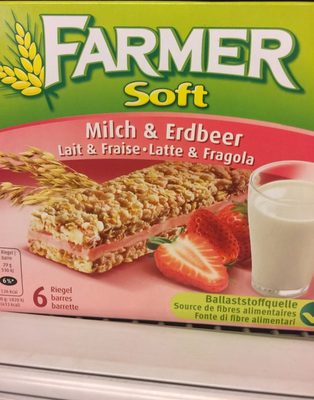
Soft Milch & Erdbeer
Barcode 7613269187257
FARMER

Soft Milch & Erdbeer

174 g
BARCODE:7613269187257
COUNTRIES:France, Switzerland

Health

Nutrition

Nutri-Score data warning

Warning: the amount of fruits, vegetables and nuts is not specified on the label, it was estimated from the list of ingredients: 7

Nutrition label

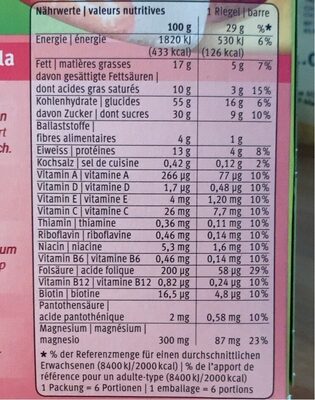
Soft Milch & Erdbeer nutrition label

Nutrition facts

Nutrition factsAs sold for 100 g / 100 ml
Energy1820 kJ (433 kcal)
Fat17 g
Saturated fat10 g
Carbohydrates55 g
Sugars30 g
Dietary fiber4 g
Proteins13 g
Salt0.41999998688698 g
Sodium0.168 g
Vitamin A0.000266 g
Vitamin D0.0000017 g
Vitamin E0.004 g
Vitamin C0.026 g
Vitamin PP0.0053 g
Pantothenic acid0.002 g
Magnesium0.3 g
Fruits, vegetables and legumes~ 7.3 %

Nutrition facts (Detailed data)

Nutrition factsAs sold for 100 g / 100 mlAs sold Per 100 g (packaging)As sold Per 100 g (estimate)
Energy1820 kJ (433 kcal)1820 kJ (433 kcal)?
Fat17 g17 g?
Saturated fat10 g10 g?
Carbohydrates55 g55 g?
Sugars30 g30 g?
Dietary fiber4 g4 g?
Proteins13 g13 g?
Salt0.41999998688698 g0.41999998688698 g?
Sodium0.168 g0.168 g?
Vitamin A0.000266 g0.000266 g?
Vitamin D0.0000017 g0.0000017 g?
Vitamin E0.004 g0.004 g?
Vitamin C0.026 g0.026 g?
Vitamin PP0.0053 g0.0053 g?
Pantothenic acid0.002 g0.002 g?
Magnesium0.3 g0.3 g?
Fruits, vegetables and legumes~ 7.3 %?~ 7.3 %

Serving size

29 g

Ingredients

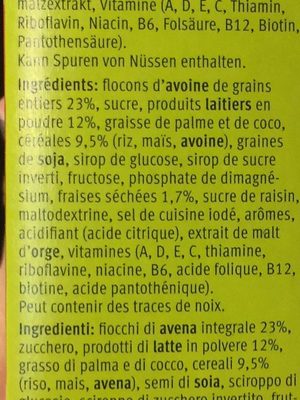
Ingredients image

Soft Milch & Erdbeer ingredients image

Ingredients list

20% intergrale oat flakes, sugar, 12% powdered milk products, palm and coconut fat, grains 9.5% (rice, corn, oats), soybeans, glucose syrup, invert sugar syrup, fructose, dimagnesium phosphate, 1,7% dried strawberries, grape sugar, maltodextrin, iodised salt, flavorings, acidifier (citric acid), barley malt extract, vitamins (A, D, E, C, thiamin, riboflavin, niacin, B6, folic acid, B12, biotin, pantothenic acid).

Ingredient information

Flocons D Avoine De Grains Entiers
23.0%
Sugar
17.5% (estimate)
Products Laitiers En Poudre
12.0%
Fat
10.75% (estimate)
Palm Oil
7.75% (estimate)
Coconut Oil
3% (estimate)
Cereal
9.5%
Rice
6.33% (estimate)
Corn
1.58% (estimate)
Oat
1.58% (estimate)
Soya Bean
5.6% (estimate)
Glucose Syrup
5.28% (estimate)
Sirup De Sucre Inverti
4.4% (estimate)
Fructose
3.77% (estimate)
Phosphate De Dimagnesium
3.3% (estimate)
Strawberry
1.7%
Grape Sugar
0.85% (estimate)
Maltodextrin
0.85% (estimate)
Iodised Salt
0.21% (estimate)
Flavouring
0.21% (estimate)
Acid
0.21% (estimate)
E330
0.21% (estimate)
Barley Malt Extract
0.21% (estimate)
Vitamins
0.21% (estimate)
Vitamin A
0.21% (estimate)
Vitamin D
0.12% (estimate)
Vitamin E
0.06% (estimate)
Vitamin C
0.03% (estimate)
Thiamin
0.01% (estimate)
E101
0.01% (estimate)
E375
0% (estimate)
Vitamin B6
0% (estimate)
Folic Acid
0% (estimate)
Vitamin B12
0% (estimate)
Biotin
0% (estimate)
Pantothenic Acid
0% (estimate)

Added sugars

Contains added sugars (25%) Added sugars: sugar, glucose syrup, fructose, grape sugar Quantity of added sugars: 25%

Allergens

GlutenSoybeans

Traces

Nuts

Ingredients analysis

Palm oil free
No

Contains ingredients containing palm oil.

Vegan
Unknown

Vegan status unknown

Unrecognized: fr:flocons-d-avoine-de-grains-entiers, fr:products-laitiers-en-poudre, fr:sirup-de-sucre-inverti, fr:phosphate-de-dimagnesium

Vegetarian
Unknown

Vegetarian status unknown

Unrecognized: fr:flocons-d-avoine-de-grains-entiers, fr:products-laitiers-en-poudre, fr:sirup-de-sucre-inverti, fr:phosphate-de-dimagnesium


Food Processing

NOVA group

4Ultra-processed food and drink products

Elements that indicate the product is in NOVA group 4

Ingredients
Flavouring
Ingredients
Glucose
Ingredients
Glucose Syrup
Ingredients
Maltodextrin
Ingredients
Fructose

How NOVA works

The NOVA classification assigns food products into 4 groups based on their degree of processing: 1. Unprocessed or minimally processed foods 2. Processed culinary ingredients 3. Processed foods 4. Ultra-processed food and drink products

Additives

E330 - Citric acidAntioxidantSequestrant

Citric acid is a natural organic acid found in citrus fruits such as lemons, oranges, and limes.

It is widely used in the food industry as a flavor enhancer, acidulant, and preservative due to its tart and refreshing taste.

Citric acid is safe for consumption when used in moderation and is considered a generally recognized as safe (GRAS) food additive by regulatory agencies worldwide.

Environment

Green-Score, origins bonus, and transportation impact are shown for Worldwide .

Green Score

Overall grade

UnknownUnknown environmental impact

About Green-Score

The Green-Score is an experimental score that summarizes the environmental impacts of food products.

Current scope

The Green-Score was initially developed for France and it is being extended to other European countries. The Green-Score formula is subject to change as it is regularly improved to make it more precise and better suited to each country. Select a country to include the full impact of transportation in the final score.

Green-Score availability

We could not compute the Green-Score of this product because some data is missing. A more precise category, ingredients list, origins or packaging data can unlock the computation.

Bonuses and maluses

Declared origins

Origins of ingredients are missing for this product. Ingredients need to be completed before the transportation bonus can be computed precisely.

Threatened species risk

Contains ingredients that may threaten species or ecosystems, such as palm oil.

Packaging impact

Packaging with a high impact Malus: -15 The information about the packaging of this product is not filled in.

Packaging

Packaging impact

Packaging with a high impact Malus: -15 The information about the packaging of this product is not filled in.

Data precision

The packaging information is not sufficiently precise to compute the most accurate packaging impact. Exact shapes and materials of all packaging components help improve the Green-Score.

Transportation

Declared origins

Origins of ingredients are missing for this product. Ingredients need to be completed before the transportation bonus can be computed precisely.

Forest footprint

Forest footprint

Medium risk of deforestation Presence of one or more ingredients at risk of deforestation, with moderate risk given their quantity, origin and/or labels. Forest Footprint The Forest Footprint is a methodology developed by the association Envol Vert to estimate the risk of deforestation related to our consumption. → More information on the methodology Forest Footprint grade: C Presence of one or more ingredients at risk of deforestation, with moderate risk given their quantity, origin and/or labels. Total Forest Footprint: 0.003 m² per kg of food

Deforestation risk details

Palm oil Primary ingredient grade: C Primary ingredient: 0.003 m² per kg of food Palm oil production, concentrated mainly in Indonesia and Malaysia, contributes significantly to deforestation. Borneo has lost more than half of its forests since the 1970s. Other risky ingredients These ingredients are not yet assessed for deforestation risk: soya bean rice corn Labels The presence of certain labels can greatly help reduce the risk of deforestation, through the presence of environmental criteria and/or through better remuneration of producers.

Data Source

Product data comes from Open Food Facts. Food Benchmark also adds translations, category comparisons and explanatory calculations.

The database is licensed under ODbL 1.0, individual contents under DbCL 1.0, and product photos under CC BY-SA 3.0.

Product added on February 7, 2017 at 10:50:42 PM UTC by openfood-ch-import .

Last edit on March 17, 2026 at 11:08:34 AM UTC by new-nutrition-bot .

Product page also edited by foodrepo, kiliweb, new-nutrition-bot, openfood-ch-import, openfoodfacts-contributors, yuka.EKpfOtqNIM4xF8vx8o0R_jW3StfJOPBQKlsKog, yuka.J558GNCkGcElA8CC8aYawTO9Gc3LCe1iKWVVog, yuka.WXEwbUlyZ1F1ZjFTeHZRdTFEejArNHRXMmM2VUFudnRKdmhPSUE9PQ.