
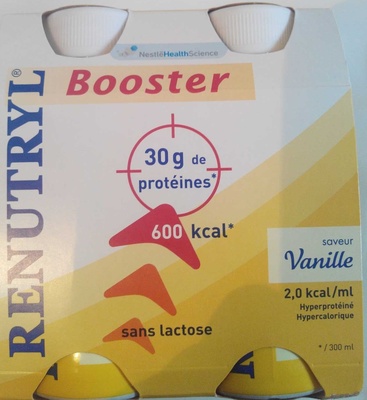
Booster saveur vanille
Health
Nutrition
Nutri-Score data warning
Nutrient levels
Fat in moderate quantity (7%)
Saturated fat in low quantity (0.9%)
Sugars in moderate quantity (6.33%)
Salt in low quantity (0.207%)
Nutrition label
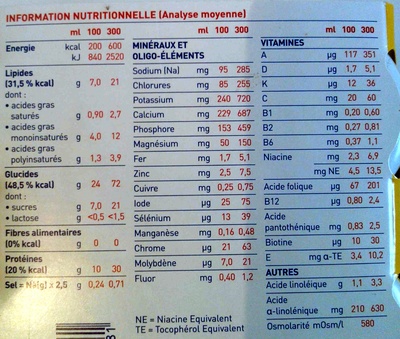
Nutrition facts
| Nutrition facts | As sold for 100 g / 100 ml | Compared to: Dietary supplements |
|---|---|---|
| Energy | 837 kcal (200 kcal) | 1,343.148 kJ (314 kcal) |
| Fat | 7 g | 6.661 g (+5%) |
| Saturated fat | 0.9 g | 2.689 g (-67%) |
| Alpha linolenic acid | 0.07 mg | ? |
| Linoleic acid | 0.367 g | 2.051 g (-82%) |
| Carbohydrates | 24.3 g | 18.483 g (+31%) |
| Sugars | 6.33 g | 6.22 g (+2%) |
| Lactose | < 0.167 g | 0.431 g (-61%) |
| Dietary fiber | ? | ? |
| Proteins | 10 g | 39.42 g (-75%) |
| Salt | 0.207 g | 0.614 g (-66%) |
| Sodium | 0.0827 g | 0.245 g (-66%) |
| Vitamin PP | 0.000767 mg | ? |
| Biotin | 0.00000333 µg | 306.743 µg (-100%) |
| Chloride | 0.0283 mg | 132.834 mg (-100%) |
| Fluoride | 0.000133 mg | 0.203 mg (-100%) |
| Chromium | 0.000007 µg | 60.027 µg (-100%) |
| Molybdenum | 0.00000233 µg | 60.946 µg (-100%) |
| Iodine | 0.00000833 µg | 42.496 µg (-100%) |
| Fruits, vegetables and legumes | ? | ? |
Nutrition facts (Detailed data)
| Nutrition facts | As sold for 100 g / 100 ml | As sold Per serving (legacy) |
|---|---|---|
| Energy | 837 kcal (200 kcal) | 2510 kcal (600 kcal) |
| Fat | 7 g | 21 g |
| Saturated fat | 0.9 g | 2.7 g |
| Alpha linolenic acid | 0.07 mg | 0.21 mg |
| Linoleic acid | 0.367 g | 1.1 g |
| Carbohydrates | 24.3 g | 73 g |
| Sugars | 6.33 g | 19 g |
| Lactose | < 0.167 g | < 0.5 g |
| Dietary fiber | ? | ? |
| Proteins | 10 g | 30 g |
| Salt | 0.207 g | 0.62 g |
| Sodium | 0.0827 g | 0.248 g |
| Vitamin PP | 0.000767 mg | 0.0023 mg |
| Biotin | 0.00000333 µg | 0.00001 µg |
| Chloride | 0.0283 mg | 0.085 mg |
| Fluoride | 0.000133 mg | 0.0004 mg |
| Chromium | 0.000007 µg | 0.000021 µg |
| Molybdenum | 0.00000233 µg | 0.000007 µg |
| Iodine | 0.00000833 µg | 0.000025 µg |
| Fruits, vegetables and legumes | ? | ? |
Serving size
Ingredients
Ingredients image

Ingredients list
Ingredient information
Added sugars
Allergens
Ingredients analysis
Palm oil content unknown
Contains non-vegan ingredients.
Unrecognized: en:sodium-citrate, en:zinc-sulfate, en:ferrous-sulfate, en:sodium-fluoride, en:manganese-sulfate, en:chromium-chloride, en:sodium-selenate, en:sodium-molybdate
Vegetarian status unknown
Unrecognized: en:sodium-citrate, en:zinc-sulfate, en:ferrous-sulfate, en:sodium-fluoride, en:manganese-sulfate, en:chromium-chloride, en:sodium-selenate, en:sodium-molybdate
Food Processing
NOVA group
 Ultra-processed food and drink products
Elements that indicate the product is in NOVA group 4
How NOVA works
Additives
E160a - caroteneColour
β-Carotene is an organic, strongly colored red-orange pigment abundant in plants and fruits. It is a member of the carotenes, which are terpenoids (isoprenoids), synthesized biochemically from eight isoprene units and thus having 40 carbons. Among the carotenes, β-carotene is distinguished by having beta-rings at both ends of the molecule. β-Carotene is biosynthesized from geranylgeranyl pyrophosphate.β-Carotene is the most common form of carotene in plants. When used as a food coloring, it has the E number E160a. The structure was deduced by Karrer et al. in 1930. In nature, β-carotene is a precursor (inactive form) to vitamin A via the action of beta-carotene 15,15'-monooxygenase.Isolation of β-carotene from fruits abundant in carotenoids is commonly done using column chromatography. It can also be extracted from the beta-carotene rich algae, Dunaliella salina. The separation of β-carotene from the mixture of other carotenoids is based on the polarity of a compound. β-Carotene is a non-polar compound, so it is separated with a non-polar solvent such as hexane. Being highly conjugated, it is deeply colored, and as a hydrocarbon lacking functional groups, it is very lipophilic.
E160ai - Beta-caroteneColour
No additive description is available yet.
E407 - Carrageenan EFSA overexposure risk: highCarrierEmulsifierHumectantStabiliserThickener
Carrageenan (E407), derived from red seaweed, is widely employed in the food industry as a gelling, thickening, and stabilizing agent, notably in dairy and meat products.
It can exist in various forms, each imparting distinct textural properties to food.
However, its degraded form, often referred to as poligeenan, has raised health concerns due to its potential inflammatory effects and its classification as a possible human carcinogen (Group 2B) by the International Agency for Research on Cancer (IARC).
Nevertheless, food-grade carrageenan has been deemed safe by various regulatory bodies when consumed in amounts typically found in food.
E471 - Mono- and diglycerides of fatty acidsEmulsifierStabiliser
Mono- and diglycerides of fatty acids (E471), are food additives commonly used as emulsifiers in various processed foods.
These compounds consist of glycerol molecules linked to one or two fatty acid chains, which help stabilize and blend water and oil-based ingredients. E471 enhances the texture and shelf life of products like margarine, baked goods, and ice cream, ensuring a smooth and consistent texture.
It is generally considered safe for consumption within established regulatory limits.
E525 - Potassium hydroxide
Potassium hydroxide is an inorganic compound with the formula KOH, and is commonly called caustic potash. Along with sodium hydroxide (NaOH), this colorless solid is a prototypical strong base. It has many industrial and niche applications, most of which exploit its corrosive nature and its reactivity toward acids. An estimated 700,000 to 800,000 tonnes were produced in 2005. About 100 times more NaOH than KOH is produced annually. KOH is noteworthy as the precursor to most soft and liquid soaps, as well as numerous potassium-containing chemicals.
Environment
Green-Score, origins bonus, and transportation impact are shown for Worldwide .
Green Score
Overall grade
 Unknown environmental impact
About Green-Score
Current scope
Green-Score availability
Bonuses and maluses
Declared origins
Packaging impact
Packaging
Packaging impact
Packaging components
| Shape | Material | Recycling | Impact |
|---|---|---|---|
| Bottle | Plastic | Unknown | High |
| Unknown | Cardboard | Unknown | Low |
Declared packaging
Data precision
Transportation
Manufacturing locations
Declared origins
Forest footprint
Forest footprint
Deforestation risk details
Data Source
Product data comes from Open Food Facts. Food Benchmark also adds translations, category comparisons and explanatory calculations.
The database is licensed under ODbL 1.0, individual contents under DbCL 1.0, and product photos under CC BY-SA 3.0.
Product added on September 27, 2015 at 1:27:54 PM UTC by sebleouf .
Last edit on August 12, 2025 at 1:10:38 PM UTC by macrofactor .
Product page also edited by macrofactor, packbot, roboto-app, sebleouf.