

Bergminze Menthe des montagnes
Health
Nutrition
Nutri-Score
 Good nutritional quality
Nutri-Score data warning
Nutrient levels
Fat in low quantity (0%)
Saturated fat in low quantity (0%)
Sugars in low quantity (0%)
Salt in low quantity (0%)
Nutrition label
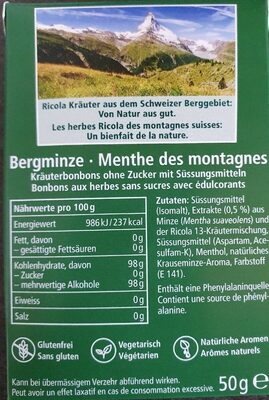
Nutrition facts
| Nutrition facts | As sold for 100 g / 100 ml | Compared to: Hard candies |
|---|---|---|
| Energy | 986 kJ (237 kcal) | 1,360.929 kJ (304 kcal) (-28%) |
| Fat | 0 g | 0.541 g (-100%) |
| Saturated fat | 0 g | 0.313 g (-100%) |
| Carbohydrates | 98 g | 94.532 g (+4%) |
| Sugars | 0 g | 33.551 g (-100%) |
| Polyols | 98 g | ? |
| Dietary fiber | ? | ? |
| Proteins | 0 g | 0.13 g (-100%) |
| Salt | 0 g | 0.096 g (-100%) |
| Sodium | 0 g | 0.038 g (-100%) |
| Fruits, vegetables and legumes | ~ 0.25 % | ? |
Nutrition facts (Detailed data)
| Nutrition facts | As sold for 100 g / 100 ml | As sold Per 100 g (packaging) | As sold Per 100 g (estimate) |
|---|---|---|---|
| Energy | 986 kJ (237 kcal) | 986 kJ (237 kcal) | ? |
| Fat | 0 g | 0 g | ? |
| Saturated fat | 0 g | 0 g | ? |
| Carbohydrates | 98 g | 98 g | ? |
| Sugars | 0 g | 0 g | ? |
| Polyols | 98 g | 98 g | ? |
| Dietary fiber | ? | ? | ? |
| Proteins | 0 g | 0 g | ? |
| Salt | 0 g | 0 g | ? |
| Sodium | 0 g | 0 g | ? |
| Fruits, vegetables and legumes | ~ 0.25 % | ? | ~ 0.25 % |
Ingredients
Ingredients image
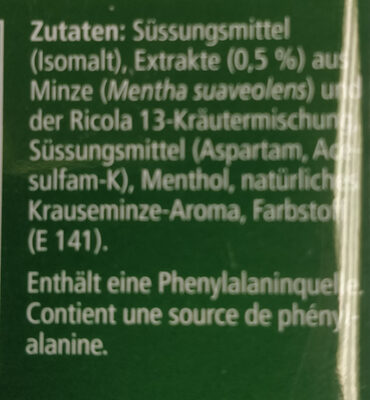
Ingredients list
Ingredient information
Ingredients analysis
No ingredients containing palm oil.
Unrecognized: de:extrakte, de:mentha-suaveolens, de:der-ricola-13-kräutermischun-süssungsmittel, de:ad-sulfam-k, de:natürliches-krauseminze-aroma, de:farbstof, de:enthält-eine-phenylalaninquelle-contient-une-source-de-phény-alanine
Vegan status unknown
Unrecognized: de:extrakte, de:mentha-suaveolens, de:ad-sulfam-k, en:menthol, de:natürliches-krauseminze-aroma, de:enthält-eine-phenylalaninquelle-contient-une-source-de-phény-alanine
Vegetarian status unknown
Unrecognized: de:extrakte, de:mentha-suaveolens, de:ad-sulfam-k, en:menthol, de:natürliches-krauseminze-aroma, de:enthält-eine-phenylalaninquelle-contient-une-source-de-phény-alanine
Food Processing
NOVA group
 Ultra-processed food and drink products
Elements that indicate the product is in NOVA group 4
How NOVA works
Additives
E141 - Copper complexes of chlorophylls and chlorophyllinsColour
No additive description is available yet.
E951 - Aspartame EFSA overexposure risk: noSweetener
Aspartame (E951) is a low-calorie artificial sweetener composed of two amino acids.
It is used as a sugar substitute in thousands of "sugar-free" or "diet" products, such as carbonated soft drinks, chewing gum, yogurts, and tabletop sweeteners, to provide sweetness without the calories of sugar.
Despite being one of the most rigorously tested food additives, its safety remains controversial. While major regulatory bodies like the FDA and EFSA deem it safe for the general public, the IARC has classified it as "possibly carcinogenic to humans" (Group 2B). It must also be avoided by individuals with the genetic condition phenylketonuria (PKU).
E953 - isomaltStabiliserSweetenerThickener
ISOMALT is a sugar substitute, a type of sugar alcohol used primarily for its sugar-like physical properties. It has little to no impact on blood sugar levels, and does not stimulate the release of insulin. Isomalt is widely used for the production of sugar-free candy, especially hard-boiled candy.
Environment
Green-Score, origins bonus, and transportation impact are shown for Worldwide .
Green Score
Overall grade
 Low environmental impact
About Green-Score
Current scope
Life cycle analysis
Average impact of the category
 Hard candy and lollipop • Score: 88/100
Life-cycle reference
Overall environmental impact by stage (PEF)
The overall environmental impact figure (PEF) comes from ADEME's Agribalyse database, for the category: Hard candy and lollipop. Source: ADEME Agribalyse Database.
| Stage | Impact |
|---|---|
| Agriculture | 50.2 % |
| Processing | 19.3 % |
| Packaging | 17.3 % |
| Transportation | 11.2 % |
| Distribution | 2.3 % |
| Consumption | 0.0 % |
Bonuses and maluses
Declared origins
Packaging impact
Green-Score for this product
Green-Score for this product
Final score: 68/100Final score breakdown
Carbon footprint
Carbon footprint
Climate impact by stage (CO2e)
The carbon emission figure comes from ADEME's Agribalyse database, for the category: Hard candy and lollipop. Source: ADEME Agribalyse Database.
| Stage | Impact |
|---|---|
| Agriculture | 42.2 % |
| Processing | 24.0 % |
| Packaging | 14.3 % |
| Transportation | 18.6 % |
| Distribution | 1.3 % |
| Consumption | 0.0 % |
Packaging
Packaging impact
Data precision
Transportation
Declared origins
Forest footprint
Forest footprint
Deforestation risk details
Data Source
Product data comes from Open Food Facts. Food Benchmark also adds translations, category comparisons and explanatory calculations.
The database is licensed under ODbL 1.0, individual contents under DbCL 1.0, and product photos under CC BY-SA 3.0.
Product added on April 12, 2018 at 11:09:42 AM UTC by kiliweb .
Last edit on March 17, 2026 at 10:49:54 AM UTC by new-nutrition-bot .
Product page also edited by alex-na, autorotate-bot, ddechamb, femmenoire, foodrepo, kiliweb, new-nutrition-bot, openfoodfacts-contributors, roboto-app, sebleouf, teolemon, yuka.LI1yZtKbFuscDcrKyNop5BPrFPznAOBCRScNoQ, yuka.VkxzSkNmNFBuS1lScC9NTzhBUCs1Y2xjeDhhTWZscWJPclpNSUE9PQ, yuka.sY2b0xO6T85zoF3NwEKvlnNEavH3mGjPND7nt1KXwfvUNabUTv1g3qzkF6s, yukafix.