
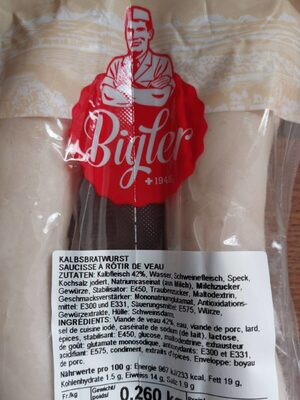
Saucisse à rôtir de veau
Labels
 Poor nutritional quality
 Ultra-processed food and drink products
 Green-Score not computed
Health
Nutrition
Label
Poor nutritional qualityNutrient levels
Fat in moderate quantity (20%)
Saturated fat in high quantity (8%)
Sugars in low quantity (0.5%)
Salt in high quantity (1.67%)
Nutrition label
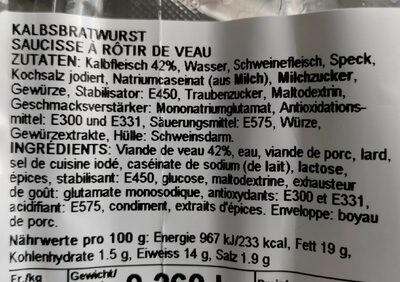
Nutrition facts
| Nutrition facts | As sold for 100 g / 100 ml |
|---|---|
| Energy | ~ 990.5 kJ (238 kcal) |
| FAT | 20 g |
| Saturated fat | 8 g |
| Carbohydrates | 1.5 g |
| Sugars | 0.5 g |
| Dietary fiber | 0.5 g |
| Proteins | 13 g |
| Salt | 1.67 g |
| Sodium | 0.67 g |
| Minerals | |
| Fruits, vegetables and legumes | ~ 0 % |
Nutrition facts (Detailed data)
| Nutrition facts | As sold for 100 g / 100 ml | As sold Per 100 g (packaging) | As sold Per 100 g (estimate) |
|---|---|---|---|
| Energy | ~ 990.5 kJ (238 kcal) | ? (238 kcal) | ? |
| FAT | 20 g | 20 g | ? |
| Saturated fat | 8 g | 8 g | ? |
| Carbohydrates | 1.5 g | 1.5 g | ? |
| Sugars | 0.5 g | 0.5 g | ? |
| Added sugars | ~ 0.84 g | ? | ~ 0.84 g |
| Dietary fiber | 0.5 g | 0.5 g | ? |
| Proteins | 13 g | 13 g | ? |
| Salt | 1.67 g | 1.67 g | ? |
| Sodium | 0.67 g | 0.67 g | ? |
| Minerals | |||
| Fruits, vegetables and legumes | ~ 0 % | ? | ~ 0 % |
Estimated Activity Time
Approximate time needed to burn the energy in 100 g / 100 ml: 991 kJ. Reference adult weight: 70 kg. Energy density: Low.
Ingredients
Ingredients image
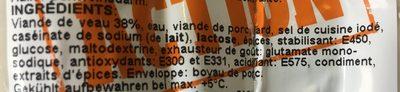
Ingredients list
Ingredient information
Allergens
Ingredients analysis
No ingredients containing palm oil.
Contains non-vegan ingredients.
Unrecognized: fr:enveloppe-boyaux-de-porc
Contains non-vegetarian ingredients.
Unrecognized: fr:enveloppe-boyaux-de-porc
Food Processing
NOVA group
Ultra-processed food and drink productsElements that indicate the product is in NOVA group 4
How NOVA works
Additives
E300 - Ascorbic acidAntioxidantSequestrant
No additive description is available yet.
E331 - Sodium citratesEmulsifierSequestrantStabiliser
DISODIUM CITRATE, more properly, disodium hydrogen citrate, is an acid salt of citric acid with the chemical formula Na2C6H6O7. It is used as an antioxidant in food and to improve the effects of other antioxidants. It is also used as an acidity regulator and sequestrant. Typical products include gelatin, jam, sweets, ice cream, carbonated beverages, milk powder, wine, and processed cheeses.
E450 - DiphosphatesEmulsifierHumectantSequestrantStabiliserThickener
Diphosphates (E450) are food additives often utilized to modify the texture of products, acting as leavening agents in baking and preventing the coagulation of canned food.
These salts can stabilize whipped cream and are also found in powdered products to maintain their flow properties. They are commonly present in baked goods, processed meats, and soft drinks.
Derived from phosphoric acid, they're part of our daily phosphate intake, which often surpasses recommended levels due to the prevalence of phosphates in processed foods and drinks.
Excessive phosphate consumption is linked to health issues, such as impaired kidney function and weakened bone health. Though diphosphates are generally regarded as safe when consumed within established acceptable daily intakes, it's imperative to monitor overall phosphate consumption to maintain optimal health.
E575 - Glucono-delta-lactoneSequestrant
Glucono delta-lactone (GDL), also known as gluconolactone, is a food additive with the E number E575 used as a sequestrant, an acidifier, or a curing, pickling, or leavening agent. It is a lactone of D-gluconic acid. Pure GDL is a white odorless crystalline powder. GDL has been marketed for use in feta cheese. GDL is neutral, but hydrolyses in water to gluconic acid which is acidic, adding a tangy taste to foods, though it has roughly a third of the sourness of citric acid. It is metabolized to 6-phospho-D-gluconate; one gram of GDL yields roughly the same amount of metabolic energy as one gram of sugar. Upon addition to water, GDL is partially hydrolysed to gluconic acid, with the balance between the lactone form and the acid form established as a chemical equilibrium. The rate of hydrolysis of GDL is increased by heat and high pH.The yeast Saccharomyces bulderi can be used to ferment gluconolactone to ethanol and carbon dioxide. The pH value greatly affects culture growth. Gluconolactone at 1 or 2% in a mineral media solution causes the pH to drop below 3.It is also a complete inhibitor of the enzyme amygdalin beta-glucosidase at concentrations of 1 mM.
E621 - Monosodium glutamateFlavour Enhancer
Monosodium glutamate (MSG), or E621, is the sodium salt of glutamic acid, an amino acid found naturally in many foods.
It is widely used as a flavor enhancer to provide an "umami" or savory taste to a variety of processed foods, including soups, snack chips, and frozen meals.
MSG is generally recognized as safe (GRAS) by food authorities. However, some people report sensitivity to MSG, experiencing short-term symptoms like headaches and flushing, though scientific studies have not shown a consistent link.
Environment
Green-Score, origins bonus, and transportation impact are shown for Worldwide .
Green Score
Overall grade
Unknown environmental impactAbout Green-Score
Current scope
Green-Score availability
Bonuses and maluses
Origins of ingredients
Packaging impact
Packaging
Packaging impact
Packaging materials
| Material | % | Packaging weight | Packaging weight per 100 g of product |
|---|---|---|---|
| Plastic | |||
| Total |
Declared packaging
Transportation
Manufacturing locations
Origins of ingredients
Origins breakdown
| Origin | Percent of ingredients | Impact |
|---|---|---|
| Switzerland | 100 % | Medium |
Data Source
Data presented on this page is sourced from the Open Food Facts database. This platform does not alter the original dataset; its purpose is solely to enhance data visualization and user accessibility.
Product added on September 24, 2014 at 4:02:32 PM UTC by emerycm .
Last edit on March 17, 2026 at 8:18:36 PM UTC by new-nutrition-bot .
Product page also edited by date-limite-app, emerycm, itsjustruby, kiliweb, macrofactor, new-nutrition-bot, openfoodfacts-contributors, packbot, roboto-app, yuka.VDd0ZkdibyttOVVPcGN3QnpCalN3WXNrN2NPUVdsbm1JZGNKSVE9PQ, yuka.sY2b0xO6T85zoF3NwEKvlkJ2T-XAmDndaT7nn2eQxuzefpzVUeB537DnKas.