
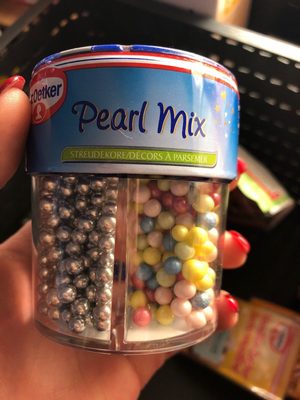
Décor à parsemer
Health
Nutrition
Nutri-Score
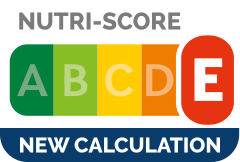 Lower nutritional quality
Nutri-Score data warning
Nutrient levels
Fat in low quantity (0.1%)
Saturated fat in low quantity (0.1%)
Sugars in high quantity (84%)
Salt in low quantity (0.12%)
Nutrition label

Nutrition facts
| Nutrition facts | As sold for 100 g / 100 ml | Compared to: Multi-coloured vermicelli |
|---|---|---|
| Energy | ~ 1577.9 kJ (372 kcal) | 1,674.85 kJ (394 kcal) (-6%) |
| Fat | 0.1 g | 7.108 g (-99%) |
| Saturated fat | 0.1 g | 3.519 g (-97%) |
| Carbohydrates | 92 g | 77.948 g (+18%) |
| Sugars | 84 g | 62.103 g (+35%) |
| Dietary fiber | ? | ? |
| Proteins | 0.6 g | 1.597 g (-62%) |
| Salt | 0.12 g | 0.112 g (+7%) |
| Sodium | 0.048 g | 0.041 g (+17%) |
| Fruits, vegetables and legumes | ~ 0 % | ? |
Nutrition facts (Detailed data)
| Nutrition facts | As sold for 100 g / 100 ml | As sold Per 100 g (packaging) | As sold Per 100 g (estimate) |
|---|---|---|---|
| Energy | ~ 1577.9 kJ (372 kcal) | ? (372 kcal) | ? |
| Fat | 0.1 g | 0.1 g | ? |
| Saturated fat | 0.1 g | 0.1 g | ? |
| Carbohydrates | 92 g | 92 g | ? |
| Sugars | 84 g | 84 g | ? |
| Dietary fiber | ? | ? | ? |
| Proteins | 0.6 g | 0.6 g | ? |
| Salt | 0.12 g | 0.12 g | ? |
| Sodium | 0.048 g | 0.048 g | ? |
| Fruits, vegetables and legumes | ~ 0 % | ? | ~ 0 % |
Ingredients
Ingredients image

Ingredients list
Ingredient information
Added sugars
Allergens
Ingredients analysis
Contains ingredients containing palm oil.
Contains non-vegan ingredients.
Unrecognized: de:pearl-mix-decor-da-cospar, de:zuckerperlen-grün, de:zuckerperlen-weiss, de:2-60-032686-perlen-farbig, de:zuckerperlen-silber, de:konzentrate-aus-spirulina, de:kühl-und-trocken-lagern, de:nährwertangaben-siehe-boden, de:mindestens-haltbar-bis-ende, de:siehe-aufdruck
Contains non-vegetarian ingredients.
Unrecognized: de:pearl-mix-decor-da-cospar, de:zuckerperlen-grün, de:zuckerperlen-weiss, de:2-60-032686-perlen-farbig, de:zuckerperlen-silber, de:konzentrate-aus-spirulina, de:kühl-und-trocken-lagern, de:nährwertangaben-siehe-boden, de:mindestens-haltbar-bis-ende, de:siehe-aufdruck
Food Processing
NOVA group
 Ultra-processed food and drink products
Elements that indicate the product is in NOVA group 4
How NOVA works
Additives
E100 - CurcuminColour
No additive description is available yet.
E132 - Indigotine EFSA overexposure risk: noColour
Indigo carmine, or 5,5′-indigodisulfonic acid sodium salt, is an organic salt derived from indigo by sulfonation, which renders the compound soluble in water. It is approved for use as a food colorant in the U.S and E.U., It has the E number E132. It is also a pH indicator.
E171 - Titanium dioxideColour
Titanium dioxide, also known as titanium(IV) oxide or titania, is the naturally occurring oxide of titanium, chemical formula TiO2. When used as a pigment, it is called titanium white, Pigment White 6 (PW6), or CI 77891. Generally, it is sourced from ilmenite, rutile and anatase. It has a wide range of applications, including paint, sunscreen and food coloring. When used as a food coloring, it has E number E171. World production in 2014 exceeded 9 million metric tons. It has been estimated that titanium dioxide is used in two-thirds of all pigments, and the oxide has been valued at $13.2 billion.
E173 - Aluminium
Aluminium or aluminum is a chemical element with symbol Al and atomic number 13. It is a silvery-white, soft, nonmagnetic and ductile metal in the boron group. By mass, aluminium makes up about 8% of the Earth's crust; it is the third most abundant element after oxygen and silicon and the most abundant metal in the crust, though it is less common in the mantle below. The chief ore of aluminium is bauxite. Aluminium metal is so chemically reactive that native specimens are rare and limited to extreme reducing environments. Instead, it is found combined in over 270 different minerals.Aluminium is remarkable for its low density and its ability to resist corrosion through the phenomenon of passivation. Aluminium and its alloys are vital to the aerospace industry and important in transportation and building industries, such as building facades and window frames. The oxides and sulfates are the most useful compounds of aluminium.Despite its prevalence in the environment, no known form of life uses aluminium salts metabolically, but aluminium is well tolerated by plants and animals. Because of these salts' abundance, the potential for a biological role for them is of continuing interest, and studies continue.
E330 - Citric acidAntioxidantSequestrant
Citric acid is a natural organic acid found in citrus fruits such as lemons, oranges, and limes.
It is widely used in the food industry as a flavor enhancer, acidulant, and preservative due to its tart and refreshing taste.
Citric acid is safe for consumption when used in moderation and is considered a generally recognized as safe (GRAS) food additive by regulatory agencies worldwide.
E428 - Gelatine
No additive description is available yet.
E471 - Mono- and diglycerides of fatty acidsEmulsifierStabiliser
Mono- and diglycerides of fatty acids (E471), are food additives commonly used as emulsifiers in various processed foods.
These compounds consist of glycerol molecules linked to one or two fatty acid chains, which help stabilize and blend water and oil-based ingredients. E471 enhances the texture and shelf life of products like margarine, baked goods, and ice cream, ensuring a smooth and consistent texture.
It is generally considered safe for consumption within established regulatory limits.
E904 - Shellac
Shellac is a resin secreted by the female lac bug, on trees in the forests of India and Thailand. It is processed and sold as dry flakes (pictured) and dissolved in alcohol to make liquid shellac, which is used as a brush-on colorant, food glaze and wood finish. Shellac functions as a tough natural primer, sanding sealant, tannin-blocker, odour-blocker, stain, and high-gloss varnish. Shellac was once used in electrical applications as it possesses good insulation qualities and it seals out moisture. Phonograph and 78 rpm gramophone records were made of it until they were replaced by vinyl long-playing records from the 1950s onwards. From the time it replaced oil and wax finishes in the 19th century, shellac was one of the dominant wood finishes in the western world until it was largely replaced by nitrocellulose lacquer in the 1920s and 1930s.
Environment
Green-Score, origins bonus, and transportation impact are shown for Worldwide .
Green Score
Overall grade
 Unknown environmental impact
About Green-Score
Current scope
Green-Score availability
Bonuses and maluses
Declared origins
Threatened species risk
Packaging impact
Packaging
Packaging impact
Data precision
Transportation
Declared origins
Forest footprint
Forest footprint
Deforestation risk details
Data Source
Product data comes from Open Food Facts. Food Benchmark also adds translations, category comparisons and explanatory calculations.
The database is licensed under ODbL 1.0, individual contents under DbCL 1.0, and product photos under CC BY-SA 3.0.
Product added on November 15, 2018 at 2:37:24 PM UTC by date-limite-app .
Last edit on March 17, 2026 at 9:49:01 PM UTC by new-nutrition-bot .
Product page also edited by aleene, date-limite-app, frank4711, inf, itsjustruby, kiliweb, new-nutrition-bot, yuka.SC9nNVByUTlsL1Fvb3RoaC9FN3E0TmRNM2EyN1RYTHVCZkVkSVE9PQ.