ProductsMarabouJapp
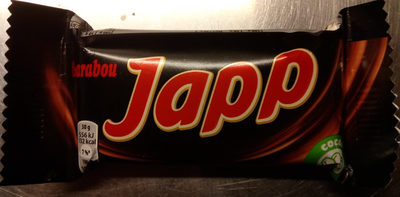
Japp
Barcode 7040110663408
Marabou, Mondelez

Japp

30 g
BARCODE:7040110663408
COMMON NAME:Mjölkchoklad fylld med mjuk chokladmaräng 50% och kola 20%
CATEGORIES:Snacks, Sweet Snacks, Cocoa And Its Products, Confectioneries, Bars, Chocolate Candies, Bonbons, Candy Chocolate Bars, Caramel Chocolate Bars
LABELS:Cocoa Life
PACKAGING:Plastic, Pp Polypropylene, Green Dot
COUNTRIES:France, Sweden
STORES:Coop Konsum

Health

Nutrition

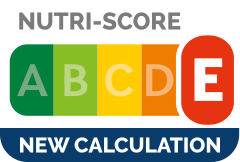
Nutri-Score

ELower nutritional quality

Nutri-Score data warning

Warning: the amount of fruits, vegetables and nuts is not specified on the label, it was estimated from the list of ingredients: 0

Nutrient levels

Fat in moderate quantity (15%)
What you need to know • A high consumption of fat, especially saturated fats, can raise cholesterol, which increases the risk of heart diseases. Recommendation: Limit the consumption of fat and saturated fat • Choose products with lower fat and saturated fat content. Source: National Health Service UK (NHS) - Fat: the facts
Saturated fat in high quantity (8.8%)
What you need to know • A high consumption of fat, especially saturated fats, can raise cholesterol, which increases the risk of heart diseases. Recommendation: Limit the consumption of fat and saturated fat • Choose products with lower fat and saturated fat content. Source: National Health Service UK (NHS) - Fat: the facts
Sugars in high quantity (52%)
What you need to know • A high consumption of sugar can cause weight gain and tooth decay. It also augments the risk of type 2 diabetes and cardio-vascular diseases. Recommendation: Limit the consumption of sugar and sugary drinks • Sugary drinks (such as sodas, fruit beverages, and fruit juices and nectars) should be limited as much as possible (no more than 1 glass a day). • Choose products with lower sugar content and reduce the consumption of products with added sugars. Source: National Health Service UK (NHS) - Sugar: the facts
Salt in low quantity (0.18%)
What you need to know • A high consumption of salt (or sodium) can cause raised blood pressure, which can increase the risk of heart disease and stroke. • Many people who have high blood pressure do not know it, as there are often no symptoms. • Most people consume too much salt (on average 9 to 12 grams per day), around twice the recommended maximum level of intake. Recommendation: Limit the consumption of salt and salted food • Reduce the quantity of salt used when cooking, and don't salt again at the table. • Limit the consumption of salty snacks and choose products with lower salt content. Source: World Health Organization (WHO) - Fact sheet - Salt reduction Source: National Health Service UK (NHS) - Salt: the facts

Nutrition label

Japp nutrition label

Nutrition facts

Nutrition factsAs sold for 100 g / 100 mlCompared to: caramel-chocolate-bars
Energy~ 1843.9 kJ (441 kcal)2,006.449 kJ (475 kcal) (-8%)
Fat15 g22.927 g (-35%)
Saturated fat8.8 g12.172 g (-28%)
Carbohydrates72 g58.401 g (+23%)
Sugars52 g46.153 g (+13%)
Dietary fiber1.1 g?
Proteins3.3 g6.593 g (-50%)
Salt0.18 g0.436 g (-59%)
Sodium0.072 g0.177 g (-59%)
Fruits, vegetables and legumes~ 0 %?

Nutrition facts (Detailed data)

Nutrition factsAs sold for 100 g / 100 mlAs sold Per 100 g (packaging)As sold Per 100 g (estimate)
Energy~ 1843.9 kJ (441 kcal)? (441 kcal)~ 1548.57795715332 kJ (365 kcal)
Fat15 g15 g~ 10.313604927063 g
Saturated fat8.8 g8.8 g~ 2.92389678955078 g
Carbohydrates72 g72 g~ 77.3950071334839 g
Sugars52 g52 g~ 77.3764780044556 g
Dietary fiber1.1 g1.1 g~ 0.0135040283203125 g
Proteins3.3 g3.3 g~ 0.653855895996094 g
Salt0.18 g0.18 g~ 0.0259628356933594 g
Sodium0.072 g0.072 g~ 0.0102847354125977 g
Fruits, vegetables and legumes~ 0 %?~ 0 %

Ingredients

Ingredients image

Japp ingredients image

Ingredients list

sugar, glucose syrup, sockrad condensed skimmed milk , palm oil, cocoa butter, cocoa mass, skimmed milk powder , stabiliser (sorbitol), whey powder ( milk ), invert sugar, fettreducerad cocoa powder, butter fat , malt extract from barley , egg whites , emulsifiers ( soy lecithin , solroslecitin, e476), flavourings,

Ingredient information

Sugar
53.13% (estimate)
Glucose Syrup
23.44% (estimate)
Sweetened Condensed Skimmed Milk
11.72% (estimate)
Palm Oil
5.86% (estimate)
Cocoa Butter
2.93% (estimate)
Cocoa Paste
1.46% (estimate)
Skimmed Milk Powder
0.73% (estimate)
Stabiliser
0.37% (estimate)
E420
0.37% (estimate)
Whey Powder
0.18% (estimate)
Invert Sugar
0.09% (estimate)
Fat Reduced Cocoa
0.05% (estimate)
Butterfat
0.02% (estimate)
Barley Malt Extract
0.01% (estimate)
Egg White
0.01% (estimate)
Emulsifier
0% (estimate)
Soya Lecithin
0% (estimate)
Sunflower Lecithin
0% (estimate)
E476
0% (estimate)
Flavouring
0% (estimate)

Added sugars

Contains added sugars (52%) Added sugars: sugar, glucose syrup, invert sugar Quantity of added sugars: 52%

Allergens

EggsGlutenMilkSoybeans

Traces

GlutenNutsPeanuts

Ingredients analysis

Palm oil free
No

Contains ingredients containing palm oil.

Vegan
No

Contains non-vegan ingredients.

Unrecognized: en:invert-sugar

Vegetarian
Unknown

Vegetarian status unknown

Unrecognized: en:invert-sugar


Food Processing

NOVA group

4Ultra-processed food and drink products

Elements that indicate the product is in NOVA group 4

Additives
E420 - Sorbitol
Additives
E476 - Polyglycerol polyricinoleate
Ingredients
Emulsifier
Ingredients
Flavouring
Ingredients
Glucose
Ingredients
Glucose Syrup
Ingredients
Invert Sugar
Ingredients
Whey

How NOVA works

The NOVA classification assigns food products into 4 groups based on their degree of processing: 1. Unprocessed or minimally processed foods 2. Processed culinary ingredients 3. Processed foods 4. Ultra-processed food and drink products

Additives

E420 - SorbitolHumectantSequestrantStabiliserSweetenerThickener

Sorbitol (), less commonly known as glucitol (), is a sugar alcohol with a sweet taste which the human body metabolizes slowly. It can be obtained by reduction of glucose, which changes the aldehyde group to a hydroxyl group. Most sorbitol is made from corn syrup, but it is also found in nature, for example in apples, pears, peaches, and prunes. It is converted to fructose by sorbitol-6-phosphate 2-dehydrogenase. Sorbitol is an isomer of mannitol, another sugar alcohol; the two differ only in the orientation of the hydroxyl group on carbon 2. While similar, the two sugar alcohols have very different sources in nature, melting points, and uses.

E476 - Polyglycerol polyricinoleateEmulsifier

Polyglycerol polyricinoleate (PGPR), E476, is an emulsifier made from glycerol and fatty acids (usually from castor bean, but also from soybean oil). In chocolate, compound chocolate and similar coatings, PGPR is mainly used with another substance like lecithin to reduce viscosity. It is used at low levels (below 0.5%), and works by decreasing the friction between the solid particles (e.g. cacao, sugar, milk) in molten chocolate, reducing the yield stress so that it flows more easily, approaching the behaviour of a Newtonian fluid. It can also be used as an emulsifier in spreads and in salad dressings, or to improve the texture of baked goods. It is made up of a short chain of glycerol molecules connected by ether bonds, with ricinoleic acid side chains connected by ester bonds. PGPR is a yellowish, viscous liquid, and is strongly lipophilic: it is soluble in fats and oils and insoluble in water and ethanol.

Environment

Green-Score, origins bonus, and transportation impact are shown for Worldwide .

Green Score

Overall grade

UnknownUnknown environmental impact

About Green-Score

The Green-Score is an experimental score that summarizes the environmental impacts of food products.

Current scope

The Green-Score was initially developed for France and it is being extended to other European countries. The Green-Score formula is subject to change as it is regularly improved to make it more precise and better suited to each country. Select a country to include the full impact of transportation in the final score.

Green-Score availability

We could not compute the Green-Score of this product because some data is missing. A more precise category, ingredients list, origins or packaging data can unlock the computation.

Bonuses and maluses

Declared origins

Origins of ingredients are missing for this product. Ingredients need to be completed before the transportation bonus can be computed precisely.

Threatened species risk

Contains ingredients that may threaten species or ecosystems, such as palm oil.

Packaging impact

Packaging with a medium impact Malus: -8 Packaging score: +21

Packaging

Packaging impact

Packaging with a medium impact Malus: -8 Packaging score: +21

Packaging components

ShapeMaterialRecyclingImpact
UnknownPP 5 PolypropyleneUnknownHigh

Declared packaging

Plastic, Pp Polypropylene, Green Dot

Data precision

The packaging information is not sufficiently precise to compute the most accurate packaging impact. Exact shapes and materials of all packaging components help improve the Green-Score.

Transportation

Declared origins

Origins of ingredients are missing for this product. Ingredients need to be completed before the transportation bonus can be computed precisely.

Forest footprint

Forest footprint

Total forest footprint: 0.00 m2 per kg of food This estimate highlights ingredients that depend on soy-linked animal feed and deforestation risk.

Ingredients linked to forest pressure

IngredientTypePercent in productForest footprint
EGG WhiteOeufs Importés0.01 %0.00

Data Source

Product data comes from Open Food Facts. Food Benchmark also adds translations, category comparisons and explanatory calculations.

The database is licensed under ODbL 1.0, individual contents under DbCL 1.0, and product photos under CC BY-SA 3.0.

Product added on January 17, 2018 at 10:29:51 AM UTC by olofolleola4 .

Last edit on March 17, 2026 at 10:12:22 AM UTC by new-nutrition-bot .

Product page also edited by inf, jumati, kiliweb, moon-rabbit, new-nutrition-bot, olofolleola4, openfoodfacts-contributors, packbot, patrick90126, yuka.WXBJdkhJQWJtL3dXc3MwbHBSSFA1dFJzbTRMM1FGSHBGOVEzSVE9PQ.