

Doritos sweet chili pepper 45g
Health
Nutrition
Nutri-Score
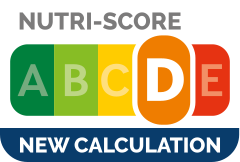 Lower nutritional quality
Nutrient levels
Fat in high quantity (21%)
Saturated fat in high quantity (8.3%)
Sugars in low quantity (3.1%)
Salt in moderate quantity (1.28%)
Nutrition label

Nutrition facts
| Nutrition facts | As sold for 100 g / 100 ml | Compared to: Corn chips |
|---|---|---|
| Energy | ~ 2005.1 kJ (464 kcal) | 2,043.711 kJ (488 kcal) (-2%) |
| Fat | 21 g | 23 g (-9%) |
| Saturated fat | 8.3 g | 3.2 g (+159%) |
| Carbohydrates | 63 g | 61.293 g (+3%) |
| Sugars | 3.1 g | 2.138 g (+45%) |
| Dietary fiber | 5.4 g | ? |
| Proteins | 6.7 g | 6.614 g (+1%) |
| Salt | 1.2825 g | 1.218 g (+5%) |
| Sodium | 0.513 g | 0.486 g (+6%) |
| Fruits, vegetables and legumes | ~ 1.55 % | ? |
Nutrition facts (Detailed data)
| Nutrition facts | As sold for 100 g / 100 ml | As sold Per 100 g (packaging) | As sold Per 100 g (estimate) |
|---|---|---|---|
| Energy | ~ 2005.1 kJ (464 kcal) | ? (464 kcal) | ? |
| Fat | 21 g | 21 g | ? |
| Saturated fat | 8.3 g | 8.3 g | ? |
| Carbohydrates | 63 g | 63 g | ? |
| Sugars | 3.1 g | 3.1 g | ? |
| Dietary fiber | 5.4 g | 5.4 g | ? |
| Proteins | 6.7 g | 6.7 g | ? |
| Salt | 1.2825 g | 1.2825 g | ? |
| Sodium | 0.513 g | 0.513 g | ? |
| Fruits, vegetables and legumes | ~ 1.55 % | ? | ~ 1.55 % |
Serving size
Ingredients
Ingredients image

Ingredients list
Ingredient information
Added sugars
Allergens
Ingredients analysis
No ingredients containing palm oil.
Vegan status unknown
Unrecognized: en:fruit-palm, en:maize-germ, en:c, en:contains-phenylalanine
Vegetarian status unknown
Unrecognized: en:fruit-palm, en:maize-germ, en:c, en:contains-phenylalanine
Food Processing
NOVA group
 Ultra-processed food and drink products
Elements that indicate the product is in NOVA group 4
How NOVA works
Additives
E110 - Sunset yellow FCFColour
Sunset Yellow FCF (also known as Orange Yellow S, or C.I. 15985) is a petroleum-derived orange azo dye with a pH dependent maximum absorption at about 480 nm at pH 1 and 443 nm at pH 13 with a shoulder at 500 nm. When added to foods sold in the US it is known as FD&C Yellow 6; when sold in Europe, it is denoted by E Number E110.
E122 - Azorubine EFSA overexposure risk: noColour
Azorubine is an azo dye produced as a disodium salt. In its dry form, the product appears red to maroon. It is mainly used in foods which are heat-treated after fermentation. It has E number E122.
E160c - Paprika extractColour
No additive description is available yet.
E262 - Sodium acetatesPreservativeSequestrant
SODIUM ACETATE, also abbreviated NaOAc,[8] is the sodium salt of acetic acid.
E296 - Malic acid
MALIC ACID is an organic compound with the molecular formula C4H6O5. Malic acid has two stereoisomeric forms (L- and D-enantiomers), though only the L-isomer exists naturally.
E319 - Tertiary-butylhydroquinone (tbhq)Antioxidant
tert-Butylhydroquinone (TBHQ, tertiary butylhydroquinone) is a synthetic aromatic organic compound which is a type of phenol. It is a derivative of hydroquinone, substituted with a tert-butyl group.
E341 - Calcium phosphates EFSA overexposure risk: highEmulsifierHumectantSequestrantStabiliserThickener
Calcium phosphate is a family of materials and minerals containing calcium ions (Ca2+) together with inorganic phosphate anions. Some so-called calcium phosphates contain oxide and hydroxide as well. They are white solids of nutritious value.
E508 - Potassium chloride EFSA overexposure risk: moderateStabiliserThickenerPreservative
Potassium chloride (KCl) is a metal halide salt composed of potassium and chlorine. It is odorless and has a white or colorless vitreous crystal appearance. The solid dissolves readily in water and its solutions have a salt-like taste. KCl is used as a fertilizer, in medicine, in scientific applications, and in food processing. In a few states of the United States it is used to cause cardiac arrest as the third drug in the "three drug cocktail" for executions by lethal injection. It occurs naturally as the mineral sylvite, and in combination with sodium chloride as sylvinite.The version for injection is on the World Health Organization's List of Essential Medicines, the most important medications needed in a basic health system.
E551 - Silicon dioxideCarrier
Silicon dioxide, also known as silica, silicic acid or silicic acid anydride is an oxide of silicon with the chemical formula SiO2, most commonly found in nature as quartz and in various living organisms. In many parts of the world, silica is the major constituent of sand. Silica is one of the most complex and most abundant families of materials, existing as a compound of several minerals and as synthetic product. Notable examples include fused quartz, fumed silica, silica gel, and aerogels. It is used in structural materials, microelectronics (as an electrical insulator), and as components in the food and pharmaceutical industries. Inhaling finely divided crystalline silica is toxic and can lead to severe inflammation of the lung tissue, silicosis, bronchitis, lung cancer, and systemic autoimmune diseases, such as lupus and rheumatoid arthritis. Uptake of amorphous silicon dioxide, in high doses, leads to non-permanent short-term inflammation, where all effects heal.
E621 - Monosodium glutamate EFSA overexposure risk: highFlavour Enhancer
Monosodium glutamate (MSG), or E621, is the sodium salt of glutamic acid, an amino acid found naturally in many foods.
It is widely used as a flavor enhancer to provide an "umami" or savory taste to a variety of processed foods, including soups, snack chips, and frozen meals.
MSG is generally recognized as safe (GRAS) by food authorities. However, some people report sensitivity to MSG, experiencing short-term symptoms like headaches and flushing, though scientific studies have not shown a consistent link.
E627 - Disodium guanylate
Disodium guanylate, also known as sodium 5'-guanylate and disodium 5'-guanylate, is a natural sodium salt of the flavor enhancing nucleotide guanosine monophosphate (GMP). Disodium guanylate is a food additive with the E number E627. It is commonly used in conjunction with glutamic acid. As it is a fairly expensive additive, it is not used independently of glutamic acid; if disodium guanylate is present in a list of ingredients but MSG does not appear to be, it is likely that glutamic acid is provided as part of another ingredient such as a processed soy protein complex. It is often added to foods in conjunction with disodium inosinate; the combination is known as disodium 5'-ribonucleotides. Disodium guanylate is produced from dried seaweed and is often added to instant noodles, potato chips and other snacks, savory rice, tinned vegetables, cured meats, and packaged soup.
E631 - Disodium inosinate
Disodium inosinate (E631) is the disodium salt of inosinic acid with the chemical formula C10H11N4Na2O8P. It is used as a food additive and often found in instant noodles, potato chips, and a variety of other snacks. Although it can be obtained from bacterial fermentation of sugars, it is often commercially prepared from animal sources.
E951 - Aspartame EFSA overexposure risk: noSweetener
Aspartame (E951) is a low-calorie artificial sweetener composed of two amino acids.
It is used as a sugar substitute in thousands of "sugar-free" or "diet" products, such as carbonated soft drinks, chewing gum, yogurts, and tabletop sweeteners, to provide sweetness without the calories of sugar.
Despite being one of the most rigorously tested food additives, its safety remains controversial. While major regulatory bodies like the FDA and EFSA deem it safe for the general public, the IARC has classified it as "possibly carcinogenic to humans" (Group 2B). It must also be avoided by individuals with the genetic condition phenylketonuria (PKU).
Environment
Green-Score, origins bonus, and transportation impact are shown for Worldwide .
Green Score
Overall grade
 Low environmental impact
About Green-Score
Current scope
Life cycle analysis
Average impact of the category
 Corn chips or tortilla chips • Score: 83/100
Life-cycle reference
Overall environmental impact by stage (PEF)
The overall environmental impact figure (PEF) comes from ADEME's Agribalyse database, for the category: Corn chips or tortilla chips. Source: ADEME Agribalyse Database.
| Stage | Impact |
|---|---|
| Agriculture | 48.6 % |
| Processing | 14.7 % |
| Packaging | 27.3 % |
| Transportation | 7.3 % |
| Distribution | 2.1 % |
| Consumption | 0.0 % |
Bonuses and maluses
Declared origins
Packaging impact
Green-Score for this product
Green-Score for this product
Final score: 63/100Final score breakdown
Carbon footprint
Carbon footprint
Climate impact by stage (CO2e)
The carbon emission figure comes from ADEME's Agribalyse database, for the category: Corn chips or tortilla chips. Source: ADEME Agribalyse Database.
| Stage | Impact |
|---|---|
| Agriculture | 32.4 % |
| Processing | 10.0 % |
| Packaging | 46.8 % |
| Transportation | 9.9 % |
| Distribution | 1.2 % |
| Consumption | 0.0 % |
Packaging
Packaging impact
Declared packaging
Data precision
Transportation
Manufacturing locations
Declared origins
Forest footprint
Forest footprint
Deforestation risk details
Data Source
Product data comes from Open Food Facts. Food Benchmark also adds translations, category comparisons and explanatory calculations.
The database is licensed under ODbL 1.0, individual contents under DbCL 1.0, and product photos under CC BY-SA 3.0.
Product added on February 1, 2018 at 7:54:38 AM UTC by kiliweb .
Last edit on March 17, 2026 at 6:55:20 AM UTC by foodless .
Product page also edited by beniben, fix-serving-size-bot, foodless, harragastudios, inf, kiliweb, macrofactor, mkh350, openfoodfacts-contributors, packbot, quechoisir, yuka.RzdvN0RKd2QvOWd2aFBNZTVpNzM2dGdvbmNHNWVWcm1KZmc0SVE9PQ, yuka.sY2b0xO6T85zoF3NwEKvlhZ_CvH8gBPnDjrgkEOlnuucPLb6WdNv3IqlE6o.