
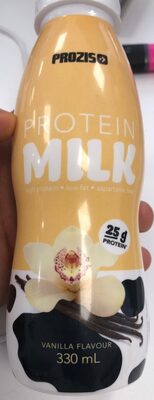
Protein milk vanilla
Health
Nutrition
Nutri-Score data warning
Nutrient levels
Fat in low quantity (0.5%)
Saturated fat in low quantity (0.1%)
Sugars in moderate quantity (3%)
Salt in moderate quantity (0.18%)
Nutrition label

Nutrition facts
| Nutrition facts | As sold for 100 ml | Compared to: Unsweetened beverages |
|---|---|---|
| Energy | 210 kJ (50 kcal) | 165.566 kJ (38 kcal) (+27%) |
| Fat | < 0.5 g | 0.215 g (+133%) |
| Saturated fat | 0.1 g | 0.041 g (+144%) |
| Carbohydrates | 3 g | 8.349 g (-64%) |
| Sugars | 3 g | 7.274 g (-59%) |
| Dietary fiber | ? | ? |
| Proteins | 7.6 g | 0.29 g (+2521%) |
| Salt | 0.18 g | 0.024 g (+650%) |
| Sodium | 0.072 g | 0.01 g (+620%) |
| Fruits, vegetables and legumes | ~ 0 % | ? |
Nutrition facts (Detailed data)
| Nutrition facts | As sold for 100 ml | As sold Per 100 ml (packaging) | As sold Per 100 g (estimate) |
|---|---|---|---|
| Energy | 210 kJ (50 kcal) | 210 kJ (50 kcal) | ? |
| Fat | < 0.5 g | < 0.5 g | ? |
| Saturated fat | 0.1 g | 0.1 g | ? |
| Carbohydrates | 3 g | 3 g | ? |
| Sugars | 3 g | 3 g | ? |
| Dietary fiber | ? | ? | ? |
| Proteins | 7.6 g | 7.6 g | ? |
| Salt | 0.18 g | 0.18 g | ? |
| Sodium | 0.072 g | 0.072 g | ? |
| Fruits, vegetables and legumes | ~ 0 % | ? | ~ 0 % |
Ingredients
Ingredients image
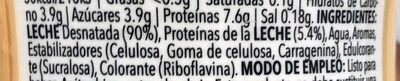
Ingredients list
Ingredient information
Allergens
Ingredients analysis
No ingredients containing palm oil.
Contains non-vegan ingredients.
Vegetarian status unknown
Food Processing
NOVA group
 Ultra-processed food and drink products
Elements that indicate the product is in NOVA group 4
How NOVA works
Additives
E101 - RiboflavinColour
Riboflavin, also known as vitamin B2, is a vitamin found in food and used as a dietary supplement. Food sources include eggs, green vegetables, milk and other dairy product, meat, mushrooms, and almonds. Some countries require its addition to grains. As a supplement it is used to prevent and treat riboflavin deficiency and prevent migraines. It may be given by mouth or injection.It is nearly always well tolerated. Normal doses are safe during pregnancy. Riboflavin is in the vitamin B group. It is required by the body for cellular respiration.Riboflavin was discovered in 1920, isolated in 1933, and first made in 1935. It is on the World Health Organization's List of Essential Medicines, the most effective and safe medicines needed in a health system. Riboflavin is available as a generic medication and over the counter. In the United States a month of supplements costs less than 25 USD.
E101i - RiboflavinColour
No additive description is available yet.
E407 - Carrageenan EFSA overexposure risk: highCarrierEmulsifierHumectantStabiliserThickener
Carrageenan (E407), derived from red seaweed, is widely employed in the food industry as a gelling, thickening, and stabilizing agent, notably in dairy and meat products.
It can exist in various forms, each imparting distinct textural properties to food.
However, its degraded form, often referred to as poligeenan, has raised health concerns due to its potential inflammatory effects and its classification as a possible human carcinogen (Group 2B) by the International Agency for Research on Cancer (IARC).
Nevertheless, food-grade carrageenan has been deemed safe by various regulatory bodies when consumed in amounts typically found in food.
E460 - CelluloseCarrierEmulsifierHumectantStabiliserThickener
CELLULOSE is an organic compound with the formula (C6H10O5)n, a polysaccharide consisting of a linear chain of several hundred to many thousands of linked D-glucose units. Cellulose is used as emulsifier, thickener and stabilizer in processed foods. Cellulose powder is, for example, used in processed cheese to prevent caking inside the package.
E466 - Sodium carboxy methyl celluloseEmulsifierHumectantStabiliserThickener
Carboxymethyl cellulose (CMC) or cellulose gum or tylose powder is a cellulose derivative with carboxymethyl groups (-CH2-COOH) bound to some of the hydroxyl groups of the glucopyranose monomers that make up the cellulose backbone. It is often used as its sodium salt, sodium carboxymethyl cellulose.
E955 - SucraloseSweetener
Sucralose is an artificial sweetener and sugar substitute. The majority of ingested sucralose is not broken down by the body, so it is noncaloric. In the European Union, it is also known under the E number E955. It is produced by chlorination of sucrose. Sucralose is about 320 to 1,000 times sweeter than sucrose, three times as sweet as both aspartame and acesulfame potassium, and twice as sweet as sodium saccharin. Evidence of benefit is lacking for long-term weight loss with some data supporting weight gain and heart disease risks.It is stable under heat and over a broad range of pH conditions. Therefore, it can be used in baking or in products that require a long shelf life. The commercial success of sucralose-based products stems from its favorable comparison to other low-calorie sweeteners in terms of taste, stability, and safety. Common brand names of sucralose-based sweeteners are Splenda, Zerocal, Sukrana, SucraPlus, Candys, Cukren, and Nevella. Canderel Yellow also contains sucralose, but the original Canderel and Green Canderel do not.
Environment
Green-Score, origins bonus, and transportation impact are shown for Worldwide .
Green Score
Overall grade
 High environmental impact
About Green-Score
Current scope
Life cycle analysis
Average impact of the category
 Milk, semi-skimmed, UHT • Score: 58/100
Life-cycle reference
Overall environmental impact by stage (PEF)
The overall environmental impact figure (PEF) comes from ADEME's Agribalyse database, for the category: Milk, semi-skimmed, UHT. Source: ADEME Agribalyse Database.
| Stage | Impact |
|---|---|
| Agriculture | 74.8 % |
| Processing | 1.3 % |
| Packaging | 7.0 % |
| Transportation | 13.4 % |
| Distribution | 3.9 % |
| Consumption | 0.0 % |
Bonuses and maluses
Declared origins
Packaging impact
Green-Score for this product
Green-Score for this product
Final score: 38/100Final score breakdown
Carbon footprint
Carbon footprint
Climate impact by stage (CO2e)
The carbon emission figure comes from ADEME's Agribalyse database, for the category: Milk, semi-skimmed, UHT. Source: ADEME Agribalyse Database.
| Stage | Impact |
|---|---|
| Agriculture | 73.5 % |
| Processing | 1.0 % |
| Packaging | 7.6 % |
| Transportation | 17.0 % |
| Distribution | 1.3 % |
| Consumption | 0.0 % |
Packaging
Packaging impact
Data precision
Transportation
Declared origins
Forest footprint
Forest footprint
Deforestation risk details
Data Source
Product data comes from Open Food Facts. Food Benchmark also adds translations, category comparisons and explanatory calculations.
The database is licensed under ODbL 1.0, individual contents under DbCL 1.0, and product photos under CC BY-SA 3.0.
Product added on May 16, 2018 at 12:48:37 PM UTC by kiliweb .
Last edit on March 17, 2026 at 10:21:55 AM UTC by new-nutrition-bot .
Product page also edited by elcoco, feat, flipwared, foodvisor, kiliweb, new-nutrition-bot, openfoodfacts-contributors, teolemon, thaialagata, yuka.C6ISOuLWPPMrDMSMzoEEg2blLsXAPOMAHFInog, yuka.EYpGJcW2O5wMBcGDyJxqgRmQN9e4GPN-QVRcog, yuka.NJpvAfCHQfV4DvT_7Lw6hwScE_3MB9ECHHhWog, yuka.WXFJckxhY0J1K014bzhVUTNqUDMxZU55emFLb2RqcUZOT1FVSVE9PQ, yuka.XLxyP4KJOdB-O8Tb3Ngy5GSqTffuDudfAnIjog.