

Alpro Soja-Joghurtalternative Himbeere-Cranberry, 150g, cup
Health
Nutrition
Nutri-Score
 Very good nutritional quality
Nutri-Score data warning
Nutrient levels
Fat in low quantity (1.9%)
Saturated fat in low quantity (0.3%)
Sugars in moderate quantity (9.5%)
Salt in low quantity (0.22%)
Nutrition label

Nutrition facts
| Nutrition facts | As sold for 100 g / 100 ml |
|---|---|
| Energy | 322 kJ (76 kcal) |
| Fat | 1.9 g |
| Saturated fat | 0.3 g |
| Monounsaturated fat | 0 g |
| Polyunsaturated fat | 0 g |
| Trans fat | 0 g |
| Cholesterol | 0 g |
| Carbohydrates | 9.7 g |
| Sugars | 9.5 g |
| Added sugars | 0 g |
| Starch | 0 g |
| Dietary fiber | 1.1 g |
| Proteins | 3.6 g |
| Salt | 0.22 g |
| Sodium | 0.088 g |
| Alcohol | 0 % vol |
| Vitamin A | 0 g |
| Vitamin D | 0.00000075 g |
| Vitamin E | 0 g |
| Vitamin K | 0 g |
| Vitamin C | 0 g |
| Potassium | 0 g |
| Calcium | 0.12 g |
| Phosphorus | 0 g |
| Iron | 0 g |
| Magnesium | 0 g |
| Zinc | 0 g |
| Copper | 0 g |
| Manganese | 0 g |
| Selenium | 0 g |
| Caffeine | 0 g |
| Fruits, vegetables and legumes | ~ 61.7 % |
| Choline | 0 g |
Nutrition facts (Detailed data)
| Nutrition facts | As sold for 100 g / 100 ml | As sold Per 100 g (packaging) | As sold Per 100 g (estimate) |
|---|---|---|---|
| Energy | 322 kJ (76 kcal) | 322 kJ (76 kcal) | ~ 384.059 kJ (90 kcal) |
| Fat | 1.9 g | 1.9 g | ~ 2.0236 g |
| Saturated fat | 0.3 g | 0.3 g | ~ 0.026195 g |
| Monounsaturated fat | 0 g | 0 g | ? |
| Polyunsaturated fat | 0 g | 0 g | ? |
| Trans fat | 0 g | 0 g | ? |
| Cholesterol | 0 g | 0 g | ~ 0 g |
| Carbohydrates | 9.7 g | 9.7 g | ~ 23.302045 g |
| Sugars | 9.5 g | 9.5 g | ~ 21.90881 g |
| Added sugars | 0 g | 0 g | ~ 20.15 g |
| Starch | 0 g | 0 g | ~ 1.22937 g |
| Dietary fiber | 1.1 g | 1.1 g | ~ 2.12745 g |
| Proteins | 3.6 g | 3.6 g | ~ 3.586285 g |
| Salt | 0.22 g | 0.22 g | ~ 0.00688505 g |
| Sodium | 0.088 g | 0.088 g | ~ 0.002432005 g |
| Alcohol | 0 % vol | 0 % vol | ~ 0 % vol |
| Vitamin A | 0 g | 0 g | ~ 0 g |
| Vitamin D | 0.00000075 g | 0.00000075 g | ~ 0 g |
| Vitamin E | 0 g | 0 g | ~ 0.00025977 g |
| Vitamin K | 0 g | 0 g | ? |
| Vitamin C | 0 g | 0 g | ~ 0.00435005 g |
| Potassium | 0 g | 0 g | ~ 0.20612025 g |
| Calcium | 0.12 g | 0.12 g | ~ 0.028872535 g |
| Phosphorus | 0 g | 0 g | ~ 0.0626855 g |
| Iron | 0 g | 0 g | ~ 0.0016340155 g |
| Magnesium | 0 g | 0 g | ~ 0.029398475 g |
| Zinc | 0 g | 0 g | ~ 0.00034404 g |
| Copper | 0 g | 0 g | ~ 0.00010302825 g |
| Manganese | 0 g | 0 g | ~ 0.00030955945 g |
| Selenium | 0 g | 0 g | ~ 0.0000032725 g |
| Caffeine | 0 g | 0 g | ? |
| Fruits, vegetables and legumes | ~ 61.7 % | ? | ~ 61.7 % |
| Choline | 0 g | 0 g | ? |
Ingredients
Ingredients image

Ingredients list
Ingredient information
Allergens
Traces
Ingredients analysis
Palm oil content unknown
No non-vegan ingredients.
Unrecognized: de:str, de:thermophilus, de:l, de:bulgaricus
No non-vegetarian ingredients.
Unrecognized: de:str, de:thermophilus, de:l, de:bulgaricus
Food Processing
NOVA group
 Ultra-processed food and drink products
Elements that indicate the product is in NOVA group 4
How NOVA works
Additives
E296 - Malic acid
MALIC ACID is an organic compound with the molecular formula C4H6O5. Malic acid has two stereoisomeric forms (L- and D-enantiomers), though only the L-isomer exists naturally.
E304 - Fatty acid esters of ascorbic acidAntioxidant
ASCORBYL PALMITATE is an ester formed from ascorbic acid and palmitic acid creating a fat-soluble form of vitamin C.
E306 - Tocopherol-rich extract
No additive description is available yet.
E330 - Citric acidAntioxidantSequestrant
Citric acid is a natural organic acid found in citrus fruits such as lemons, oranges, and limes.
It is widely used in the food industry as a flavor enhancer, acidulant, and preservative due to its tart and refreshing taste.
Citric acid is safe for consumption when used in moderation and is considered a generally recognized as safe (GRAS) food additive by regulatory agencies worldwide.
E331 - Sodium citratesEmulsifierSequestrantStabiliser
DISODIUM CITRATE, more properly, disodium hydrogen citrate, is an acid salt of citric acid with the chemical formula Na2C6H6O7. It is used as an antioxidant in food and to improve the effects of other antioxidants. It is also used as an acidity regulator and sequestrant. Typical products include gelatin, jam, sweets, ice cream, carbonated beverages, milk powder, wine, and processed cheeses.
E341 - Calcium phosphates EFSA overexposure risk: highEmulsifierHumectantSequestrantStabiliserThickener
Calcium phosphate is a family of materials and minerals containing calcium ions (Ca2+) together with inorganic phosphate anions. Some so-called calcium phosphates contain oxide and hydroxide as well. They are white solids of nutritious value.
E341iii - Tricalcium phosphateEmulsifierHumectantSequestrantStabiliserThickener
No additive description is available yet.
E440 - PectinsEmulsifierStabiliserThickener
Pectins (E440) are natural carbohydrates, predominantly found in fruits, that act as gelling agents in the food industry, creating the desirable jelly-like texture in jams, jellies, and marmalades.
Pectins stabilize and thicken various food products, such as desserts, confectioneries, and beverages, ensuring a uniform consistency and quality.
Recognized as safe by various health authorities, pectins have been widely used without notable adverse effects when consumed in typical dietary amounts.
Environment
Green-Score, origins bonus, and transportation impact are shown for Worldwide .
Green Score
Overall grade
 Very low environmental impact
About Green-Score
Current scope
Life cycle analysis
Average impact of the category
 Soy dessert, plain, refrigerated • Score: 96/100
Life-cycle reference
Overall environmental impact by stage (PEF)
The overall environmental impact figure (PEF) comes from ADEME's Agribalyse database, for the category: Soy dessert, plain, refrigerated. Source: ADEME Agribalyse Database.
| Stage | Impact |
|---|---|
| Agriculture | 16.2 % |
| Processing | 28.1 % |
| Packaging | 30.5 % |
| Transportation | 15.5 % |
| Distribution | 7.7 % |
| Consumption | 2.1 % |
Bonuses and maluses
Declared origins
Packaging impact
Green-Score for this product
Green-Score for this product
Final score: 79/100Final score breakdown
Carbon footprint
Carbon footprint
Climate impact by stage (CO2e)
The carbon emission figure comes from ADEME's Agribalyse database, for the category: Soy dessert, plain, refrigerated. Source: ADEME Agribalyse Database.
| Stage | Impact |
|---|---|
| Agriculture | 12.6 % |
| Processing | 19.4 % |
| Packaging | 42.8 % |
| Transportation | 21.0 % |
| Distribution | 3.5 % |
| Consumption | 0.6 % |
Packaging
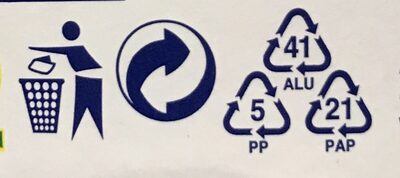
Packaging impact
Packaging components
| Shape | Material | Recycling | Impact |
|---|---|---|---|
| Unknown | Heavy Aluminium | Unknown | Medium |
| Unknown | PP 5 Polypropylene | Unknown | High |
| Unknown | Paper | Unknown | Low |
| Unknown | NON Corrugated Cardboard | Unknown | Low |
Declared packaging
Data precision
Transportation
Declared origins
Additional information
- Conservation conditions
- Gekühlt aufbewahren bei max. 7°C.
Data Source
Product data comes from Open Food Facts. Food Benchmark also adds translations, category comparisons and explanatory calculations.
The database is licensed under ODbL 1.0, individual contents under DbCL 1.0, and product photos under CC BY-SA 3.0.
Product added on March 28, 2018 at 6:45:37 PM UTC by kiliweb .
Last edit on March 17, 2026 at 10:08:47 AM UTC by foodless .
Product page also edited by anticultist, date-limite-app, derthas, ecoscore-impact-estimator, foodless, inf, joe44, kiliweb, lbe-dev, moon-rabbit, municorn-calorie-counter-app, openfoodfacts-contributors, org-danone-gmbh, packbot, risajanda, roboto-app, scanbot, tacite-mass-editor, yuka.ZVo4eEhycFFtZnNUbDhZQTB3eVB3WUpzN29HN1hIaTdPK3NCSWc9PQ, yuka.sY2b0xO6T85zoF3NwEKvlnZGTeP6uj3pEhLSoEeim9qUIqLGPckvyIfBK6s.
Source List
- danone-gmbh