

Smiths Scampi & Lemon Snacks
Health
Nutrition
Nutri-Score
 Lower nutritional quality
Nutrient levels
Fat in high quantity (23%)
Saturated fat in moderate quantity (2.22%)
Sugars in high quantity (44.4%)
Salt in high quantity (2.81%)
Nutrition label
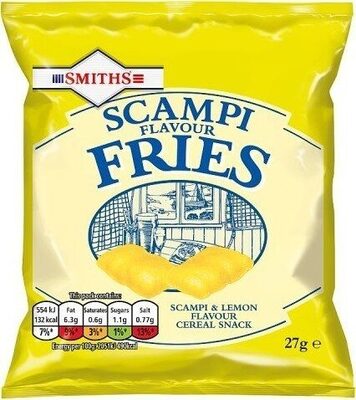
Nutrition facts
| Nutrition facts | As sold for 100 g / 100 ml | Compared to: Flavoured corn crisps |
|---|---|---|
| Energy | ~ 2053.7037037037 kJ (485 kcal) | 2,070.715 kJ (490 kcal) (-1%) |
| Fat | 22.962962962963 g | 23.895 g (-4%) |
| Saturated fat | 2.22222222222222 g | 3.931 g (-43%) |
| Carbohydrates | 59.2592592592593 g | 59.825 g (-1%) |
| Sugars | 44.4444444444444 g | 3.183 g (+1296%) |
| Dietary fiber | 3.33333333333333 g | ? |
| Proteins | 10 g | 6.937 g (+44%) |
| Salt | 2.80555555555556 g | 1.426 g (+97%) |
| Sodium | 1.12222222222222 g | 0.58 g (+93%) |
| Fruits, vegetables and legumes | ~ 0 % | ? |
Nutrition facts (Detailed data)
| Nutrition facts | As sold for 100 g / 100 ml | As sold Per serving (27 g) (packaging) | As sold Per 100 g (estimate) |
|---|---|---|---|
| Energy | ~ 2053.7037037037 kJ (485 kcal) | ? (131 kcal) | ~ 2687.32421875 kJ (650 kcal) |
| Fat | 22.962962962963 g | 6.2 g | ~ 57.622587890625 g |
| Saturated fat | 2.22222222222222 g | 0.6 g | ~ 6.5434990234375 g |
| Carbohydrates | 59.2592592592593 g | 16 g | ~ 27.346484375 g |
| Sugars | 44.4444444444444 g | 12 g | ~ 1.8055078125 g |
| Dietary fiber | 3.33333333333333 g | 0.9 g | ~ 2.559375 g |
| Proteins | 10 g | 2.7 g | ~ 4.303095703125 g |
| Salt | 2.80555555555556 g | 0.7575 g | ~ 0.4173076171875 g |
| Sodium | 1.12222222222222 g | 0.303 g | ~ 0.16570078125 g |
| Fruits, vegetables and legumes | ~ 0 % | ? | ~ 0 % |
Serving size
Ingredients
Ingredients image

Ingredients list
Ingredient information
Added sugars
Allergens
Traces
Ingredients analysis
No ingredients containing palm oil.
Contains non-vegan ingredients.
Unrecognized: en:s-ifg-sund-151224l1
Vegetarian status unknown
Food Processing
NOVA group
 Ultra-processed food and drink products
Elements that indicate the product is in NOVA group 4
How NOVA works
Additives
E100 - CurcuminColour
No additive description is available yet.
E160b - AnnattoColour
No additive description is available yet.
E160bii - Annatto norbixinColour
No additive description is available yet.
E330 - Citric acidAntioxidantSequestrant
Citric acid is a natural organic acid found in citrus fruits such as lemons, oranges, and limes.
It is widely used in the food industry as a flavor enhancer, acidulant, and preservative due to its tart and refreshing taste.
Citric acid is safe for consumption when used in moderation and is considered a generally recognized as safe (GRAS) food additive by regulatory agencies worldwide.
E508 - Potassium chloride EFSA overexposure risk: moderateStabiliserThickenerPreservative
Potassium chloride (KCl) is a metal halide salt composed of potassium and chlorine. It is odorless and has a white or colorless vitreous crystal appearance. The solid dissolves readily in water and its solutions have a salt-like taste. KCl is used as a fertilizer, in medicine, in scientific applications, and in food processing. In a few states of the United States it is used to cause cardiac arrest as the third drug in the "three drug cocktail" for executions by lethal injection. It occurs naturally as the mineral sylvite, and in combination with sodium chloride as sylvinite.The version for injection is on the World Health Organization's List of Essential Medicines, the most important medications needed in a basic health system.
E621 - Monosodium glutamate EFSA overexposure risk: highFlavour Enhancer
Monosodium glutamate (MSG), or E621, is the sodium salt of glutamic acid, an amino acid found naturally in many foods.
It is widely used as a flavor enhancer to provide an "umami" or savory taste to a variety of processed foods, including soups, snack chips, and frozen meals.
MSG is generally recognized as safe (GRAS) by food authorities. However, some people report sensitivity to MSG, experiencing short-term symptoms like headaches and flushing, though scientific studies have not shown a consistent link.
Environment
Green-Score, origins bonus, and transportation impact are shown for Worldwide .
Green Score
Overall grade
 Low environmental impact
About Green-Score
Current scope
Life cycle analysis
Average impact of the category
 Corn chips or tortilla chips • Score: 83/100
Life-cycle reference
Overall environmental impact by stage (PEF)
The overall environmental impact figure (PEF) comes from ADEME's Agribalyse database, for the category: Corn chips or tortilla chips. Source: ADEME Agribalyse Database.
| Stage | Impact |
|---|---|
| Agriculture | 48.6 % |
| Processing | 14.7 % |
| Packaging | 27.3 % |
| Transportation | 7.3 % |
| Distribution | 2.1 % |
| Consumption | 0.0 % |
Bonuses and maluses
Declared origins
Packaging impact
Green-Score for this product
Green-Score for this product
Final score: 63/100Final score breakdown
Carbon footprint
Carbon footprint
Climate impact by stage (CO2e)
The carbon emission figure comes from ADEME's Agribalyse database, for the category: Corn chips or tortilla chips. Source: ADEME Agribalyse Database.
| Stage | Impact |
|---|---|
| Agriculture | 32.4 % |
| Processing | 10.0 % |
| Packaging | 46.8 % |
| Transportation | 9.9 % |
| Distribution | 1.2 % |
| Consumption | 0.0 % |
Packaging
Packaging impact
Data precision
Transportation
Declared origins
Forest footprint
Forest footprint
Deforestation risk details
Data Source
Product data comes from Open Food Facts. Food Benchmark also adds translations, category comparisons and explanatory calculations.
The database is licensed under ODbL 1.0, individual contents under DbCL 1.0, and product photos under CC BY-SA 3.0.
Product added on February 13, 2018 at 2:24:54 PM UTC by kiliweb .
Last edit on March 17, 2026 at 10:33:10 AM UTC by foodless .
Product page also edited by 2kind, chevalstar, cleek, foodless, garmyuc, kiliweb, macrofactor, openfoodfacts-contributors, roboto-app, scanbot, yuka.YXFFWkVyOVlxZXRXbzhSbDF4T0Uyb3RUMzRXdFUwYnZDKzBZSVE9PQ, yuka.sY2b0xO6T85zoF3NwEKvlhZOcoSFnhDFM0bgwROQw-jSC5PEStdf86P3MKg, yuka.sY2b0xO6T85zoF3NwEKvlkteQvHQnRTuFDrfl2qa6-e-Ar_IcdFMzaz6MKs.