

Shiro Miso Shiru
Health
Nutrition
Nutrition label
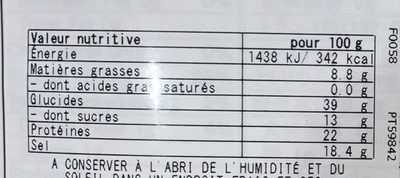
Nutrition facts
| Nutrition facts | As sold for 100 g / 100 ml | Compared to: Miso soup |
|---|---|---|
| Energy | ~ 1362.6 kJ (300 kcal) | 619.455 kJ (146 kcal) (+120%) |
| Fat | 8.8 g | 4.383 g (+101%) |
| Saturated fat | 0 g | 0.555 g (-100%) |
| Carbohydrates | 39 g | 15.565 g (+151%) |
| Sugars | 13 g | 6.204 g (+110%) |
| Dietary fiber | ? | ? |
| Proteins | 22 g | 9.091 g (+142%) |
| Salt | 18.1 g | 8.518 g (+112%) |
| Sodium | 7.24 g | 3.401 g (+113%) |
| Fruits, vegetables and legumes | ~ 20.8333333333333 % | ? |
Nutrition facts (Detailed data)
| Nutrition facts | As sold for 100 g / 100 ml | As sold Per 100 g (packaging) | As sold Per 100 g (estimate) |
|---|---|---|---|
| Energy | ~ 1362.6 kJ (300 kcal) | ? (300 kcal) | ? |
| Fat | 8.8 g | 8.8 g | ? |
| Saturated fat | 0 g | 0 g | ? |
| Carbohydrates | 39 g | 39 g | ? |
| Sugars | 13 g | 13 g | ? |
| Dietary fiber | ? | ? | ? |
| Proteins | 22 g | 22 g | ? |
| Salt | 18.1 g | 18.1 g | ? |
| Sodium | 7.24 g | 7.24 g | ? |
| Fruits, vegetables and legumes | ~ 20.8333333333333 % | ? | ~ 20.8333333333333 % |
Ingredients
Ingredients image

Ingredients list
Ingredient information
Allergens
Ingredients analysis
No ingredients containing palm oil.
Unrecognized: fr:blanc, fr:77e, fr:poudre-poisson-xhaij-epaississant-e415
Vegan status unknown
Unrecognized: fr:blanc, fr:77e, fr:poudre-poisson-xhaij-epaississant-e415
Vegetarian status unknown
Unrecognized: fr:blanc, fr:77e, fr:poudre-poisson-xhaij-epaississant-e415
Food Processing
NOVA group
 Ultra-processed food and drink products
Elements that indicate the product is in NOVA group 4
How NOVA works
Additives
E1400 - DextrinCarrierEmulsifierStabiliserThickener
Dextrins are a group of low-molecular-weight carbohydrates produced by the hydrolysis of starch or glycogen. Dextrins are mixtures of polymers of D-glucose units linked by α-(1→4) or α-(1→6) glycosidic bonds. Dextrins can be produced from starch using enzymes like amylases, as during digestion in the human body and during malting and mashing, or by applying dry heat under acidic conditions (pyrolysis or roasting). The latter process is used industrially, and also occurs on the surface of bread during the baking process, contributing to flavor, color and crispness. Dextrins produced by heat are also known as pyrodextrins. The starch hydrolyses during roasting under acidic conditions, and short-chained starch parts partially rebranch with α-(1,6) bonds to the degraded starch molecule. See also Maillard Reaction. Dextrins are white, yellow, or brown powders that are partially or fully water-soluble, yielding optically active solutions of low viscosity. Most of them can be detected with iodine solution, giving a red coloration; one distinguishes erythrodextrin (dextrin that colours red) and achrodextrin (giving no colour). White and yellow dextrins from starch roasted with little or no acid are called British gum.
Environment
Green-Score, origins bonus, and transportation impact are shown for Worldwide .
Green Score
Overall grade
 Unknown environmental impact
About Green-Score
Current scope
Green-Score availability
Bonuses and maluses
Declared origins
Packaging impact
Packaging
Packaging impact
Data precision
Transportation
Declared origins
Forest footprint
Forest footprint
Deforestation risk details
Data Source
Product data comes from Open Food Facts. Food Benchmark also adds translations, category comparisons and explanatory calculations.
The database is licensed under ODbL 1.0, individual contents under DbCL 1.0, and product photos under CC BY-SA 3.0.
Product added on February 27, 2017 at 6:53:31 PM UTC by kiliweb .
Last edit on March 17, 2026 at 11:04:53 AM UTC by new-nutrition-bot .
Product page also edited by date-limite-app, kiliweb, laura-chaud, new-nutrition-bot, openfoodfacts-contributors, roboto-app, tacite, yuka.RzU4aUtyc0ZyS0V4cGNRaTEwdlMrZDV2M0xPQ1l6bWFLYllWSVE9PQ, yuka.U6l_Fv2JFfMxTML4w6wLzWS0D-C5JdZ9EnsdoQ.