
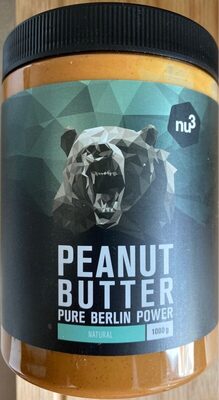
Beurre de cacahuète onctueux
Labels
 Very good nutritional quality
 Processed culinary ingredients
 High environmental impact
Health
Nutrition
Label
Very good nutritional qualityNutrient levels
Fat in high quantity (50%)
Saturated fat in high quantity (6.8%)
Sugars in low quantity (3.6%)
Salt in low quantity (0.02%)
Nutrition label
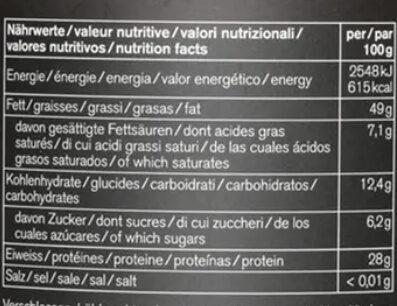
Nutrition facts
| Nutrition facts | As sold for 100 g / 100 ml |
|---|---|
| Energy | 2,498 kJ (597 kcal) |
| FAT | 50 g |
| Saturated fat | 6.8 g |
| Carbohydrates | 7 g |
| Sugars | 3.6 g |
| Dietary fiber | ~ 8.6 g |
| Proteins | 29.5 g |
| Salt | 0.02 g |
| Sodium | 0.01 g |
| Minerals | |
| Fruits, vegetables and legumes | ~ 0 % |
Nutrition facts (Detailed data)
| Nutrition facts | As sold for 100 g / 100 ml | As sold Per 100 g (packaging) | As sold Per 100 g (estimate) |
|---|---|---|---|
| Energy | 2,498 kJ (597 kcal) | 2,498 kJ (597 kcal) | ~ 2,520 kJ (610 kcal) |
| FAT | 50 g | 50 g | ~ 49.1 g |
| Saturated fat | 6.8 g | 6.8 g | ~ 8.4 g |
| Cholesterol | ~ 0 g | ? | ~ 0 g |
| Carbohydrates | 7 g | 7 g | ~ 14.8 g |
| Sugars | 3.6 g | 3.6 g | ~ 5.9 g |
| Added sugars | ~ 0 g | ? | ~ 0 g |
| Sucrose | ~ 5.9 g | ? | ~ 5.9 g |
| Glucose | ~ 0.1 g | ? | ~ 0.1 g |
| Fructose | ~ 0.1 g | ? | ~ 0.1 g |
| Galactose | ~ 0 g | ? | ~ 0 g |
| Lactose | ~ 0.1 g | ? | ~ 0.1 g |
| Maltose | ~ 0.1 g | ? | ~ 0.1 g |
| Starch | ~ 5 g | ? | ~ 5 g |
| Polyols | ~ 0 g | ? | ~ 0 g |
| Dietary fiber | ~ 8.6 g | ? | ~ 8.6 g |
| Proteins | 29.5 g | 29.5 g | ~ 22.8 g |
| Salt | 0.02 g | 0.02 g | ~ 0.02 g |
| Sodium | 0.01 g | 0.01 g | ~ 0.01 g |
| Alcohol | ~ 0 % vol | ? | ~ 0 % vol |
| Vitamins | |||
| Vitamin A | ~ 0 g | ? | ~ 0 g |
| Beta-carotene | ~ 0 g | ? | ~ 0 g |
| Vitamin D | ~ 0 g | ? | ~ 0 g |
| Vitamin E | ~ 0 g | ? | ~ 0 g |
| Vitamin C | ~ 0 g | ? | ~ 0 g |
| Vitamin B1 | ~ 0 g | ? | ~ 0 g |
| Vitamin B2 | ~ 0 g | ? | ~ 0 g |
| Vitamin PP | ~ 0.01 g | ? | ~ 0.01 g |
| Vitamin B6 | ~ 0 g | ? | ~ 0 g |
| Vitamin B9 | ~ 0 g | ? | ~ 0 g |
| Vitamin B12 | ~ 0 g | ? | ~ 0 g |
| Pantothenic acid | ~ 0 g | ? | ~ 0 g |
| Minerals | |||
| Potassium | ~ 0.7 g | ? | ~ 0.7 g |
| Calcium | ~ 0.06 g | ? | ~ 0.06 g |
| Phosphorus | ~ 0.4 g | ? | ~ 0.4 g |
| Iron | ~ 0 g | ? | ~ 0 g |
| Magnesium | ~ 0.19 g | ? | ~ 0.19 g |
| Zinc | ~ 0 g | ? | ~ 0 g |
| Copper | ~ 0 g | ? | ~ 0 g |
| Manganese | ~ 0 g | ? | ~ 0 g |
| Selenium | ~ 0 g | ? | ~ 0 g |
| Iodine | ~ 0 g | ? | ~ 0 g |
| Fruits, vegetables and legumes | ~ 0 % | ? | ~ 0 % |
| Phylloquinone | ~ 0 g | ? | ~ 0 g |
| Water | ~ 2.2 g | ? | ~ 2.2 g |
Estimated Activity Time
Approximate time needed to burn the energy in 100 g / 100 ml: 2,498 kJ. Reference adult weight: 70 kg. Energy density: High.
Ingredients
Ingredients image

Ingredients list
Ingredient information
Allergens
Ingredients analysis
No ingredients containing palm oil.
No non-vegan ingredients.
No non-vegetarian ingredients.
Food Processing
NOVA group
Processed culinary ingredientsElements that indicate the product is in NOVA group 2
How NOVA works
Additives
Environment
Green-Score, origins bonus, and transportation impact are shown for Worldwide .
Green Score
Overall grade
High environmental impactAbout Green-Score
Current scope
Life cycle analysis
Average impact of the category
 Peanut butter or peanut paste • Score: 49/100
Life-cycle reference
Overall environmental impact by stage (PEF)
The overall environmental impact figure (PEF) comes from ADEME's Agribalyse database, for the category: Peanut butter or peanut paste. Source: ADEME Agribalyse Database.
| Stage | Impact |
|---|---|
| Agriculture | 64.0 % |
| Processing | 12.5 % |
| Packaging | 14.1 % |
| Transportation | 5.4 % |
| Distribution | 1.7 % |
| Consumption | 2.4 % |
Bonuses and maluses
Origins of ingredients
Packaging impact
Green-Score for this product
Green-Score for this product
Final score: 36/100Final score breakdown
Carbon footprint
Carbon footprint
Climate impact by stage (CO2e)
The carbon emission figure comes from ADEME's Agribalyse database, for the category: Peanut butter or peanut paste. Source: ADEME Agribalyse Database.
| Stage | Impact |
|---|---|
| Agriculture | 45.8 % |
| Processing | 11.6 % |
| Packaging | 24.4 % |
| Transportation | 9.4 % |
| Distribution | 0.9 % |
| Consumption | 8.0 % |
Packaging
Packaging impact
Packaging materials
| Material | % | Packaging weight | Packaging weight per 100 g of product |
|---|---|---|---|
| Plastic | |||
| Total |
Declared packaging
Transportation
Origins of ingredients
Origins breakdown
| Origin | Percent of ingredients | Impact |
|---|---|---|
| Argentina | 100 % | High |
Data Source
Data presented on this page is sourced from the Open Food Facts database. This platform does not alter the original dataset; its purpose is solely to enhance data visualization and user accessibility.
Product added on April 3, 2016 at 3:55:39 PM UTC by hangy .
Last edit on March 17, 2026 at 8:06:25 PM UTC by new-nutrition-bot .
Product page also edited by analou, beniben, date-limite-app, flomt, grumpf, guezguez-majed, hangy, itsjustruby, kiliweb, new-nutrition-bot, openfoodfacts-contributors, packbot, quechoisir, tacite, tacite-mass-editor, xab, yuka.BrJkHuyGQPBxLcvX6qUQwT_hMsfaBaBiIlsvog, yuka.Kp8fLtuaQZV_Pd2J-NMt7Ga5Or66G_t5Rl8hog, yuka.LqB9HOeTFpIxGcjO6a0MwhiUK8zfIfhyH10VoQ, yuka.NZsdEIGaAN0BOsLO6N1v0zqKC_i_BvwBNCYRoQ, yuka.PKleP_K5LdcCFvDQ8ZNu_WmDTL_bIt9FAVcrog, yuka.SG9FRFQ2RWdncWtHcXNjN3hFckhvWXhzdzg2aVIwcXVNK3cxSVE9PQ, yuka.UotJPIDbJvc4Hcf48owX4ySYG9yxMvAIJXpVow, yuka.XYB-BPOEBuw_IcHeyKYQhxyxDsTfKvEBRWQuog, yuka.YWJ3Y0ZLQUxnZVVUbTh3dTJCeVBvczFIMThTdWNHVHVkcnRJSUE9PQ, yuka.ZDROZkFQaFlwZUFrd2ZjRzFEV0k0dGQ4eGFMNVpIR0xGL1V1SVE9PQ, yuka.Zm9zN0c0SVlodVF4dTh3ODhCRCsrNHhJNkpLZ1pYR3JMclU0SVE9PQ, yuka.sY2b0xO6T85zoF3NwEKvlkJaU9yO_mP9JSfgxG-zxO_ff6XjaPJ7-o_ECKs, yuka.sY2b0xO6T85zoF3NwEKvlkp5UoPshjb4Ox3lhnG3me2DNpvHTPxKz7TaMKg, yuka.sY2b0xO6T85zoF3NwEKvll0fDurYrBHtZyHWwmeg_eWPfrGxQ9VZwJj9aao, yuka.sY2b0xO6T85zoF3NwEKvll1NQtffuTDjCSDmsBGpzP2BI7jUaIBf35LwE6o.