
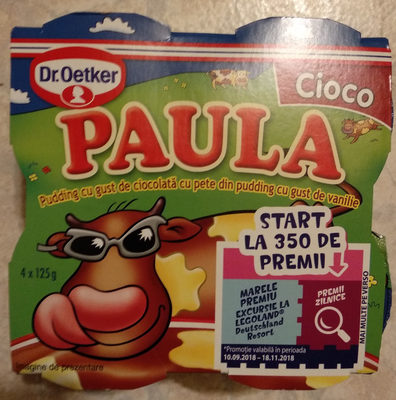
Paula pudding cu gust de ciocolata și vanilie
Labels
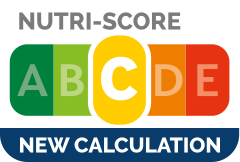 Moderate nutritional quality
 Ultra-processed food and drink products
 Green-Score not computed
Health
Nutrition
Label
Moderate nutritional qualityNutrient levels
Fat in moderate quantity (3.1%)
Saturated fat in moderate quantity (1.9%)
Sugars in moderate quantity (11%)
Salt in low quantity (0.12%)
Nutrition label

Nutrition facts
| Nutrition facts | As sold for 100 g / 100 ml |
|---|---|
| Energy | 418 kJ (99 kcal) |
| FAT | 3.1 g |
| Saturated fat | 1.9 g |
| Carbohydrates | 14 g |
| Sugars | 11 g |
| Dietary fiber | ~ 0.45 g |
| Proteins | 3.3 g |
| Salt | 0.12 g |
| Sodium | 0.05 g |
| Minerals | |
| Fruits, vegetables and legumes | ~ 0 % |
Nutrition facts (Detailed data)
| Nutrition facts | As sold for 100 g / 100 ml | As sold Per 100 g (packaging) | As sold Per 100 g (estimate) |
|---|---|---|---|
| Energy | 418 kJ (99 kcal) | 418 kJ (99 kcal) | ~ 436.12 kJ (104 kcal) |
| FAT | 3.1 g | 3.1 g | ~ 3.42 g |
| Saturated fat | 1.9 g | 1.9 g | ~ 2.24 g |
| Cholesterol | ~ 0.01 g | ? | ~ 0.01 g |
| Carbohydrates | 14 g | 14 g | ~ 14.78 g |
| Sugars | 11 g | 11 g | ~ 10.09 g |
| Added sugars | ~ 6.48 g | ? | ~ 6.48 g |
| Sucrose | ~ 6.6 g | ? | ~ 6.6 g |
| Glucose | ~ 0.13 g | ? | ~ 0.13 g |
| Fructose | ~ 0.13 g | ? | ~ 0.13 g |
| Galactose | ~ 0 g | ? | ~ 0 g |
| Lactose | ~ 3.61 g | ? | ~ 3.61 g |
| Maltose | ~ 0.13 g | ? | ~ 0.13 g |
| Starch | ~ 4 g | ? | ~ 4 g |
| Polyols | ~ 0 g | ? | ~ 0 g |
| Dietary fiber | ~ 0.45 g | ? | ~ 0.45 g |
| Proteins | 3.3 g | 3.3 g | ~ 3.19 g |
| Salt | 0.12 g | 0.12 g | ~ 0.16 g |
| Sodium | 0.05 g | 0.05 g | ~ 0.06 g |
| Alcohol | ~ 0 % vol | ? | ~ 0 % vol |
| Vitamins | |||
| Vitamin A | ~ 0 g | ? | ~ 0 g |
| Beta-carotene | ~ 0 g | ? | ~ 0 g |
| Vitamin D | ~ 0 g | ? | ~ 0 g |
| Vitamin E | ~ 0 g | ? | ~ 0 g |
| Vitamin C | ~ 0 g | ? | ~ 0 g |
| Vitamin B1 | ~ 0 g | ? | ~ 0 g |
| Vitamin B2 | ~ 0 g | ? | ~ 0 g |
| Vitamin PP | ~ 0 g | ? | ~ 0 g |
| Vitamin B6 | ~ 0 g | ? | ~ 0 g |
| Vitamin B9 | ~ 0 g | ? | ~ 0 g |
| Vitamin B12 | ~ 0 g | ? | ~ 0 g |
| Pantothenic acid | ~ 0 g | ? | ~ 0 g |
| Minerals | |||
| Potassium | ~ 0.19 g | ? | ~ 0.19 g |
| Calcium | ~ 0.11 g | ? | ~ 0.11 g |
| Phosphorus | ~ 0.1 g | ? | ~ 0.1 g |
| Iron | ~ 0 g | ? | ~ 0 g |
| Magnesium | ~ 0.02 g | ? | ~ 0.02 g |
| Zinc | ~ 0 g | ? | ~ 0 g |
| Copper | ~ 0 g | ? | ~ 0 g |
| Manganese | ~ 0 g | ? | ~ 0 g |
| Selenium | ~ 0 g | ? | ~ 0 g |
| Iodine | ~ 0 g | ? | ~ 0 g |
| Fruits, vegetables and legumes | ~ 0 % | ? | ~ 0 % |
| Phylloquinone | ~ 0 g | ? | ~ 0 g |
| Water | ~ 75.72 g | ? | ~ 75.72 g |
Serving size
Estimated Activity Time
Approximate time needed to burn the energy in 100 g / 100 ml: 418 kJ. Reference adult weight: 70 kg. Energy density: Low.
Ingredients
Ingredients image
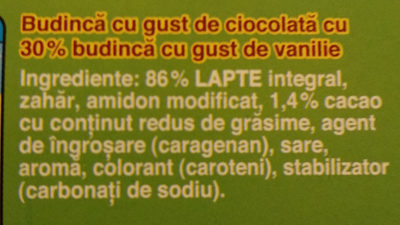
Ingredients list
Ingredient information
Allergens
Ingredients analysis
Palm oil content unknown
Contains non-vegan ingredients.
Vegetarian status unknown
Food Processing
NOVA group
Ultra-processed food and drink productsElements that indicate the product is in NOVA group 4
How NOVA works
Additives
E14XX - Modified StarchEmulsifierStabiliserThickener
No additive description is available yet.
E160a - caroteneColour
β-Carotene is an organic, strongly colored red-orange pigment abundant in plants and fruits. It is a member of the carotenes, which are terpenoids (isoprenoids), synthesized biochemically from eight isoprene units and thus having 40 carbons. Among the carotenes, β-carotene is distinguished by having beta-rings at both ends of the molecule. β-Carotene is biosynthesized from geranylgeranyl pyrophosphate.β-Carotene is the most common form of carotene in plants. When used as a food coloring, it has the E number E160a. The structure was deduced by Karrer et al. in 1930. In nature, β-carotene is a precursor (inactive form) to vitamin A via the action of beta-carotene 15,15'-monooxygenase.Isolation of β-carotene from fruits abundant in carotenoids is commonly done using column chromatography. It can also be extracted from the beta-carotene rich algae, Dunaliella salina. The separation of β-carotene from the mixture of other carotenoids is based on the polarity of a compound. β-Carotene is a non-polar compound, so it is separated with a non-polar solvent such as hexane. Being highly conjugated, it is deeply colored, and as a hydrocarbon lacking functional groups, it is very lipophilic.
E407 - CarrageenanCarrierEmulsifierHumectantStabiliserThickener
Carrageenan (E407), derived from red seaweed, is widely employed in the food industry as a gelling, thickening, and stabilizing agent, notably in dairy and meat products.
It can exist in various forms, each imparting distinct textural properties to food.
However, its degraded form, often referred to as poligeenan, has raised health concerns due to its potential inflammatory effects and its classification as a possible human carcinogen (Group 2B) by the International Agency for Research on Cancer (IARC).
Nevertheless, food-grade carrageenan has been deemed safe by various regulatory bodies when consumed in amounts typically found in food.
E500 - Sodium carbonatesStabiliserThickener
Sodium carbonates (E500) are compounds commonly used in food preparation as leavening agents, helping baked goods rise by releasing carbon dioxide when they interact with acids.
Often found in baking soda, they regulate the pH of food, preventing it from becoming too acidic or too alkaline. In the culinary world, sodium carbonates can also enhance the texture and structure of foods, such as noodles, by modifying the gluten network.
Generally recognized as safe, sodium carbonates are non-toxic when consumed in typical amounts found in food.
Environment
Green-Score, origins bonus, and transportation impact are shown for Worldwide .
Green Score
Overall grade
Unknown environmental impactAbout Green-Score
Current scope
Green-Score availability
Bonuses and maluses
Origins of ingredients
Packaging impact
Packaging
Packaging impact
Declared packaging
Data precision
Transportation
Manufacturing locations
Origins of ingredients
Origins breakdown
| Origin | Percent of ingredients | Impact |
|---|---|---|
| Germany | 100 % | Medium |
Data Source
Data presented on this page is sourced from the Open Food Facts database. This platform does not alter the original dataset; its purpose is solely to enhance data visualization and user accessibility.
Product added on October 15, 2018 at 6:11:06 PM UTC by foodninja .
Last edit on March 18, 2026 at 6:53:14 AM UTC by foodless .
Product page also edited by avdigital, foodless, foodninja, openfoodfacts-contributors, roboto-app, vainamoin3n.