
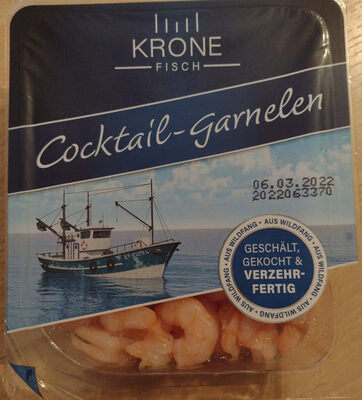
Cocktail-Garnelen
Labels
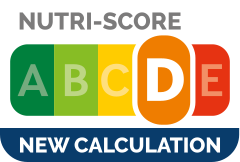 Poor nutritional quality
 Ultra-processed food and drink products
Health
Nutrition
Label
Poor nutritional qualityNutrient levels
Fat in low quantity (1%)
Saturated fat in low quantity (0.3%)
Sugars in low quantity (0.5%)
Salt in high quantity (2.5%)
Nutrition label

Nutrition facts
| Nutrition facts | As sold for 100 g / 100 ml |
|---|---|
| Energy | 275 kJ (65 kcal) |
| FAT | 1 g |
| Saturated fat | 0.3 g |
| Carbohydrates | < 0.5 g |
| Sugars | < 0.5 g |
| Dietary fiber | ? |
| Proteins | 14 g |
| Salt | 2.5 g |
| Sodium | 1 g |
| Minerals | |
| Fruits, vegetables and legumes | ~ 0 % |
Nutrition facts (Detailed data)
| Nutrition facts | As sold for 100 g / 100 ml | As sold Per 100 g (packaging) | As sold Per 100 g (estimate) |
|---|---|---|---|
| Energy | 275 kJ (65 kcal) | 275 kJ (65 kcal) | ? |
| FAT | 1 g | 1 g | ? |
| Saturated fat | 0.3 g | 0.3 g | ? |
| Carbohydrates | < 0.5 g | < 0.5 g | ? |
| Sugars | < 0.5 g | < 0.5 g | ? |
| Added sugars | ~ 0 g | ? | ~ 0 g |
| Dietary fiber | ? | ? | ? |
| Proteins | 14 g | 14 g | ? |
| Salt | 2.5 g | 2.5 g | ? |
| Sodium | 1 g | 1 g | ? |
| Minerals | |||
| Fruits, vegetables and legumes | ~ 0 % | ? | ~ 0 % |
Estimated Activity Time
Approximate time needed to burn the energy in 100 g / 100 ml: 275 kJ. Reference adult weight: 70 kg. Energy density: Low.
Ingredients
Ingredients image

Ingredients list
Ingredient information
Allergens
Traces
Ingredients analysis
No ingredients containing palm oil.
Contains non-vegan ingredients.
Unrecognized: de:beta-apo-8-carotinal
Contains non-vegetarian ingredients.
Unrecognized: de:beta-apo-8-carotinal
Food Processing
NOVA group
Ultra-processed food and drink productsElements that indicate the product is in NOVA group 4
How NOVA works
Additives
E162 - Beetroot redColour
Betanin, or Beetroot Red, is a red glycosidic food dye obtained from beets; its aglycone, obtained by hydrolyzing away the glucose molecule, is betanidin. As a food additive, its E number is E162. The color of betanin depends on pH; between four and five it is bright bluish-red, becoming blue-violet as the pH increases. Once the pH reaches alkaline levels betanin degrades by hydrolysis, resulting in a yellow-brown color. Betanin is a betalain pigment, together with isobetanin, probetanin, and neobetanin. Other pigments contained in beet are indicaxanthin and vulgaxanthins.
E200 - Sorbic acidPreservative
SORBIC ACID, or 2,4-hexadienoic acid, is a natural organic compound used as a food preservative. It has the chemical formula CH3(CH)4CO2H.
E210 - Benzoic acidPreservative
Benzoic acid , C7H6O2 (or C6H5COOH), is a colorless crystalline solid and a simple aromatic carboxylic acid. The name is derived from gum benzoin, which was for a long time its only known source. Benzoic acid occurs naturally in many plants and serves as an intermediate in the biosynthesis of many secondary metabolites. Salts of benzoic acid are used as food preservatives and benzoic acid is an important precursor for the industrial synthesis of many other organic substances. The salts and esters of benzoic acid are known as benzoates .
E260 - Acetic acidPreservative
ACETIC ACID, systematically named ethanoic acid, is a colourless liquid organic compound with the chemical formula CH3COOH (also written as CH3CO2H or C2H4O2).
E270 - Lactic acid
LACTIC ACID is an organic compound with the formula CH3CH(OH)CO2H. In the form of its conjugate base called lactate (this is thus different and kept as a separate ingredient). Lactic acid is chiral, consisting of two optical isomers. One is known as L-(+)-lactic acid or (S)-lactic acid and the other, its mirror image, is D-(−)-lactic acid or (R)-lactic acid in food the L-variant is used
E330 - Citric acidAntioxidantSequestrant
Citric acid is a natural organic acid found in citrus fruits such as lemons, oranges, and limes.
It is widely used in the food industry as a flavor enhancer, acidulant, and preservative due to its tart and refreshing taste.
Citric acid is safe for consumption when used in moderation and is considered a generally recognized as safe (GRAS) food additive by regulatory agencies worldwide.
Environment
Green-Score, origins bonus, and transportation impact are shown for Worldwide .
Green Score
Overall grade
About Green-Score
Current scope
Life cycle analysis
Average impact of the category
Life-cycle reference
Overall environmental impact by stage (PEF)
The overall environmental impact figure (PEF) comes from ADEME's Agribalyse database, for the category: Shrimp or prawn, raw. Source: ADEME Agribalyse Database.
| Stage | Impact |
|---|---|
| Agriculture | 94.2 % |
| Processing | 0.0 % |
| Packaging | 1.3 % |
| Transportation | 3.0 % |
| Distribution | 0.6 % |
| Consumption | 0.7 % |
Bonuses and maluses
Declared origins
Packaging impact
Green-Score for this product
Green-Score for this product
Final score breakdown
Carbon footprint
Carbon footprint
Climate impact by stage (CO2e)
The carbon emission figure comes from ADEME's Agribalyse database, for the category: Shrimp or prawn, raw. Source: ADEME Agribalyse Database.
| Stage | Impact |
|---|---|
| Agriculture | 88.2 % |
| Processing | 0.0 % |
| Packaging | 3.4 % |
| Transportation | 6.2 % |
| Distribution | 0.4 % |
| Consumption | 2.0 % |
Packaging
Packaging impact
Packaging materials
| Material | % | Packaging weight | Packaging weight per 100 g of product |
|---|---|---|---|
| Plastic | |||
| Total |
Declared packaging
Data precision
Transportation
Declared origins
Data Source
Data presented on this page is sourced from the Open Food Facts database. This platform does not alter the original dataset; its purpose is solely to enhance data visualization and user accessibility.
Product added on April 27, 2017 at 4:36:35 PM UTC by date-limite-app .
Last edit on March 17, 2026 at 8:39:14 PM UTC by new-nutrition-bot .
Product page also edited by date-limite-app, derthas, dmt33, ecoscore-impact-estimator, new-nutrition-bot, openfoodfacts-contributors, roboto-app.