

Вафла Хипер класик
Health
Nutrition
Nutri-Score
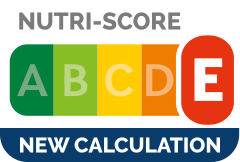 Lower nutritional quality
Nutri-Score data warning
Nutrient levels
Fat in high quantity (29%)
Saturated fat in high quantity (15.4%)
Sugars in high quantity (43%)
Salt in low quantity (0.198%)
Nutrition label
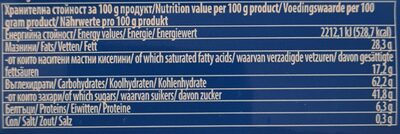
Nutrition facts
| Nutrition facts | As sold for 100 g / 100 ml | Compared to: Chocolate stuffed wafers |
|---|---|---|
| Energy | ~ 2229 kJ (533 kcal) | 2,148.933 kJ (514 kcal) (+4%) |
| Fat | 29 g | 27.194 g (+7%) |
| Saturated fat | 15.4 g | 17.323 g (-11%) |
| Carbohydrates | 61.8 g | 59.913 g (+3%) |
| Sugars | 43 g | 34.205 g (+26%) |
| Dietary fiber | ? | ? |
| Proteins | 6.2 g | 6.121 g (+1%) |
| Salt | 0.1975 g | 0.276 g (-28%) |
| Sodium | 0.079 g | 0.11 g (-28%) |
| Fruits, vegetables and legumes | ~ 0 % | ? |
Nutrition facts (Detailed data)
| Nutrition facts | As sold for 100 g / 100 ml | As sold Per 100 g (packaging) | As sold Per 100 g (estimate) |
|---|---|---|---|
| Energy | ~ 2229 kJ (533 kcal) | ? (533 kcal) | ? |
| Fat | 29 g | 29 g | ? |
| Saturated fat | 15.4 g | 15.4 g | ? |
| Carbohydrates | 61.8 g | 61.8 g | ? |
| Sugars | 43 g | 43 g | ? |
| Dietary fiber | ? | ? | ? |
| Proteins | 6.2 g | 6.2 g | ? |
| Salt | 0.1975 g | 0.1975 g | ? |
| Sodium | 0.079 g | 0.079 g | ? |
| Fruits, vegetables and legumes | ~ 0 % | ? | ~ 0 % |
Serving size
Ingredients
Ingredients image
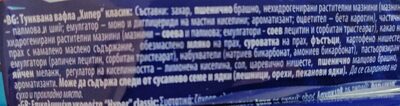
Ingredients list
Ingredient information
Added sugars
Allergens
Traces
Ingredients analysis
Palm oil content unknown
Contains non-vegan ingredients.
Unrecognized: bg:мазнини-палмова-и-ший, bg:емулгатор-моно-и-дилицериди-на-мастни-киселини, bg:соева-и-палмова, bg:емгулгатори, bg:соев-лецитин-и-сорбитан-тристеарат, bg:пастьоризиран-яйчен-меланж, bg:лимонена-каселина
Vegetarian status unknown
Unrecognized: bg:мазнини-палмова-и-ший, bg:емулгатор-моно-и-дилицериди-на-мастни-киселини, bg:соева-и-палмова, bg:емгулгатори, bg:соев-лецитин-и-сорбитан-тристеарат, bg:пастьоризиран-яйчен-меланж, bg:лимонена-каселина
Food Processing
NOVA group
 Ultra-processed food and drink products
Elements that indicate the product is in NOVA group 4
How NOVA works
Additives
E160a - caroteneColour
β-Carotene is an organic, strongly colored red-orange pigment abundant in plants and fruits. It is a member of the carotenes, which are terpenoids (isoprenoids), synthesized biochemically from eight isoprene units and thus having 40 carbons. Among the carotenes, β-carotene is distinguished by having beta-rings at both ends of the molecule. β-Carotene is biosynthesized from geranylgeranyl pyrophosphate.β-Carotene is the most common form of carotene in plants. When used as a food coloring, it has the E number E160a. The structure was deduced by Karrer et al. in 1930. In nature, β-carotene is a precursor (inactive form) to vitamin A via the action of beta-carotene 15,15'-monooxygenase.Isolation of β-carotene from fruits abundant in carotenoids is commonly done using column chromatography. It can also be extracted from the beta-carotene rich algae, Dunaliella salina. The separation of β-carotene from the mixture of other carotenoids is based on the polarity of a compound. β-Carotene is a non-polar compound, so it is separated with a non-polar solvent such as hexane. Being highly conjugated, it is deeply colored, and as a hydrocarbon lacking functional groups, it is very lipophilic.
E160ai - Beta-caroteneColour
No additive description is available yet.
E492 - Sorbitan tristearate EFSA overexposure risk: highEmulsifierStabiliser
Sorbitan tristearate is a nonionic surfactant. It is variously used as a dispersing agent, emulsifier, and stabilizer, in food and in aerosol sprays. As a food additive, it has the E number E492. Brand names for polysorbates include Alkest, Canarcel, and Span. The consistency of sorbitan tristearate is waxy; its color is light cream to tan.
E500 - Sodium carbonatesStabiliserThickener
Sodium carbonates (E500) are compounds commonly used in food preparation as leavening agents, helping baked goods rise by releasing carbon dioxide when they interact with acids.
Often found in baking soda, they regulate the pH of food, preventing it from becoming too acidic or too alkaline. In the culinary world, sodium carbonates can also enhance the texture and structure of foods, such as noodles, by modifying the gluten network.
Generally recognized as safe, sodium carbonates are non-toxic when consumed in typical amounts found in food.
E500ii - Sodium hydrogen carbonateStabiliserThickener
Sodium hydrogen carbonate, also known as E500ii, is a food additive commonly used as a leavening agent.
When added to recipes, it releases carbon dioxide gas upon exposure to heat or acids, causing dough to rise and resulting in a light, fluffy texture in baked goods.
It is generally recognized as safe (GRAS) by regulatory authorities when used in appropriate quantities and poses no significant health risks when consumed in typical food applications.
E503 - Ammonium carbonates
AMMONIUM BICARBONATE is an inorganic compound with formula (NH4)HCO3, simplified to NH5CO3. Ammonium bicarbonate is used in the food industry as a raising agent for flat baked goods, such as cookies and crackers, and in China in steamed buns and Chinese almond cookies. It was commonly used in the home before modern day baking powder was made available.
E503ii - Ammonium hydrogen carbonate
No additive description is available yet.
Environment
Green-Score, origins bonus, and transportation impact are shown for Worldwide .
Green Score
Overall grade
 Low environmental impact
About Green-Score
Current scope
Life cycle analysis
Average impact of the category
 Wafer biscuit, crunchy (thin or dry), plain or with sugar, prepacked • Score: 84/100
Life-cycle reference
Overall environmental impact by stage (PEF)
The overall environmental impact figure (PEF) comes from ADEME's Agribalyse database, for the category: Wafer biscuit, crunchy (thin or dry), plain or with sugar, prepacked. Source: ADEME Agribalyse Database.
| Stage | Impact |
|---|---|
| Agriculture | 73.8 % |
| Processing | 14.2 % |
| Packaging | 4.4 % |
| Transportation | 5.3 % |
| Distribution | 2.2 % |
| Consumption | 0.0 % |
Bonuses and maluses
Declared origins
Packaging impact
Green-Score for this product
Green-Score for this product
Final score: 69/100Final score breakdown
Carbon footprint
Carbon footprint
Climate impact by stage (CO2e)
The carbon emission figure comes from ADEME's Agribalyse database, for the category: Wafer biscuit, crunchy (thin or dry), plain or with sugar, prepacked. Source: ADEME Agribalyse Database.
| Stage | Impact |
|---|---|
| Agriculture | 75.1 % |
| Processing | 8.1 % |
| Packaging | 7.6 % |
| Transportation | 7.7 % |
| Distribution | 1.2 % |
| Consumption | 0.0 % |
Packaging

Packaging impact
Packaging components
| Shape | Material | Recycling | Impact |
|---|---|---|---|
| Unknown | Plastic | Unknown | High |
Declared packaging
Data precision
Transportation
Declared origins
Forest footprint
Forest footprint
Deforestation risk details
Data Source
Product data comes from Open Food Facts. Food Benchmark also adds translations, category comparisons and explanatory calculations.
The database is licensed under ODbL 1.0, individual contents under DbCL 1.0, and product photos under CC BY-SA 3.0.
Product added on August 22, 2019 at 10:19:21 AM UTC by openfoodfacts-contributors .
Last edit on March 17, 2026 at 10:19:41 PM UTC by new-nutrition-bot .
Product page also edited by ecoscore-impact-estimator, foodless, inf, kiliweb, macrofactor, new-nutrition-bot, openfoodfacts-contributors, roto, smoothie-app, yuka.CJJgNc-oQdV6EMvu0bwqxjqYG8juLqNcE0Isog.