
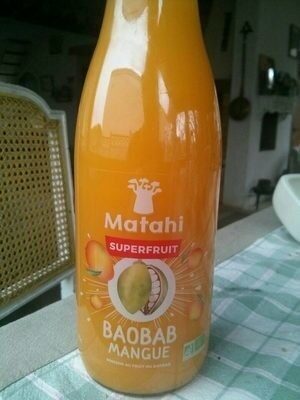
Matahi superfruit
Labels
 Poor nutritional quality
 Unprocessed or minimally processed foods
 Very low environmental impact
Health
Nutrition
Label
Poor nutritional qualityNutrient levels
Fat in low quantity (0.5%)
Saturated fat in low quantity (0.1%)
Sugars in high quantity (7.4%)
Salt in low quantity (0.04%)
Nutrition label

Nutrition facts
| Nutrition facts | As sold for 100 ml |
|---|---|
| Energy | ~ 163.6 kJ (32 kcal) |
| FAT | 0.5 g |
| Saturated fat | 0.1 g |
| Carbohydrates | 7.8 g |
| Sugars | 7.4 g |
| Dietary fiber | 0.5 g |
| Proteins | 0.5 g |
| Salt | 0.04 g |
| Sodium | 0.02 g |
| Minerals | |
| Fruits, vegetables and legumes | ~ 10 % |
Nutrition facts (Detailed data)
| Nutrition facts | As sold for 100 ml | As sold Per 100 ml (packaging) | As sold Per 100 g (estimate) |
|---|---|---|---|
| Energy | ~ 163.6 kJ (32 kcal) | ? (32 kcal) | ? |
| FAT | 0.5 g | 0.5 g | ? |
| Saturated fat | 0.1 g | 0.1 g | ? |
| Carbohydrates | 7.8 g | 7.8 g | ? |
| Sugars | 7.4 g | 7.4 g | ? |
| Added sugars | ~ 8 g | ? | ~ 8 g |
| Dietary fiber | 0.5 g | 0.5 g | ? |
| Proteins | 0.5 g | 0.5 g | ? |
| Salt | 0.04 g | 0.04 g | ? |
| Sodium | 0.02 g | 0.02 g | ? |
| Minerals | |||
| Fruits, vegetables and legumes | ~ 10 % | ? | ~ 10 % |
Estimated Activity Time
Approximate time needed to burn the energy in 100 g / 100 ml: 164 kJ. Reference adult weight: 70 kg. Energy density: Moderate.
Ingredients
Ingredients image
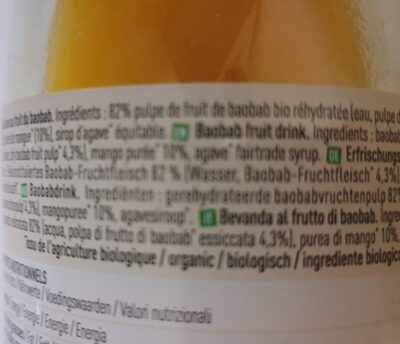
Ingredients list
Ingredient information
Ingredients analysis
No ingredients containing palm oil.
Unrecognized: fr:pulpe-de-fruit-de-baobab-rehydratee, fr:pulpe-de-fruit-sec-de-baobab
Vegan status unknown
Unrecognized: fr:pulpe-de-fruit-sec-de-baobab
Vegetarian status unknown
Unrecognized: fr:pulpe-de-fruit-sec-de-baobab
Food Processing
NOVA group
Unprocessed or minimally processed foodsHow NOVA works
Additives
Environment
Green-Score, origins bonus, and transportation impact are shown for Worldwide .
Green Score
Overall grade
Very low environmental impactAbout Green-Score
Current scope
Life cycle analysis
Average impact of the category
 Fruit soft drink, still (fruit juice content unspecified), with sugar • Score: 69/100
Life-cycle reference
Overall environmental impact by stage (PEF)
The overall environmental impact figure (PEF) comes from ADEME's Agribalyse database, for the category: Fruit soft drink, still (fruit juice content unspecified), with sugar. Source: ADEME Agribalyse Database.
| Stage | Impact |
|---|---|
| Agriculture | 41.7 % |
| Processing | 0.1 % |
| Packaging | 27.0 % |
| Transportation | 17.1 % |
| Distribution | 11.0 % |
| Consumption | 3.1 % |
Bonuses and maluses
Production system
Origins of ingredients
Packaging impact
Green-Score for this product
Green-Score for this product
Final score: 82/100Final score breakdown
Carbon footprint
Carbon footprint
Climate impact by stage (CO2e)
The carbon emission figure comes from ADEME's Agribalyse database, for the category: Fruit soft drink, still (fruit juice content unspecified), with sugar. Source: ADEME Agribalyse Database.
| Stage | Impact |
|---|---|
| Agriculture | 33.6 % |
| Processing | 0.0 % |
| Packaging | 24.4 % |
| Transportation | 34.5 % |
| Distribution | 6.4 % |
| Consumption | 1.2 % |
Packaging
Packaging impact
Packaging materials
| Material | % | Packaging weight | Packaging weight per 100 g of product |
|---|---|---|---|
| Glass | |||
| Total |
Declared packaging
Transportation
Manufacturing locations
Origins of ingredients
Origins breakdown
| Origin | Percent of ingredients | Impact |
|---|---|---|
| France | 100 % | High |
Data Source
Data presented on this page is sourced from the Open Food Facts database. This platform does not alter the original dataset; its purpose is solely to enhance data visualization and user accessibility.
Product added on January 21, 2018 at 10:48:04 AM UTC by kiliweb .
Last edit on March 17, 2026 at 8:14:27 PM UTC by new-nutrition-bot .
Product page also edited by aida, autorotate-bot, kiliweb, new-nutrition-bot, openfoodfacts-contributors, packbot, tacite, yuka.CKIfOf_UDZN-DcDjwZAP_Be3Gb3fJKBgQlQdog, yuka.SGZ3Nk9vOVEvOTREdjhNdjF5MzEzb3RsbnJ5UVhubW1EdWs0SVE9PQ, yuka.YUswdkVwUmN1OXNRdDhZLzRTamE1czBxMk1LYmVuT3RBZWdTSVE9PQ, yuka.sY2b0xO6T85zoF3NwEKvlldbScSOgG2eJgXSskPaxdasHrPHeMhu3JTXN6g.