
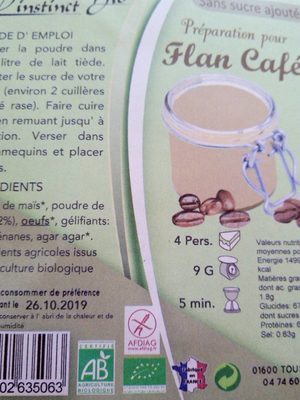
Préparation pour flan café
Health
Nutrition
Nutrient levels
Fat in moderate quantity (4.4%)
Saturated fat in moderate quantity (1.8%)
Sugars in low quantity (0%)
Salt in moderate quantity (0.6%)
Nutrition label

Nutrition facts
| Nutrition facts | As sold for 100 g / 100 ml | Compared to: fr:Préparations pour flans |
|---|---|---|
| Energy | ~ 1417.4 kJ (359 kcal) | 920.769 kJ (225 kcal) (+54%) |
| Fat | 4.4 g | 1.522 g (+189%) |
| Saturated fat | 1.8 g | 0.772 g (+133%) |
| Carbohydrates | 67 g | 46.696 g (+43%) |
| Sugars | 0 g | 27.346 g (-100%) |
| Dietary fiber | ? | ? |
| Proteins | 6.8 g | 2.499 g (+172%) |
| Salt | 0.6 g | 0.139 g (+332%) |
| Sodium | 0.24 g | 0.055 g (+336%) |
| Fruits, vegetables and legumes | ~ 0 % | ? |
Nutrition facts (Detailed data)
| Nutrition facts | As sold for 100 g / 100 ml | As sold Per 100 g (packaging) | As sold Per 100 g (estimate) |
|---|---|---|---|
| Energy | ~ 1417.4 kJ (359 kcal) | ? (359 kcal) | ? |
| Fat | 4.4 g | 4.4 g | ? |
| Saturated fat | 1.8 g | 1.8 g | ? |
| Carbohydrates | 67 g | 67 g | ? |
| Sugars | 0 g | 0 g | ? |
| Dietary fiber | ? | ? | ? |
| Proteins | 6.8 g | 6.8 g | ? |
| Salt | 0.6 g | 0.6 g | ? |
| Sodium | 0.24 g | 0.24 g | ? |
| Fruits, vegetables and legumes | ~ 0 % | ? | ~ 0 % |
Ingredients
Ingredients image

Ingredients list
Ingredient information
Allergens
Ingredients analysis
No ingredients containing palm oil.
Contains non-vegan ingredients.
No non-vegetarian ingredients.
Food Processing
NOVA group
 Ultra-processed food and drink products
Elements that indicate the product is in NOVA group 4
How NOVA works
Additives
E406 - AgarCarrierEmulsifierHumectantStabiliserThickener
Agar (pronounced , sometimes ) or agar-agar is a jelly-like substance, obtained from red algae.Agar is a mixture of two components: the linear polysaccharide agarose, and a heterogeneous mixture of smaller molecules called agaropectin. It forms the supporting structure in the cell walls of certain species of algae, and is released on boiling. These algae are known as agarophytes, and belong to the Rhodophyta (red algae) phylum.Agar has been used as an ingredient in desserts throughout Asia, and also as a solid substrate to contain culture media for microbiological work. Agar can be used as a laxative, an appetite suppressant, a vegetarian substitute for gelatin, a thickener for soups, in fruit preserves, ice cream, and other desserts, as a clarifying agent in brewing, and for sizing paper and fabrics.The gelling agent in agar is an unbranched polysaccharide obtained from the cell walls of some species of red algae, primarily from tengusa (Gelidiaceae) and ogonori (Gracilaria). For commercial purposes, it is derived primarily from ogonori. In chemical terms, agar is a polymer made up of subunits of the sugar galactose.
E407 - Carrageenan EFSA overexposure risk: highCarrierEmulsifierHumectantStabiliserThickener
Carrageenan (E407), derived from red seaweed, is widely employed in the food industry as a gelling, thickening, and stabilizing agent, notably in dairy and meat products.
It can exist in various forms, each imparting distinct textural properties to food.
However, its degraded form, often referred to as poligeenan, has raised health concerns due to its potential inflammatory effects and its classification as a possible human carcinogen (Group 2B) by the International Agency for Research on Cancer (IARC).
Nevertheless, food-grade carrageenan has been deemed safe by various regulatory bodies when consumed in amounts typically found in food.
Environment
Green-Score, origins bonus, and transportation impact are shown for Worldwide .
Green Score
Overall grade
 Unknown environmental impact
About Green-Score
Current scope
Green-Score availability
Bonuses and maluses
Production system
Declared origins
Packaging impact
Packaging
Packaging impact
Packaging components
| Shape | Material | Recycling | Impact |
|---|---|---|---|
| BAG | Plastic | Unknown | High |
Declared packaging
Transportation
Manufacturing locations
Declared origins
Forest footprint
Forest footprint
Ingredients linked to forest pressure
| Ingredient | Type | Percent in product | Forest footprint |
|---|---|---|---|
| EGG | Oeufs Bio | 6.00 % | 0.00 |
Data Source
Product data comes from Open Food Facts. Food Benchmark also adds translations, category comparisons and explanatory calculations.
The database is licensed under ODbL 1.0, individual contents under DbCL 1.0, and product photos under CC BY-SA 3.0.
Product added on December 20, 2017 at 12:48:11 PM UTC by openfoodfacts-contributors .
Last edit on March 17, 2026 at 10:26:57 AM UTC by new-nutrition-bot .
Product page also edited by beniben, gmlaa, kiliweb, new-nutrition-bot, openfoodfacts-contributors, packbot, sebleouf, teolemon, yuka.HOtsA9OkEdYrPvT4jd0I2janNcPrAdQFCiBQow, yuka.VElZWU1xZGNvdUlzb3MwdnBBNk14ZndzNDdtdVdqcXFBZTlQSUE9PQ.