ProductsL'Atelier MitiÉmietté de Crevettes au Fromage Blanc & Fines Herbes
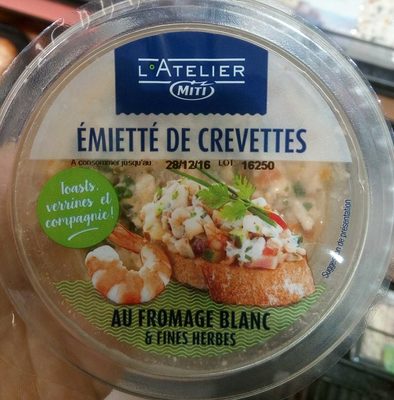
Émietté de Crevettes au Fromage Blanc & Fines Herbes
Barcode 3760070014594
L'Atelier Miti, Miti

Émietté de Crevettes au Fromage Blanc & Fines Herbes

100 g
BARCODE:3760070014594
COMMON NAME:Émietté de Crevettes au Fromage Blanc et Fines Herbes
CATEGORIES:Seafood, Spreads, Meals, Salted Spreads, Meals With Fish, Refrigerated Foods, Meals With Shellfish, Refrigerated Meals, Meals With Shrimps
PACKAGING:Plastic, Fresh
COUNTRIES:France
STORES:Carrefour

Labels

Nutri-Score
Nutri-ScoreGood nutritional quality
NOVA Group
NOVA GroupUltra-processed food and drink products
Green-Score
Green-ScoreGreen-Score not computed

Health

Nutrition

Label

BGood nutritional quality

Nutrient levels

Fat in moderate quantity (6.8%)
What you need to know • A high consumption of fat, especially saturated fats, can raise cholesterol, which increases the risk of heart diseases. Recommendation: Limit the consumption of fat and saturated fat • Choose products with lower fat and saturated fat content. Source: National Health Service UK (NHS) - Fat: the facts
Saturated fat in low quantity (1%)
What you need to know • A high consumption of fat, especially saturated fats, can raise cholesterol, which increases the risk of heart diseases. Recommendation: Limit the consumption of fat and saturated fat • Choose products with lower fat and saturated fat content. Source: National Health Service UK (NHS) - Fat: the facts
Sugars in low quantity (1.4%)
What you need to know • A high consumption of sugar can cause weight gain and tooth decay. It also augments the risk of type 2 diabetes and cardio-vascular diseases. Recommendation: Limit the consumption of sugar and sugary drinks • Sugary drinks (such as sodas, fruit beverages, and fruit juices and nectars) should be limited as much as possible (no more than 1 glass a day). • Choose products with lower sugar content and reduce the consumption of products with added sugars. Source: National Health Service UK (NHS) - Sugar: the facts
Salt in moderate quantity (1.2%)
What you need to know • A high consumption of salt (or sodium) can cause raised blood pressure, which can increase the risk of heart disease and stroke. • Many people who have high blood pressure do not know it, as there are often no symptoms. • Most people consume too much salt (on average 9 to 12 grams per day), around twice the recommended maximum level of intake. Recommendation: Limit the consumption of salt and salted food • Reduce the quantity of salt used when cooking, and don't salt again at the table. • Limit the consumption of salty snacks and choose products with lower salt content. Source: World Health Organization (WHO) - Fact sheet - Salt reduction Source: National Health Service UK (NHS) - Salt: the facts

Nutrition label

Émietté de Crevettes au Fromage Blanc & Fines Herbes nutrition label

Nutrition facts

Nutrition factsAs sold for 100 g / 100 ml
Energy480 kJ (113 kcal)
FAT6.8 g
Saturated fat1 g
Carbohydrates1.9 g
Sugars1.4 g
Dietary fiber?
Proteins11 g
Salt1.2 g
Sodium0.48 g
Minerals
Fruits, vegetables and legumes~ 3.8 %

Nutrition facts (Detailed data)

Nutrition factsAs sold for 100 g / 100 mlAs sold Per 100 g (packaging)As sold Per 100 g (estimate)
Energy480 kJ (113 kcal)480 kJ (115 kcal)?
FAT6.8 g6.8 g?
Saturated fat1 g1 g?
Carbohydrates1.9 g1.9 g?
Sugars1.4 g1.4 g?
Added sugars~ 0 g?~ 0 g
Dietary fiber???
Proteins11 g11 g?
Salt1.2 g1.2 g?
Sodium0.48 g0.48 g?
Minerals
Fruits, vegetables and legumes~ 3.8 %?~ 3.8 %

Estimated Activity Time

Approximate time needed to burn the energy in 100 g / 100 ml: 480 kJ. Reference adult weight: 70 kg. Energy density: Low.

Walking
28 min (~2,799 steps)
Swimming
17 min
Bicycling
13 min
Running
10 min

Ingredients

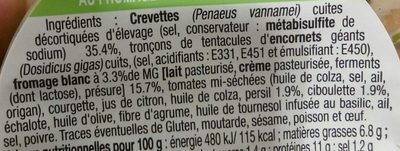
Ingredients image

Émietté de Crevettes au Fromage Blanc & Fines Herbes ingredients image

Ingredients list

_Crevettes_ (Penaeus vannamei) cuites décortiquées d'élevage (sel, conservateur : _métabisulfite_ de sodium) 35,4 %, tronçons de tentacules d'_encornets_ géants (Disodicus gigas) cuits, (sel, acidifiants : E331, E451 et émulsifiant : E450), _fromage_ blanc à 3,3 % de MG [_lait_ pasteurisé, _crème_ pasteurisée, ferments (dont lactose), présure] 15,7 %, tomates mi-séchées (huile de colza, sel, ail, origan), courgette, jus de citron, huile de colza, persil 1,9 %, ciboulette 1,9 %, échalote, huile d'olive, fibre d'agrume, huile de tournesol infusée au basilic, ail, sel, poivre.

Ingredient information

Shrimp
50% (estimate)
Whiteleg Shrimp
50% (estimate)
Cuites Decortiquees D Elevage
35.4%
Salt
17.7% (estimate)
Preservative
17.7% (estimate)
E221
17.7% (estimate)
Troncons De Tentacules D Encornets Geants
7.3% (estimate)
Disodicus Gigas
7.3% (estimate)
Cuits
3.65% (estimate)
Salt
1.82% (estimate)
Acid
0.91% (estimate)
E331
0.91% (estimate)
E451
0.46% (estimate)
Emulsifier
0.46% (estimate)
E450
0.46% (estimate)
Fromage Blanc A 3 3 De Mg
15.7%
Milk
1.83% (estimate)
Cream
0.91% (estimate)
Ferment
0.46% (estimate)
Rennet
0.46% (estimate)
Tomates Semi Sechees
Unknown (not provided)
Colza Oil
Unknown (not provided)
Salt
Unknown (not provided)
Garlic
Unknown (not provided)
Oregano
Unknown (not provided)
Courgette
Unknown (not provided)
Lemon Juice
Unknown (not provided)
Colza Oil
Unknown (not provided)
Parsley
1.9%
Chives
1.9%
Shallot
Unknown (not provided)
Olive Oil
Unknown (not provided)
Citrus Fibre
Unknown (not provided)
Huile De Tournesol Infusee Au Basilic
Unknown (not provided)
Garlic
Unknown (not provided)
Salt
Unknown (not provided)
Pepper
Unknown (not provided)

Allergens

CrustaceansMilkMolluscsSulphur Dioxide And Sulphites

Traces

EggsFishGlutenMustardSesame Seeds

Ingredients analysis

Palm oil free
Yes

No ingredients containing palm oil.

Vegan
No

Contains non-vegan ingredients.

Unrecognized: fr:disodicus-gigas, fr:huile-de-tournesol-infusee-au-basilic

Vegetarian
No

Contains non-vegetarian ingredients.

Unrecognized: fr:disodicus-gigas, fr:huile-de-tournesol-infusee-au-basilic


Food Processing

NOVA group

4Ultra-processed food and drink products

Elements that indicate the product is in NOVA group 4

Additives
E450 - Diphosphates
Additives
E451 - Triphosphates
Ingredients
Emulsifier
Ingredients
Vegetable Fiber

How NOVA works

The NOVA classification assigns food products into 4 groups based on their degree of processing: 1. Unprocessed or minimally processed foods 2. Processed culinary ingredients 3. Processed foods 4. Ultra-processed food and drink products

Additives

E223 - Sodium metabisulphiteAntioxidantPreservative

SODIUM METABISULFITE or sodium pyrosulfite (IUPAC spelling; Br. E. sodium metabisulphite or sodium pyrosulphite) is an inorganic compound of chemical formula Na2S2O5.

E331 - Sodium citratesEmulsifierSequestrantStabiliser

DISODIUM CITRATE, more properly, disodium hydrogen citrate, is an acid salt of citric acid with the chemical formula Na2C6H6O7. It is used as an antioxidant in food and to improve the effects of other antioxidants. It is also used as an acidity regulator and sequestrant. Typical products include gelatin, jam, sweets, ice cream, carbonated beverages, milk powder, wine, and processed cheeses.

E450 - DiphosphatesEmulsifierHumectantSequestrantStabiliserThickener

Diphosphates (E450) are food additives often utilized to modify the texture of products, acting as leavening agents in baking and preventing the coagulation of canned food.

These salts can stabilize whipped cream and are also found in powdered products to maintain their flow properties. They are commonly present in baked goods, processed meats, and soft drinks.

Derived from phosphoric acid, they're part of our daily phosphate intake, which often surpasses recommended levels due to the prevalence of phosphates in processed foods and drinks.

Excessive phosphate consumption is linked to health issues, such as impaired kidney function and weakened bone health. Though diphosphates are generally regarded as safe when consumed within established acceptable daily intakes, it's imperative to monitor overall phosphate consumption to maintain optimal health.

E451 - TriphosphatesEmulsifierHumectantSequestrantStabiliserThickener

Sodium triphosphate (STP), also sodium tripolyphosphate (STPP), or tripolyphosphate (TPP),) is an inorganic compound with formula Na5P3O10. It is the sodium salt of the polyphosphate penta-anion, which is the conjugate base of triphosphoric acid. It is produced on a large scale as a component of many domestic and industrial products, especially detergents. Environmental problems associated with eutrophication are attributed to its widespread use.

Environment

Green-Score, origins bonus, and transportation impact are shown for Worldwide .

Green Score

Overall grade

UnknownUnknown environmental impact

About Green-Score

The Green-Score is an experimental score that summarizes the environmental impacts of food products.

Current scope

The Green-Score was initially developed for France and it is being extended to other European countries. The Green-Score formula is subject to change as it is regularly improved to make it more precise and better suited to each country. Select a country to include the full impact of transportation in the final score.

Green-Score availability

We could not compute the Green-Score of this product because some data is missing. A more precise category, ingredients list, origins or packaging data can unlock the computation.

Bonuses and maluses

Declared origins

Origins of ingredients are missing for this product. Ingredients need to be completed before the transportation bonus can be computed precisely.

Packaging impact

Packaging with a medium impact Malus: -10 Packaging score: 0

Packaging

Packaging impact

Packaging with a medium impact Malus: -10 Packaging score: 0

Packaging materials

Material%Packaging weightPackaging weight per 100 g of product
Plastic
Total

Declared packaging

Plastic, Fresh

Data precision

The packaging information is not sufficiently precise to compute the most accurate packaging impact. Exact shapes and materials of all packaging components help improve the Green-Score.

Transportation

Declared origins

Origins of ingredients are missing for this product. Ingredients need to be completed before the transportation bonus can be computed precisely.

Data Source

Data presented on this page is sourced from the Open Food Facts database. This platform does not alter the original dataset; its purpose is solely to enhance data visualization and user accessibility.

Product added on December 21, 2016 at 6:03:16 PM UTC by sebleouf .

Last edit on March 18, 2026 at 12:08:38 AM UTC by new-nutrition-bot .

Product page also edited by beniben, claraf, new-nutrition-bot, packbot, sebleouf.