
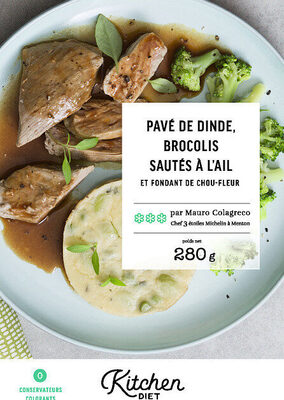
Pavé de Dinde, Fondant de Chou-Fleur et Brocolis
Health
Nutrition
Nutri-Score
 Good nutritional quality
Nutri-Score data warning
Nutrient levels
Fat in moderate quantity (6.3%)
Saturated fat in moderate quantity (2.2%)
Sugars in low quantity (1.3%)
Salt in moderate quantity (0.7%)
Nutrition label
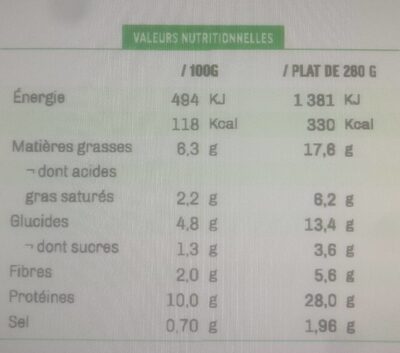
Nutrition facts
| Nutrition facts | As sold for 100 g / 100 ml | Compared to: Turkey dishes |
|---|---|---|
| Energy | 494 kJ (118 kcal) | 596.941 kJ (142 kcal) (-17%) |
| Fat | 6.3 g | 6.607 g (-5%) |
| Saturated fat | 2.2 g | 2.006 g (+10%) |
| Carbohydrates | 4.8 g | 8.901 g (-46%) |
| Sugars | 1.3 g | 1.188 g (+9%) |
| Dietary fiber | 2 g | ? |
| Proteins | 10 g | 10.485 g (-5%) |
| Salt | 0.7 g | 0.83 g (-16%) |
| Sodium | 0.28 g | 0.336 g (-17%) |
| Fruits, vegetables and legumes | ~ 39.2940909090909 % | ? |
Nutrition facts (Detailed data)
| Nutrition facts | As sold for 100 g / 100 ml | As sold Per 100 g (packaging) | As sold Per 100 g (estimate) |
|---|---|---|---|
| Energy | 494 kJ (118 kcal) | 494 kJ (118 kcal) | ? |
| Fat | 6.3 g | 6.3 g | ? |
| Saturated fat | 2.2 g | 2.2 g | ? |
| Carbohydrates | 4.8 g | 4.8 g | ? |
| Sugars | 1.3 g | 1.3 g | ? |
| Dietary fiber | 2 g | 2 g | ? |
| Proteins | 10 g | 10 g | ? |
| Salt | 0.7 g | 0.7 g | ? |
| Sodium | 0.28 g | 0.28 g | ? |
| Fruits, vegetables and legumes | ~ 39.2940909090909 % | ? | ~ 39.2940909090909 % |
Serving size
Ingredients
Ingredients image
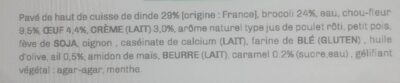
Ingredients list
Ingredient information
Added sugars
Allergens
Ingredients analysis
No ingredients containing palm oil.
Vegan status unknown
Unrecognized: fr:pave-de-haut-de-cuisse-de-dinde, fr:arome-naturel-type-jus-de-poulet-roti
No non-vegetarian ingredients.
Unrecognized: fr:pave-de-haut-de-cuisse-de-dinde, fr:arome-naturel-type-jus-de-poulet-roti
Food Processing
NOVA group
 Ultra-processed food and drink products
Elements that indicate the product is in NOVA group 4
How NOVA works
Additives
E406 - AgarCarrierEmulsifierHumectantStabiliserThickener
Agar (pronounced , sometimes ) or agar-agar is a jelly-like substance, obtained from red algae.Agar is a mixture of two components: the linear polysaccharide agarose, and a heterogeneous mixture of smaller molecules called agaropectin. It forms the supporting structure in the cell walls of certain species of algae, and is released on boiling. These algae are known as agarophytes, and belong to the Rhodophyta (red algae) phylum.Agar has been used as an ingredient in desserts throughout Asia, and also as a solid substrate to contain culture media for microbiological work. Agar can be used as a laxative, an appetite suppressant, a vegetarian substitute for gelatin, a thickener for soups, in fruit preserves, ice cream, and other desserts, as a clarifying agent in brewing, and for sizing paper and fabrics.The gelling agent in agar is an unbranched polysaccharide obtained from the cell walls of some species of red algae, primarily from tengusa (Gelidiaceae) and ogonori (Gracilaria). For commercial purposes, it is derived primarily from ogonori. In chemical terms, agar is a polymer made up of subunits of the sugar galactose.
Environment
Green-Score, origins bonus, and transportation impact are shown for Worldwide .
Green Score
Overall grade
 High environmental impact
About Green-Score
Current scope
Life cycle analysis
Average impact of the category
Chicken, Basque style • Score: 40/100Life-cycle reference
Overall environmental impact by stage (PEF)
The overall environmental impact figure (PEF) comes from ADEME's Agribalyse database, for the category: Chicken, Basque style. Source: ADEME Agribalyse Database.
| Stage | Impact |
|---|---|
| Agriculture | 76.1 % |
| Processing | 13.6 % |
| Packaging | 4.6 % |
| Transportation | 3.5 % |
| Distribution | 1.3 % |
| Consumption | 0.9 % |
Bonuses and maluses
Origins of ingredients
Packaging impact
Green-Score for this product
Green-Score for this product
Final score: 37/100Final score breakdown
Carbon footprint
Carbon footprint
Climate impact by stage (CO2e)
The carbon emission figure comes from ADEME's Agribalyse database, for the category: Chicken, Basque style. Source: ADEME Agribalyse Database.
| Stage | Impact |
|---|---|
| Agriculture | 60.7 % |
| Processing | 20.5 % |
| Packaging | 10.1 % |
| Transportation | 7.4 % |
| Distribution | 0.9 % |
| Consumption | 0.4 % |
Packaging
Packaging impact
Packaging components
| Shape | Material | Recycling | Impact |
|---|---|---|---|
| Unknown | Cardboard | Unknown | Low |
Declared packaging
Data precision
Transportation
Manufacturing locations
Origins of ingredients
Origins breakdown
| Origin | Percent of ingredients | Impact |
|---|---|---|
| Unknown | 71 % | High |
| France | 29 % | High |
Forest footprint
Forest footprint
Ingredients linked to forest pressure
| Ingredient | Type | Percent in product | Forest footprint |
|---|---|---|---|
| EGG | Oeufs Importés | 4.40 % | 0.00 |
Data Source
Product data comes from Open Food Facts. Food Benchmark also adds translations, category comparisons and explanatory calculations.
The database is licensed under ODbL 1.0, individual contents under DbCL 1.0, and product photos under CC BY-SA 3.0.
Product added on November 10, 2018 at 9:16:44 AM UTC by kiliweb .
Last edit on March 17, 2026 at 10:30:00 AM UTC by new-nutrition-bot .
Product page also edited by beniben, kiliweb, moon-rabbit, new-nutrition-bot, openfoodfacts-contributors, org-ksante, packbot, yuka.U2FRTks2NFl2OUFZc2MwRG9BejBvZlpMNDdPUlEzUHVKL0JOSUE9PQ, yuka.UjdJa0NwUWNpc3MxdThZVnJpblU5dXhlMzU3MmNIenBkcmM0SVE9PQ, yuka.sY2b0xO6T85zoF3NwEKvlhUXCfvijB_aBh3vk3C2weitc7rOUPZ-26fFbqs.
Source List
- ksante