ProductsKitchen-DietRillette de canard à l'estragon
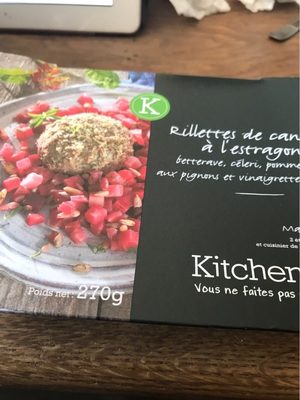
Rillette de canard à l'estragon
Barcode 3700569001674
Kitchen-Diet, Kitchendiet

Rillette de canard à l'estragon

270 g
BARCODE:3700569001674
PACKAGER CODE:FR 41.106.001 CE
CATEGORIES:Meats And Their Products, Spreads, Meats, Prepared Meats, Salted Spreads, Poultries, Rillettes, Potted Meats, Ducks, White Meat Rillettes, Poultry Rillettes, Duck Rillettes
MANUFACTURING:France
COUNTRIES:France

Health

Nutrition

Nutri-Score

BGood nutritional quality

Nutri-Score data warning

Warning: the amount of fruits, vegetables and nuts is not specified on the label, it was estimated from the list of ingredients: 72

Nutrient levels

Fat in moderate quantity (10.5%)
What you need to know • A high consumption of fat, especially saturated fats, can raise cholesterol, which increases the risk of heart diseases. Recommendation: Limit the consumption of fat and saturated fat • Choose products with lower fat and saturated fat content. Source: National Health Service UK (NHS) - Fat: the facts
Saturated fat in moderate quantity (1.9%)
What you need to know • A high consumption of fat, especially saturated fats, can raise cholesterol, which increases the risk of heart diseases. Recommendation: Limit the consumption of fat and saturated fat • Choose products with lower fat and saturated fat content. Source: National Health Service UK (NHS) - Fat: the facts
Sugars in low quantity (3.8%)
What you need to know • A high consumption of sugar can cause weight gain and tooth decay. It also augments the risk of type 2 diabetes and cardio-vascular diseases. Recommendation: Limit the consumption of sugar and sugary drinks • Sugary drinks (such as sodas, fruit beverages, and fruit juices and nectars) should be limited as much as possible (no more than 1 glass a day). • Choose products with lower sugar content and reduce the consumption of products with added sugars. Source: National Health Service UK (NHS) - Sugar: the facts
Salt in moderate quantity (0.7%)
What you need to know • A high consumption of salt (or sodium) can cause raised blood pressure, which can increase the risk of heart disease and stroke. • Many people who have high blood pressure do not know it, as there are often no symptoms. • Most people consume too much salt (on average 9 to 12 grams per day), around twice the recommended maximum level of intake. Recommendation: Limit the consumption of salt and salted food • Reduce the quantity of salt used when cooking, and don't salt again at the table. • Limit the consumption of salty snacks and choose products with lower salt content. Source: World Health Organization (WHO) - Fact sheet - Salt reduction Source: National Health Service UK (NHS) - Salt: the facts

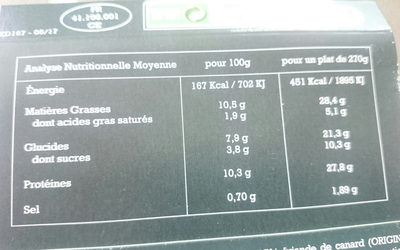
Nutrition label

Rillette de canard à l'estragon nutrition label

Nutrition facts

Nutrition factsAs sold for 100 g / 100 mlCompared to: Duck rillettes
Energy~ 697.9 kJ (167 kcal)1,641.204 kJ (394 kcal) (-57%)
Fat10.5 g36.595 g (-71%)
Saturated fat1.9 g12.333 g (-85%)
Carbohydrates7.9 g0.601 g (+1214%)
Sugars3.8 g0.262 g (+1350%)
Dietary fiber??
Proteins10.3 g15.875 g (-35%)
Salt0.7 g1.363 g (-49%)
Sodium0.28 g0.545 g (-49%)
Fruits, vegetables and legumes~ 70.8 %?

Nutrition facts (Detailed data)

Nutrition factsAs sold for 100 g / 100 mlAs sold Per 100 g (packaging)As sold Per 100 g (estimate)
Energy~ 697.9 kJ (167 kcal)? (167 kcal)?
Fat10.5 g10.5 g?
Saturated fat1.9 g1.9 g?
Carbohydrates7.9 g7.9 g?
Sugars3.8 g3.8 g?
Dietary fiber???
Proteins10.3 g10.3 g?
Salt0.7 g0.7 g?
Sodium0.28 g0.28 g?
Fruits, vegetables and legumes~ 70.8 %?~ 70.8 %

Serving size

270g

Ingredients

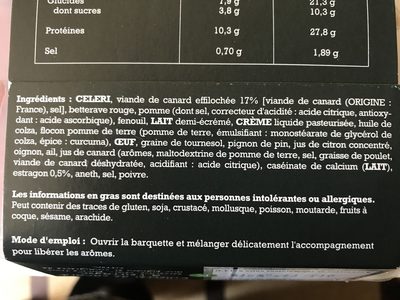
Ingredients image

Rillette de canard à l'estragon ingredients image

Ingredients list

céleri, viande de canard effilochée 17% (viande de canard, sel), betterave rouge, pomme (sel, acide citrique, acide ascorbique), fenouil, lait demi-écrémé, crème liquide pasteurisée, huile de colza, flocon pomme de terre (pomme de terre, monostéarate de glycérol de colza, curcuma), oeuf, graine de tournesol, pignon de pin, jus de citron concentré, oignon, ail, jus de canard (arômes, maltodextrine de pomme de terre, sel, graisse de poulet, viande de canard déshydratée, acide citrique), caséinate de calcium, estragon 0,5%, aneth, sel, poivre

Ingredient information

Celery
54.8% (estimate)
Viande De Canard Effilochee
17.0%
Duck Meat
16.65% (estimate)
Salt
0.35% (estimate)
Red Beetroot
8.75% (estimate)
Apple
1.3% (estimate)
Salt
0.43% (estimate)
E330
0.35% (estimate)
E300
0.52% (estimate)
Fennel
1.3% (estimate)
Semi Skimmed Milk
1.3% (estimate)
Creme Liquide Pasteurisee
1.3% (estimate)
Colza Oil
1.3% (estimate)
Potato Flakes
1.3% (estimate)
Potato
0.73% (estimate)
Glycerol Monostearate
0.28% (estimate)
Turmeric
0.28% (estimate)
Egg
1.3% (estimate)
Sunflower Seed
1.3% (estimate)
Pine Nuts
1.3% (estimate)
Concentrated Lemon Juice
1.3% (estimate)
Onion
1.3% (estimate)
Garlic
1.3% (estimate)
Duck
1.3% (estimate)
Flavouring
0.65% (estimate)
Potato Maltodextrin
0.32% (estimate)
Salt
0.16% (estimate)
Chicken Fat
0.08% (estimate)
Duck Meat
0.04% (estimate)
E330
0.04% (estimate)
Calcium Caseinate
1.3% (estimate)
Tarragon
0.5%
Dill
0.25% (estimate)
Salt
0.25% (estimate)
Pepper
0.25% (estimate)

Allergens

CeleryEggsMilkCreme Liquide Pasteurisee

Traces

CrustaceansFishGlutenMolluscsMustardNutsPeanutsSesame SeedsSoybeans

Ingredients analysis

Palm oil free
Unknown

Palm oil content unknown

Vegan
No

Contains non-vegan ingredients.

Unrecognized: fr:creme-liquide-pasteurisee, en:glycerol-monostearate

Vegetarian
No

Contains non-vegetarian ingredients.

Unrecognized: fr:creme-liquide-pasteurisee, en:glycerol-monostearate


Food Processing

NOVA group

4Ultra-processed food and drink products

Elements that indicate the product is in NOVA group 4

Additives
E471 - Mono- and diglycerides of fatty acids
Ingredients
Flavouring
Ingredients
Maltodextrin

How NOVA works

The NOVA classification assigns food products into 4 groups based on their degree of processing: 1. Unprocessed or minimally processed foods 2. Processed culinary ingredients 3. Processed foods 4. Ultra-processed food and drink products

Additives

E330 - Citric acidAntioxidantSequestrant

Citric acid is a natural organic acid found in citrus fruits such as lemons, oranges, and limes.

It is widely used in the food industry as a flavor enhancer, acidulant, and preservative due to its tart and refreshing taste.

Citric acid is safe for consumption when used in moderation and is considered a generally recognized as safe (GRAS) food additive by regulatory agencies worldwide.

E471 - Mono- and diglycerides of fatty acidsEmulsifierStabiliser

Mono- and diglycerides of fatty acids (E471), are food additives commonly used as emulsifiers in various processed foods.

These compounds consist of glycerol molecules linked to one or two fatty acid chains, which help stabilize and blend water and oil-based ingredients. E471 enhances the texture and shelf life of products like margarine, baked goods, and ice cream, ensuring a smooth and consistent texture.

It is generally considered safe for consumption within established regulatory limits.

Environment

Green-Score, origins bonus, and transportation impact are shown for Worldwide .

Green Score

Overall grade

EVery high environmental impact

About Green-Score

The Green-Score is an experimental score that summarizes the environmental impacts of food products.

Current scope

The Green-Score was initially developed for France and it is being extended to other European countries. The Green-Score formula is subject to change as it is regularly improved to make it more precise and better suited to each country. Select a country to include the full impact of transportation in the final score.

Life cycle analysis

Average impact of the category

CRillettes, duck • Score: 45/100

Life-cycle reference

Category: Rillettes, duck PEF environmental score: 0.63 Climate change impact: 6.51 kg CO2 eq / kg product The overall environmental impact figure (PEF) comes from ADEME's Agribalyse database, for the category: Rillettes, duck. Source: ADEME Agribalyse Database.

Overall environmental impact by stage (PEF)

The overall environmental impact figure (PEF) comes from ADEME's Agribalyse database, for the category: Rillettes, duck. Source: ADEME Agribalyse Database.

StageImpact
Agriculture45.1 %
Processing40.2 %
Packaging12.5 %
Transportation2.2 %
Distribution0.1 %
Consumption0.0 %

Bonuses and maluses

Declared origins

Origins of ingredients are missing for this product. Ingredients need to be completed before the transportation bonus can be computed precisely.

Packaging impact

Packaging with a high impact Malus: -15 The information about the packaging of this product is not filled in.

Green-Score for this product

Green-Score for this product

EFinal score: 25/100

Final score breakdown

Life cycle analysis score: 45 Sum of bonuses and maluses: -20 Final score: 25/100

Carbon footprint

Carbon footprint

Equivalent to driving 3.4 km in a petrol car. 651 g CO2e per 100g of product. Reference category: Rillettes, duck. The carbon emission figure comes from ADEME's Agribalyse database, for the category: Rillettes, duck. Source: ADEME Agribalyse Database.

Climate impact by stage (CO2e)

The carbon emission figure comes from ADEME's Agribalyse database, for the category: Rillettes, duck. Source: ADEME Agribalyse Database.

StageImpact
Agriculture27.2 %
Processing55.5 %
Packaging14.5 %
Transportation2.8 %
Distribution0.1 %
Consumption0.0 %

Packaging

Packaging impact

Packaging with a high impact Malus: -15 The information about the packaging of this product is not filled in.

Data precision

The packaging information is not sufficiently precise to compute the most accurate packaging impact. Exact shapes and materials of all packaging components help improve the Green-Score.

Transportation

Manufacturing locations

France

Declared origins

Origins of ingredients are missing for this product. Ingredients need to be completed before the transportation bonus can be computed precisely.

Forest footprint

Forest footprint

Total forest footprint: 0.00 m2 per kg of food This estimate highlights ingredients that depend on soy-linked animal feed and deforestation risk.

Ingredients linked to forest pressure

IngredientTypePercent in productForest footprint
EGGOeufs Importés1.30 %0.00

Data Source

Product data comes from Open Food Facts. Food Benchmark also adds translations, category comparisons and explanatory calculations.

The database is licensed under ODbL 1.0, individual contents under DbCL 1.0, and product photos under CC BY-SA 3.0.

Product added on March 21, 2018 at 10:11:47 AM UTC by kiliweb .

Last edit on March 17, 2026 at 9:39:07 AM UTC by new-nutrition-bot .

Product page also edited by kiliweb, new-nutrition-bot, openfoodfacts-contributors, sebleouf, tardaf, teolemon, yuka.RnIxYkxKNWYrYWNRaTgxdjhBcldwUHh2bUxXUEFsS0hkdFVUSWc9PQ.