
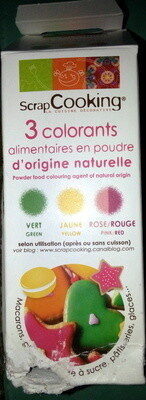
3 colorants alimentaires en poudre d'origine naturelle
Health
Nutrition
Nutri-Score data warning
Nutrition facts
| Nutrition facts | As sold for 100 g / 100 ml | Compared to: Food colorings |
|---|---|---|
| Energy | ? | 659.23 kJ (158 kcal) |
| Fat | ? | 2.426 g |
| Saturated fat | ? | 1.161 g |
| Carbohydrates | ? | 30.703 g |
| Sugars | ? | 12.564 g |
| Dietary fiber | ? | ? |
| Proteins | ? | 1.489 g |
| Salt | ? | 0.566 g |
| Fruits, vegetables and legumes | ~ 0 % | ? |
Nutrition facts (Detailed data)
| Nutrition facts | As sold for 100 g / 100 ml | As sold Per 100 g (packaging) | As sold Per 100 g (estimate) |
|---|---|---|---|
| Energy | ? | ? | ? |
| Fat | ? | ? | ? |
| Saturated fat | ? | ? | ? |
| Carbohydrates | ? | ? | ? |
| Sugars | ? | ? | ? |
| Dietary fiber | ? | ? | ? |
| Proteins | ? | ? | ? |
| Salt | ? | ? | ? |
| Fruits, vegetables and legumes | ~ 0 % | ? | ~ 0 % |
Ingredients
Ingredients image
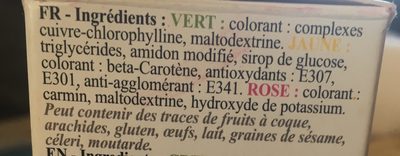
Ingredients list
Ingredient information
Ingredients analysis
Palm oil content unknown
Vegan status unknown
Unrecognized: fr:chlorophylline-cuivrique, fr:gomme-d-accacia, fr:rose
Vegetarian status unknown
Unrecognized: fr:chlorophylline-cuivrique, fr:gomme-d-accacia, fr:rose
Food Processing
NOVA group
 Ultra-processed food and drink products
Elements that indicate the product is in NOVA group 4
How NOVA works
Additives
E140 - Chlorophylls and ChlorophyllinsColour
CHLOROPHYLL is any of several related green pigments found in cyanobacteria and the chloroplasts of algae and plants. Chefs use chlorophyll to color a variety of foods and beverages green, such as pasta and spirits.
E140ii - ChlorophyllinsColour
No additive description is available yet.
E161b - LuteinColour
LUTEIN is a xanthophyll and one of 600 known naturally occurring carotenoids. Lutein is extracted from the petals of African marigold (Tagetes erecta). It is approved for use in the EU and Australia and New Zealand. In the United States lutein may not be used as a food coloring for foods intended for human consumption, but can be added to animal feed.
E304 - Fatty acid esters of ascorbic acidAntioxidant
ASCORBYL PALMITATE is an ester formed from ascorbic acid and palmitic acid creating a fat-soluble form of vitamin C.
E304i - Ascorbyl palmitateAntioxidant
No additive description is available yet.
E307 - Alpha-tocopherol
α-Tocopherol is a type of vitamin E. It has E number "E307". Vitamin E exists in eight different forms, four tocopherols and four tocotrienols. All feature a chromane ring, with a hydroxyl group that can donate a hydrogen atom to reduce free radicals and a hydrophobic side chain which allows for penetration into biological membranes. Compared to the others, α-tocopherol is preferentially absorbed and accumulated in humans.
E330 - Citric acidAntioxidantSequestrant
Citric acid is a natural organic acid found in citrus fruits such as lemons, oranges, and limes.
It is widely used in the food industry as a flavor enhancer, acidulant, and preservative due to its tart and refreshing taste.
Citric acid is safe for consumption when used in moderation and is considered a generally recognized as safe (GRAS) food additive by regulatory agencies worldwide.
E551 - Silicon dioxideCarrier
Silicon dioxide, also known as silica, silicic acid or silicic acid anydride is an oxide of silicon with the chemical formula SiO2, most commonly found in nature as quartz and in various living organisms. In many parts of the world, silica is the major constituent of sand. Silica is one of the most complex and most abundant families of materials, existing as a compound of several minerals and as synthetic product. Notable examples include fused quartz, fumed silica, silica gel, and aerogels. It is used in structural materials, microelectronics (as an electrical insulator), and as components in the food and pharmaceutical industries. Inhaling finely divided crystalline silica is toxic and can lead to severe inflammation of the lung tissue, silicosis, bronchitis, lung cancer, and systemic autoimmune diseases, such as lupus and rheumatoid arthritis. Uptake of amorphous silicon dioxide, in high doses, leads to non-permanent short-term inflammation, where all effects heal.
Environment
Green-Score, origins bonus, and transportation impact are shown for Worldwide .
Green Score
Overall grade
 Unknown environmental impact
About Green-Score
Current scope
Green-Score availability
Bonuses and maluses
Declared origins
Packaging impact
Packaging
Packaging impact
Packaging components
| Shape | Material | Recycling | Impact |
|---|---|---|---|
| Unknown | Plastic | Unknown | High |
| Unknown | Cardboard | Unknown | Low |
Declared packaging
Data precision
Transportation
Declared origins
Forest footprint
Forest footprint
Deforestation risk details
Data Source
Product data comes from Open Food Facts. Food Benchmark also adds translations, category comparisons and explanatory calculations.
The database is licensed under ODbL 1.0, individual contents under DbCL 1.0, and product photos under CC BY-SA 3.0.
Product added on December 15, 2013 at 5:06:26 PM UTC by jeanbono .
Last edit on March 17, 2026 at 11:34:06 PM UTC by new-nutrition-bot .
Product page also edited by date-limite-app, jeanbono, kiliweb, new-nutrition-bot, openfoodfacts-contributors, packbot, teolemon, yuka.Um9JTkZZc3Fpdmt1dWNVOXdVakswTXdrNTdTbUEzKzdMN0lUSWc9PQ, yuka.sY2b0xO6T85zoF3NwEKvlkIefN_eg2_2LQLkhUaqwcXeK73mO8No69n9aqo.