
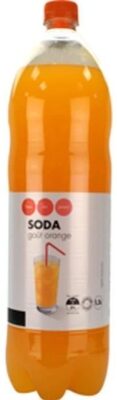
Soda Pué orange
Health
Nutrition
Nutri-Score
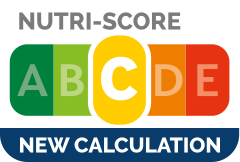 Average nutritional quality
Nutrient levels
Fat in low quantity (0%)
Saturated fat in low quantity (0%)
Sugars in low quantity (1.5%)
Salt in low quantity (0%)
Nutrition label

Nutrition facts
| Nutrition facts | As sold for 100 ml | Compared to: fr:Limonades et tonics |
|---|---|---|
| Energy | 31 kJ (7 kcal) | 100.569 kJ (24 kcal) (-69%) |
| Fat | 0 g | 0.024 g (-100%) |
| Saturated fat | 0 g | 0.002 g (-100%) |
| Carbohydrates | 1.8 g | 5.763 g (-69%) |
| Sugars | 1.5 g | 5.625 g (-73%) |
| Dietary fiber | 0 g | ? |
| Proteins | 0 g | 0 g |
| Salt | 0 g | 0.021 g (-100%) |
| Sodium | 0 g | 0.008 g (-100%) |
| Fruits, vegetables and legumes | ~ 14 % | ? |
Nutrition facts (Detailed data)
| Nutrition facts | As sold for 100 ml | As sold Per 100 ml (packaging) | As sold Per 100 g (estimate) |
|---|---|---|---|
| Energy | 31 kJ (7 kcal) | 31 kJ (7 kcal) | ~ 39.22 kJ (9 kcal) |
| Fat | 0 g | 0 g | ~ 0.0206 g |
| Saturated fat | 0 g | 0 g | ~ 0.00418 g |
| Carbohydrates | 1.8 g | 1.8 g | ~ 2.1994 g |
| Sugars | 1.5 g | 1.5 g | ~ 1.7318 g |
| Dietary fiber | 0 g | 0 g | ~ 0.084 g |
| Proteins | 0 g | 0 g | ~ 0.1031 g |
| Salt | 0 g | 0 g | ~ 0.01799 g |
| Sodium | 0 g | 0 g | ~ 0.0066868 g |
| Fruits, vegetables and legumes | ~ 14 % | ? | ~ 14 % |
Serving size
Ingredients
Ingredients image

Ingredients list
Ingredient information
Ingredients analysis
No ingredients containing palm oil.
Vegan status unknown
Vegetarian status unknown
Food Processing
NOVA group
 Ultra-processed food and drink products
Elements that indicate the product is in NOVA group 4
How NOVA works
Additives
E300 - Ascorbic acidAntioxidantSequestrant
No additive description is available yet.
E330 - Citric acidAntioxidantSequestrant
Citric acid is a natural organic acid found in citrus fruits such as lemons, oranges, and limes.
It is widely used in the food industry as a flavor enhancer, acidulant, and preservative due to its tart and refreshing taste.
Citric acid is safe for consumption when used in moderation and is considered a generally recognized as safe (GRAS) food additive by regulatory agencies worldwide.
E951 - Aspartame EFSA overexposure risk: noSweetener
Aspartame (E951) is a low-calorie artificial sweetener composed of two amino acids.
It is used as a sugar substitute in thousands of "sugar-free" or "diet" products, such as carbonated soft drinks, chewing gum, yogurts, and tabletop sweeteners, to provide sweetness without the calories of sugar.
Despite being one of the most rigorously tested food additives, its safety remains controversial. While major regulatory bodies like the FDA and EFSA deem it safe for the general public, the IARC has classified it as "possibly carcinogenic to humans" (Group 2B). It must also be avoided by individuals with the genetic condition phenylketonuria (PKU).
E954 - saccharin and its saltsSweetener
Sodium saccharin (benzoic sulfimide) is an artificial sweetener with effectively no food energy. It is about 300–400 times as sweet as sucrose but has a bitter or metallic aftertaste, especially at high concentrations. Saccharin is used to sweeten products such as drinks, candies, cookies, and medicines.
Environment
Green-Score, origins bonus, and transportation impact are shown for Worldwide .
Green Score
Overall grade
About Green-Score
Current scope
Green-Score availability
Bonuses and maluses
Declared origins
Packaging impact
Packaging
Packaging impact
Data precision
Transportation
Declared origins
Forest footprint
Forest footprint
Deforestation risk details
Additional information
- Preparation
- Servir frais.
- Conservation conditions
- Avant ouverture, à conserver dans un endroit propre et sec, à l'abri de la chaleur et de l'humidité. Après ouverture, à conserver au réfrigérateur et à consommer dans les 3 jours.
- Recycling instructions
- bouteille plastique et son bouchon
Data Source
Product data comes from Open Food Facts. Food Benchmark also adds translations, category comparisons and explanatory calculations.
The database is licensed under ODbL 1.0, individual contents under DbCL 1.0, and product photos under CC BY-SA 3.0.
Product added on May 1, 2018 at 8:47:00 PM UTC by kiliweb .
Last edit on March 17, 2026 at 9:51:41 PM UTC by new-nutrition-bot .
Product page also edited by casino, casino-off, jeanmarieluijkx, kiliweb, laura-chaud, new-nutrition-bot, openfoodfacts-contributors, org-casino, quechoisir, teolemon, yuka.R0x3YVBmcFFodlE3Z004LzVoYjh3SWtrNnAraWVHVHNHOUpNSVE9PQ, yunus2lazone.
Source List
- Casino
- casino