
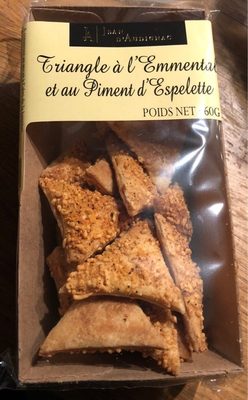
Triangle a l'emmental et au piment d'espelette
Labels
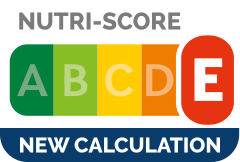 Bad nutritional quality
 Ultra-processed food and drink products
 Low environmental impact
Health
Nutrition
Label
Bad nutritional qualityNutrient levels
Fat in high quantity (27%)
Saturated fat in high quantity (18%)
Sugars in low quantity (3.5%)
Salt in high quantity (2.8%)
Nutrition facts
| Nutrition facts | As sold for 100 g / 100 ml |
|---|---|
| Energy | ~ 2,070 kJ (500 kcal) |
| FAT | 27 g |
| Saturated fat | 18 g |
| Carbohydrates | 53 g |
| Sugars | 3.5 g |
| Dietary fiber | ~ 3.48 g |
| Proteins | 10 g |
| Salt | 2.8 g |
| Sodium | 1.12 g |
| Minerals | |
| Fruits, vegetables and legumes | ~ 0.4 % |
Nutrition facts (Detailed data)
| Nutrition facts | As sold for 100 g / 100 ml | As sold Per 100 g (packaging) | As sold Per 100 g (estimate) |
|---|---|---|---|
| Energy | ~ 2,070 kJ (500 kcal) | ? (500 kcal) | ~ 1,956.27 kJ (469 kcal) |
| FAT | 27 g | 27 g | ~ 30.16 g |
| Saturated fat | 18 g | 18 g | ~ 17.39 g |
| Cholesterol | ~ 0.07 g | ? | ~ 0.07 g |
| Carbohydrates | 53 g | 53 g | ~ 40.08 g |
| Sugars | 3.5 g | 3.5 g | ~ 1.4 g |
| Added sugars | ~ 0.3 g | ? | ~ 0.3 g |
| Sucrose | ~ 0.62 g | ? | ~ 0.62 g |
| Glucose | ~ 0.09 g | ? | ~ 0.09 g |
| Fructose | ~ 0.1 g | ? | ~ 0.1 g |
| Galactose | ~ 0.02 g | ? | ~ 0.02 g |
| Lactose | ~ 0.28 g | ? | ~ 0.28 g |
| Maltose | ~ 0.53 g | ? | ~ 0.53 g |
| Starch | ~ 34.66 g | ? | ~ 34.66 g |
| Polyols | ~ 0 g | ? | ~ 0 g |
| Dietary fiber | ~ 3.48 g | ? | ~ 3.48 g |
| Proteins | 10 g | 10 g | ~ 7.51 g |
| Salt | 2.8 g | 2.8 g | ~ 1.67 g |
| Sodium | 1.12 g | 1.12 g | ~ 0.66 g |
| Alcohol | ~ 0 % vol | ? | ~ 0 % vol |
| Vitamins | |||
| Vitamin A | ~ 0 g | ? | ~ 0 g |
| Beta-carotene | ~ 0 g | ? | ~ 0 g |
| Vitamin D | ~ 0 g | ? | ~ 0 g |
| Vitamin E | ~ 0 g | ? | ~ 0 g |
| Vitamin C | ~ 0 g | ? | ~ 0 g |
| Vitamin B1 | ~ 0 g | ? | ~ 0 g |
| Vitamin B2 | ~ 0 g | ? | ~ 0 g |
| Vitamin PP | ~ 0 g | ? | ~ 0 g |
| Vitamin B6 | ~ 0 g | ? | ~ 0 g |
| Vitamin B9 | ~ 0 g | ? | ~ 0 g |
| Vitamin B12 | ~ 0 g | ? | ~ 0 g |
| Pantothenic acid | ~ 0 g | ? | ~ 0 g |
| Minerals | |||
| Potassium | ~ 0.16 g | ? | ~ 0.16 g |
| Calcium | ~ 0.1 g | ? | ~ 0.1 g |
| Phosphorus | ~ 0.17 g | ? | ~ 0.17 g |
| Iron | ~ 0 g | ? | ~ 0 g |
| Magnesium | ~ 0.04 g | ? | ~ 0.04 g |
| Zinc | ~ 0 g | ? | ~ 0 g |
| Copper | ~ 0 g | ? | ~ 0 g |
| Manganese | ~ 0 g | ? | ~ 0 g |
| Selenium | ~ 0 g | ? | ~ 0 g |
| Iodine | ~ 0 g | ? | ~ 0 g |
| Fruits, vegetables and legumes | ~ 0.4 % | ? | ~ 0.4 % |
| Phylloquinone | ~ 0 g | ? | ~ 0 g |
| Water | ~ 16.02 g | ? | ~ 16.02 g |
Serving size
Estimated Activity Time
Approximate time needed to burn the energy in 100 g / 100 ml: 2,070 kJ. Reference adult weight: 70 kg. Energy density: High.
Ingredients
Ingredients image
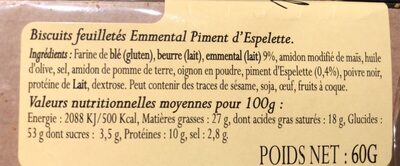
Ingredients list
Ingredient information
Allergens
Traces
Ingredients analysis
No ingredients containing palm oil.
Contains non-vegan ingredients.
Vegetarian status unknown
Food Processing
NOVA group
Ultra-processed food and drink productsElements that indicate the product is in NOVA group 4
How NOVA works
Additives
E14XX - Modified StarchEmulsifierStabiliserThickener
No additive description is available yet.
Environment
Green-Score, origins bonus, and transportation impact are shown for Worldwide .
Green Score
Overall grade
Low environmental impactAbout Green-Score
Current scope
Life cycle analysis
Average impact of the category
 Salty snacks, crackers, plain • Score: 89/100
Life-cycle reference
Overall environmental impact by stage (PEF)
The overall environmental impact figure (PEF) comes from ADEME's Agribalyse database, for the category: Salty snacks, crackers, plain. Source: ADEME Agribalyse Database.
| Stage | Impact |
|---|---|
| Agriculture | 66.3 % |
| Processing | 18.6 % |
| Packaging | 5.7 % |
| Transportation | 7.0 % |
| Distribution | 2.6 % |
| Consumption | 0.0 % |
Bonuses and maluses
Declared origins
Packaging impact
Green-Score for this product
Green-Score for this product
Final score: 73/100Final score breakdown
Carbon footprint
Carbon footprint
Climate impact by stage (CO2e)
The carbon emission figure comes from ADEME's Agribalyse database, for the category: Salty snacks, crackers, plain. Source: ADEME Agribalyse Database.
| Stage | Impact |
|---|---|
| Agriculture | 59.5 % |
| Processing | 14.8 % |
| Packaging | 11.9 % |
| Transportation | 11.8 % |
| Distribution | 1.7 % |
| Consumption | 0.0 % |
Packaging
Packaging impact
Packaging materials
| Material | % | Packaging weight | Packaging weight per 100 g of product |
|---|---|---|---|
| Paper or cardboard | |||
| Plastic | |||
| Total |
Declared packaging
Data precision
Transportation
Manufacturing locations
Declared origins
Data Source
Data presented on this page is sourced from the Open Food Facts database. This platform does not alter the original dataset; its purpose is solely to enhance data visualization and user accessibility.
Product added on April 26, 2018 at 3:45:56 PM UTC by dacaen .
Last edit on March 17, 2026 at 8:18:08 PM UTC by new-nutrition-bot .
Product page also edited by autorotate-bot, bot-tags-and-languages, dacaen, kiliweb, new-nutrition-bot, openfoodfacts-contributors, packbot, roboto-app, yuka.WjQwdUNhMGx2TkkwcHM4UXBFNkp5TmR0dzQzMWVEdTNMdWNWSVE9PQ.