
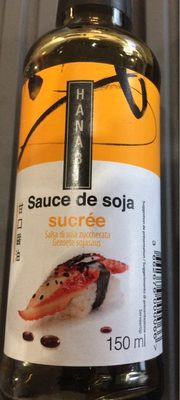
Sauce soja sucrée
Labels
 Bad nutritional quality
 Processed foods
 Very low environmental impact
Health
Nutrition
Label
Bad nutritional qualityNutrient levels
Fat in low quantity (0%)
Saturated fat in low quantity (0%)
Sugars in high quantity (58%)
Salt in high quantity (7.8%)
Nutrition label

Nutrition facts
| Nutrition facts | As sold for 100 ml |
|---|---|
| Energy | ~ 1,091.4 kJ (257 kcal) |
| FAT | 0 g |
| Saturated fat | 0 g |
| Carbohydrates | 60 g |
| Sugars | 58 g |
| Dietary fiber | 0 g |
| Proteins | 4.2 g |
| Salt | 7.8 g |
| Sodium | 3.12 g |
| Minerals | |
| Fruits, vegetables and legumes | ~ 10.94 % |
Nutrition facts (Detailed data)
| Nutrition facts | As sold for 100 ml | As sold Per 100 ml (packaging) | As sold Per 100 g (estimate) |
|---|---|---|---|
| Energy | ~ 1,091.4 kJ (257 kcal) | ? (257 kcal) | ~ 1,155.97 kJ (272 kcal) |
| FAT | 0 g | 0 g | ~ 0.19 g |
| Saturated fat | 0 g | 0 g | ~ 0.03 g |
| Cholesterol | ~ 0 g | ? | ~ 0 g |
| Carbohydrates | 60 g | 60 g | ~ 64.44 g |
| Sugars | 58 g | 58 g | ~ 56.6 g |
| Added sugars | ~ 56.25 g | ? | ~ 56.25 g |
| Sucrose | ~ 56.23 g | ? | ~ 56.23 g |
| Glucose | ~ 0.18 g | ? | ~ 0.18 g |
| Fructose | ~ 0.04 g | ? | ~ 0.04 g |
| Galactose | ~ 0.01 g | ? | ~ 0.01 g |
| Lactose | ~ 0.03 g | ? | ~ 0.03 g |
| Maltose | ~ 0.15 g | ? | ~ 0.15 g |
| Starch | ~ 6.6 g | ? | ~ 6.6 g |
| Polyols | ~ 0 g | ? | ~ 0 g |
| Dietary fiber | 0 g | 0 g | ~ 0.93 g |
| Proteins | 4.2 g | 4.2 g | ~ 2.6 g |
| Salt | 7.8 g | 7.8 g | ~ 8.75 g |
| Sodium | 3.12 g | 3.12 g | ~ 3.5 g |
| Alcohol | ~ 4.15 % vol | ? | ~ 4.15 % vol |
| Vitamins | |||
| Vitamin A | ~ 0 g | ? | ~ 0 g |
| Beta-carotene | ~ 0 g | ? | ~ 0 g |
| Vitamin D | ~ 0 g | ? | ~ 0 g |
| Vitamin E | ~ 0 g | ? | ~ 0 g |
| Vitamin C | ~ 0 g | ? | ~ 0 g |
| Vitamin B1 | ~ 0 g | ? | ~ 0 g |
| Vitamin B2 | ~ 0 g | ? | ~ 0 g |
| Vitamin PP | ~ 0 g | ? | ~ 0 g |
| Vitamin B6 | ~ 0 g | ? | ~ 0 g |
| Vitamin B9 | ~ 0 g | ? | ~ 0 g |
| Vitamin B12 | ~ 0 g | ? | ~ 0 g |
| Pantothenic acid | ~ 0 g | ? | ~ 0 g |
| Minerals | |||
| Potassium | ~ 0.16 g | ? | ~ 0.16 g |
| Calcium | ~ 0.01 g | ? | ~ 0.01 g |
| Phosphorus | ~ 0.05 g | ? | ~ 0.05 g |
| Iron | ~ 0 g | ? | ~ 0 g |
| Magnesium | ~ 0.03 g | ? | ~ 0.03 g |
| Zinc | ~ 0 g | ? | ~ 0 g |
| Copper | ~ 0 g | ? | ~ 0 g |
| Manganese | ~ 0 g | ? | ~ 0 g |
| Selenium | ~ 0 g | ? | ~ 0 g |
| Iodine | ~ 0 g | ? | ~ 0 g |
| Fruits, vegetables and legumes | ~ 10.94 % | ? | ~ 10.94 % |
| Phylloquinone | ~ 0 g | ? | ~ 0 g |
| Water | ~ 18.28 g | ? | ~ 18.28 g |
Estimated Activity Time
Approximate time needed to burn the energy in 100 g / 100 ml: 1,091 kJ. Reference adult weight: 70 kg. Energy density: Moderate.
Ingredients
Ingredients image

Ingredients list
Ingredient information
Allergens
Ingredients analysis
No ingredients containing palm oil.
Vegan status unknown
No non-vegetarian ingredients.
Food Processing
NOVA group
Processed foodsElements that indicate the product is in NOVA group 3
How NOVA works
Additives
E1510 - Ethanol
Ethanol, also called alcohol, ethyl alcohol, grain alcohol, and drinking alcohol, is a chemical compound, a simple alcohol with the chemical formula C2H5OH. Its formula can be also written as CH3−CH2−OH or C2H5−OH (an ethyl group linked to a hydroxyl group), and is often abbreviated as EtOH. Ethanol is a volatile, flammable, colorless liquid with a slight characteristic odor. It is a psychoactive substance and is the principal type of alcohol found in alcoholic drinks. Ethanol is naturally produced by the fermentation of sugars by yeasts or via petrochemical processes, and is most commonly consumed as a popular recreational drug. It also has medical applications as an antiseptic and disinfectant. The compound is widely used as a chemical solvent, either for scientific chemical testing or in synthesis of other organic compounds, and is a vital substance used across many different kinds of manufacturing industries. Ethanol is also used as a clean-burning fuel source.
Environment
Green-Score, origins bonus, and transportation impact are shown for Worldwide .
Green Score
Overall grade
Very low environmental impactAbout Green-Score
Current scope
Life cycle analysis
Average impact of the category
 Soy sauce, prepacked • Score: 95/100
Life-cycle reference
Overall environmental impact by stage (PEF)
The overall environmental impact figure (PEF) comes from ADEME's Agribalyse database, for the category: Soy sauce, prepacked. Source: ADEME Agribalyse Database.
| Stage | Impact |
|---|---|
| Agriculture | 10.6 % |
| Processing | 22.7 % |
| Packaging | 44.3 % |
| Transportation | 13.2 % |
| Distribution | 7.3 % |
| Consumption | 1.9 % |
Bonuses and maluses
Declared origins
Packaging impact
Green-Score for this product
Green-Score for this product
Final score: 80/100Final score breakdown
Carbon footprint
Carbon footprint
Climate impact by stage (CO2e)
The carbon emission figure comes from ADEME's Agribalyse database, for the category: Soy sauce, prepacked. Source: ADEME Agribalyse Database.
| Stage | Impact |
|---|---|
| Agriculture | 12.9 % |
| Processing | 15.9 % |
| Packaging | 41.6 % |
| Transportation | 24.0 % |
| Distribution | 4.8 % |
| Consumption | 0.7 % |
Packaging
Packaging impact
Packaging materials
| Material | % | Packaging weight | Packaging weight per 100 g of product |
|---|---|---|---|
| Unknown | |||
| Total |
Declared packaging
Data precision
Transportation
Declared origins
Data Source
Data presented on this page is sourced from the Open Food Facts database. This platform does not alter the original dataset; its purpose is solely to enhance data visualization and user accessibility.
Product added on June 13, 2015 at 4:40:27 PM UTC by date-limite-app .
Last edit on March 17, 2026 at 9:04:40 PM UTC by new-nutrition-bot .
Product page also edited by date-limite-app, foodvisor, gluten-scan, kiliweb, nemesisereborn, new-nutrition-bot, openfoodfacts-contributors, packbot, roboto-app, sabrinka, segundo, yuka.EOFDYOayDt4MQfqJgboE-DLnSeS_Bu96Km8Cog, yuka.WHJvbkRyZ1J1S01Udk1RQnpBSG8rZTVKNDZlTVFVTzlETTQ2SVE9PQ.