

Filet de poulet tranches épaisses doré au four
Labels
 Moderate nutritional quality
 Ultra-processed food and drink products
Health
Nutrition
Label
Moderate nutritional qualityNutrient levels
Fat in low quantity (1.6%)
Saturated fat in low quantity (0.5%)
Sugars in low quantity (0.5%)
Salt in high quantity (1.9%)
Nutrition label
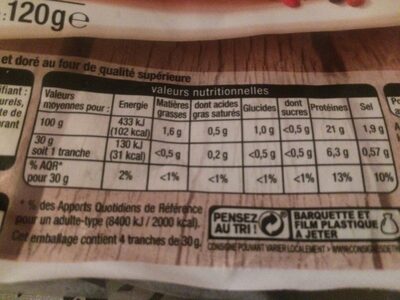
Nutrition facts
| Nutrition facts | As sold for 100 g / 100 ml |
|---|---|
| Energy | 433 kJ (102 kcal) |
| FAT | 1.6 g |
| Saturated fat | 0.5 g |
| Carbohydrates | 1 g |
| Sugars | 0.5 g |
| Dietary fiber | 0.5 g |
| Proteins | 21 g |
| Salt | 1.9 g |
| Sodium | 0.76 g |
| Minerals | |
| Fruits, vegetables and legumes | ~ 0 % |
Nutrition facts (Detailed data)
| Nutrition facts | As sold for 100 g / 100 ml | As sold Per 100 g (packaging) | As sold Per 100 g (estimate) |
|---|---|---|---|
| Energy | 433 kJ (102 kcal) | 433 kJ (102 kcal) | ~ 542.39 kJ (128 kcal) |
| FAT | 1.6 g | 1.6 g | ~ 1.76 g |
| Saturated fat | 0.5 g | 0.5 g | ~ 0.51 g |
| Cholesterol | ~ 0.08 g | ? | ~ 0.08 g |
| Carbohydrates | 1 g | 1 g | ~ 0.95 g |
| Sugars | 0.5 g | 0.5 g | ~ 0.95 g |
| Added sugars | ~ 0.95 g | ? | ~ 0.95 g |
| Sucrose | ~ 1.04 g | ? | ~ 1.04 g |
| Glucose | ~ 0.09 g | ? | ~ 0.09 g |
| Fructose | ~ 0.09 g | ? | ~ 0.09 g |
| Galactose | ~ 0 g | ? | ~ 0 g |
| Lactose | ~ 0.09 g | ? | ~ 0.09 g |
| Maltose | ~ 0.09 g | ? | ~ 0.09 g |
| Starch | ~ 0 g | ? | ~ 0 g |
| Polyols | ~ 0 g | ? | ~ 0 g |
| Dietary fiber | 0.5 g | 0.5 g | ~ 0 g |
| Proteins | 21 g | 21 g | ~ 26.49 g |
| Salt | 1.9 g | 1.9 g | ~ 1.05 g |
| Sodium | 0.76 g | 0.76 g | ~ 0.42 g |
| Alcohol | ~ 0 % vol | ? | ~ 0 % vol |
| Vitamins | |||
| Vitamin A | ~ 0 g | ? | ~ 0 g |
| Beta-carotene | ~ 0 g | ? | ~ 0 g |
| Vitamin D | ~ 0 g | ? | ~ 0 g |
| Vitamin E | ~ 0 g | ? | ~ 0 g |
| Vitamin C | ~ 0 g | ? | ~ 0 g |
| Vitamin B1 | ~ 0 g | ? | ~ 0 g |
| Vitamin B2 | ~ 0 g | ? | ~ 0 g |
| Vitamin PP | ~ 0.01 g | ? | ~ 0.01 g |
| Vitamin B6 | ~ 0 g | ? | ~ 0 g |
| Vitamin B9 | ~ 0 g | ? | ~ 0 g |
| Vitamin B12 | ~ 0 g | ? | ~ 0 g |
| Pantothenic acid | ~ 0 g | ? | ~ 0 g |
| Minerals | |||
| Potassium | ~ 0.39 g | ? | ~ 0.39 g |
| Calcium | ~ 0 g | ? | ~ 0 g |
| Phosphorus | ~ 0.24 g | ? | ~ 0.24 g |
| Iron | ~ 0 g | ? | ~ 0 g |
| Magnesium | ~ 0.03 g | ? | ~ 0.03 g |
| Zinc | ~ 0 g | ? | ~ 0 g |
| Copper | ~ 0 g | ? | ~ 0 g |
| Manganese | ~ 0 g | ? | ~ 0 g |
| Selenium | ~ 0 g | ? | ~ 0 g |
| Iodine | ~ 0 g | ? | ~ 0 g |
| Fruits, vegetables and legumes | ~ 0 % | ? | ~ 0 % |
| Phylloquinone | ~ 0 g | ? | ~ 0 g |
| Water | ~ 66.07 g | ? | ~ 66.07 g |
Serving size
Estimated Activity Time
Approximate time needed to burn the energy in 100 g / 100 ml: 433 kJ. Reference adult weight: 70 kg. Energy density: Low.
Ingredients
Ingredients image

Ingredients list
Ingredient information
Ingredients analysis
No ingredients containing palm oil.
Contains non-vegan ingredients.
Unrecognized: fr:elabore-a-partir-de-poulet
Contains non-vegetarian ingredients.
Unrecognized: fr:elabore-a-partir-de-poulet
Food Processing
NOVA group
Ultra-processed food and drink productsElements that indicate the product is in NOVA group 4
How NOVA works
Additives
E150a - Plain caramelColour
Caramel color or caramel coloring is a water-soluble food coloring.
E250 - Sodium nitritePreservative
Sodium nitrite (E250) is a salt used for curing and preserving meat products.
It plays a critical role in preventing the growth of Clostridium botulinum, the bacterium responsible for botulism, in cured meats like bacon, ham, and sausages. It also provides the characteristic pink color and flavor.
However, nitrites can react with amines in the stomach to form nitrosamines, which are potent carcinogens. High intake of processed meats containing nitrites is associated with an increased risk of colorectal cancer. Regulatory bodies have set strict limits on its use in food.
E301 - Sodium ascorbateAntioxidant
SODIUM ASCORBATE is one of a number of mineral salts of ascorbic acid (vitamin C).
E407a - Processed eucheuma seaweedCarrierEmulsifierHumectantStabiliserThickener
Carrageenans or carrageenins ( karr-ə-gee-nənz, from Irish carraigín, "little rock") are a family of linear sulfated polysaccharides that are extracted from red edible seaweeds. They are widely used in the food industry, for their gelling, thickening, and stabilizing properties. Their main application is in dairy and meat products, due to their strong binding to food proteins. There are three main varieties of carrageenan, which differ in their degree of sulfation. Kappa-carrageenan has one sulfate group per disaccharide, iota-carrageenan has two, and lambda-carrageenan has three. Gelatinous extracts of the Chondrus crispus (Irish moss) seaweed have been used as food additives since approximately the fifteenth century. Carrageenan is a vegetarian and vegan alternative to gelatin in some applications or may be used to replace gelatin in confectionery.
Environment
Green-Score, origins bonus, and transportation impact are shown for Worldwide .
Green Score
Overall grade
About Green-Score
Current scope
Life cycle analysis
Average impact of the category
 Chicken cooked ham, in slices • Score: 31/100
Life-cycle reference
Overall environmental impact by stage (PEF)
The overall environmental impact figure (PEF) comes from ADEME's Agribalyse database, for the category: Chicken cooked ham, in slices. Source: ADEME Agribalyse Database.
| Stage | Impact |
|---|---|
| Agriculture | 76.9 % |
| Processing | 10.0 % |
| Packaging | 9.2 % |
| Transportation | 2.3 % |
| Distribution | 1.0 % |
| Consumption | 0.3 % |
Bonuses and maluses
Origins of ingredients
Packaging impact
Green-Score for this product
Green-Score for this product
Final score breakdown
Carbon footprint
Carbon footprint
Climate impact by stage (CO2e)
The carbon emission figure comes from ADEME's Agribalyse database, for the category: Chicken cooked ham, in slices. Source: ADEME Agribalyse Database.
| Stage | Impact |
|---|---|
| Agriculture | 63.6 % |
| Processing | 18.5 % |
| Packaging | 11.9 % |
| Transportation | 5.2 % |
| Distribution | 0.7 % |
| Consumption | 0.1 % |
Packaging
Packaging impact
Data precision
Transportation
Origins of ingredients
Origins breakdown
| Origin | Percent of ingredients | Impact |
|---|---|---|
| Unknown | 100 % | High |
| France | 0 % | High |
Forest footprint
Forest footprint
Ingredients linked to forest pressure
| Ingredient | Type | Percent in product | Forest footprint |
|---|---|---|---|
| Chicken Fillet | Poulet Importé | 88.00 % | 2.52 |
Data Source
Data presented on this page is sourced from the Open Food Facts database. This platform does not alter the original dataset; its purpose is solely to enhance data visualization and user accessibility.
Product added on October 17, 2017 at 10:19:58 PM UTC by kiliweb .
Last edit on March 17, 2026 at 8:25:29 PM UTC by new-nutrition-bot .
Product page also edited by autorotate-bot, fix-salt-bot, kiliweb, moon-rabbit, new-nutrition-bot, openfoodfacts-contributors, org-auchan-apaw, roboto-app, spotter, teolemon, yuka.L5tYJoeKDvcdRvbt-q0GzD7gNcbuKaNTQncRog, yuka.WTdnZEhaa2FsdmdOa01aazNTMzgzZGxTbXBXSVhsMnhJcll2SVE9PQ, yuka.YmJzeUhyZ2Y5L2tJbC8wMzhoN3g2TzFUM2NmMVZ6bUpkT1UrSVE9PQ.
Source List
- auchan-apaw