

Chair de crabe
Labels
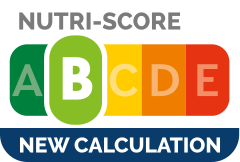 Good nutritional quality
 Ultra-processed food and drink products
 Green-Score not computed
Health
Nutrition
Label
Good nutritional qualityNutrient levels
Fat in low quantity (0.5%)
Saturated fat in low quantity (0.5%)
Sugars in low quantity (1.2%)
Salt in moderate quantity (1.4%)
Nutrition label
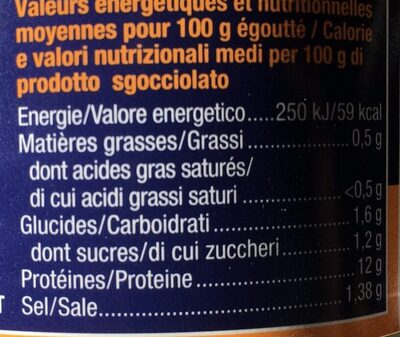
Nutrition facts
| Nutrition facts | As sold for 100 g / 100 ml |
|---|---|
| Energy | ~ 249.7 kJ (59 kcal) |
| FAT | 0.5 g |
| Saturated fat | 0.5 g |
| Carbohydrates | 1.6 g |
| Sugars | 1.2 g |
| Dietary fiber | ? |
| Proteins | 12 g |
| Salt | 1.4 g |
| Sodium | 0.56 g |
| Minerals | |
| Fruits, vegetables and legumes | ~ 0 % |
Nutrition facts (Detailed data)
| Nutrition facts | As sold for 100 g / 100 ml | As sold Per 100 g (packaging) | As sold Per 100 g (estimate) |
|---|---|---|---|
| Energy | ~ 249.7 kJ (59 kcal) | ? (59 kcal) | ? |
| FAT | 0.5 g | 0.5 g | ? |
| Saturated fat | 0.5 g | 0.5 g | ? |
| Carbohydrates | 1.6 g | 1.6 g | ? |
| Sugars | 1.2 g | 1.2 g | ? |
| Added sugars | ~ 0.6 g | ? | ~ 0.6 g |
| Dietary fiber | ? | ? | ? |
| Proteins | 12 g | 12 g | ? |
| Salt | 1.4 g | 1.4 g | ? |
| Sodium | 0.56 g | 0.56 g | ? |
| Minerals | |||
| Fruits, vegetables and legumes | ~ 0 % | ? | ~ 0 % |
Estimated Activity Time
Approximate time needed to burn the energy in 100 g / 100 ml: 250 kJ. Reference adult weight: 70 kg. Energy density: Low.
Ingredients
Ingredients image
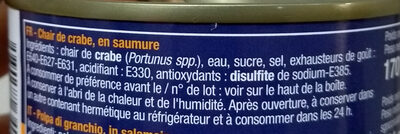
Ingredients list
Ingredient information
Allergens
Ingredients analysis
No ingredients containing palm oil.
Contains non-vegan ingredients.
Unrecognized: fr:portunus-spp
Contains non-vegetarian ingredients.
Unrecognized: fr:portunus-spp
Food Processing
NOVA group
Ultra-processed food and drink productsElements that indicate the product is in NOVA group 4
How NOVA works
Additives
E223 - Sodium metabisulphiteAntioxidantPreservative
SODIUM METABISULFITE or sodium pyrosulfite (IUPAC spelling; Br. E. sodium metabisulphite or sodium pyrosulphite) is an inorganic compound of chemical formula Na2S2O5.
E330 - Citric acidAntioxidantSequestrant
Citric acid is a natural organic acid found in citrus fruits such as lemons, oranges, and limes.
It is widely used in the food industry as a flavor enhancer, acidulant, and preservative due to its tart and refreshing taste.
Citric acid is safe for consumption when used in moderation and is considered a generally recognized as safe (GRAS) food additive by regulatory agencies worldwide.
E385 - Calcium disodium ethylenediaminetetraacetateAntioxidantPreservativeSequestrant
No additive description is available yet.
E627 - Disodium guanylate
Disodium guanylate, also known as sodium 5'-guanylate and disodium 5'-guanylate, is a natural sodium salt of the flavor enhancing nucleotide guanosine monophosphate (GMP). Disodium guanylate is a food additive with the E number E627. It is commonly used in conjunction with glutamic acid. As it is a fairly expensive additive, it is not used independently of glutamic acid; if disodium guanylate is present in a list of ingredients but MSG does not appear to be, it is likely that glutamic acid is provided as part of another ingredient such as a processed soy protein complex. It is often added to foods in conjunction with disodium inosinate; the combination is known as disodium 5'-ribonucleotides. Disodium guanylate is produced from dried seaweed and is often added to instant noodles, potato chips and other snacks, savory rice, tinned vegetables, cured meats, and packaged soup.
E631 - Disodium inosinate
Disodium inosinate (E631) is the disodium salt of inosinic acid with the chemical formula C10H11N4Na2O8P. It is used as a food additive and often found in instant noodles, potato chips, and a variety of other snacks. Although it can be obtained from bacterial fermentation of sugars, it is often commercially prepared from animal sources.
E640 - Glycine and its sodium salt
No additive description is available yet.
Environment
Green-Score, origins bonus, and transportation impact are shown for Worldwide .
Green Score
Overall grade
Unknown environmental impactAbout Green-Score
Current scope
Green-Score availability
Bonuses and maluses
Declared origins
Packaging impact
Packaging
Packaging impact
Packaging materials
| Material | % | Packaging weight | Packaging weight per 100 g of product |
|---|---|---|---|
| Unknown | |||
| Total |
Declared packaging
Data precision
Transportation
Declared origins
Data Source
Data presented on this page is sourced from the Open Food Facts database. This platform does not alter the original dataset; its purpose is solely to enhance data visualization and user accessibility.
Product added on September 23, 2017 at 8:30:24 AM UTC by kiliweb .
Last edit on March 17, 2026 at 9:14:36 PM UTC by new-nutrition-bot .
Product page also edited by date-limite-app, kiliweb, new-nutrition-bot, openfoodfacts-contributors, packbot, quechoisir, quentinbrd, ratcha, roboto-app, yuka.RnFZdkU2MHVtYUF2cXNVeXhUTFAySXhwK00vMlIwbThNZFVWSVE9PQ, yuka.SFA4Rk1ZNWFxc01QbDhFZDdDcno0YzBsNTRMNVJHcnJKdUF5SVE9PQ, yuka.VEk4N0xZOG5yZDB1Z1BNaTBDMzM5c0JOL29TMUFWam5GTThESVE9PQ, yuka.Zll3TU1hZ0NwYU5YblAwaDBqblZxNGxreVo2blhFcXVGZkFxSVE9PQ, yuka.sY2b0xO6T85zoF3NwEKvllJNfNTxiT_0bTnfyVWk-dyQFY7TYvNSztHrLag.