
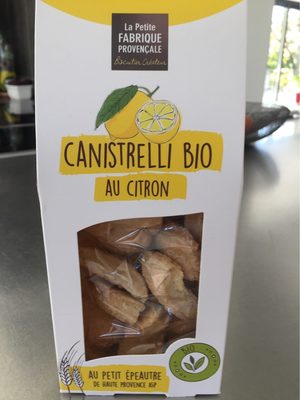
Canistrelli bio au citron
Labels
 Not computed
 Not computed
 Green-Score not computed
Health
Nutrition
Nutrition label

Nutrition facts
| Nutrition facts | As sold for 100 g / 100 ml |
|---|---|
| Energy | ~ 1,896.7 kJ (450 kcal) |
| FAT | 13 g |
| Saturated fat | 1.7 g |
| Carbohydrates | 76 g |
| Sugars | 29 g |
| Dietary fiber | 2.5 g |
| Proteins | 6.1 g |
| Salt | 0.1 g |
| Sodium | 0.04 g |
| Minerals | |
| Fruits, vegetables and legumes | ~ 0 % |
Nutrition facts (Detailed data)
| Nutrition facts | As sold for 100 g / 100 ml | As sold Per 100 g (packaging) | As sold Per 100 g (estimate) |
|---|---|---|---|
| Energy | ~ 1,896.7 kJ (450 kcal) | ? (450 kcal) | ? |
| FAT | 13 g | 13 g | ? |
| Saturated fat | 1.7 g | 1.7 g | ? |
| Carbohydrates | 76 g | 76 g | ? |
| Sugars | 29 g | 29 g | ? |
| Added sugars | ~ 0 g | ? | ~ 0 g |
| Dietary fiber | 2.5 g | 2.5 g | ? |
| Proteins | 6.1 g | 6.1 g | ? |
| Salt | 0.1 g | 0.1 g | ? |
| Sodium | 0.04 g | 0.04 g | ? |
| Minerals | |||
| Fruits, vegetables and legumes | ~ 0 % | ? | ~ 0 % |
Estimated Activity Time
Approximate time needed to burn the energy in 100 g / 100 ml: 1,897 kJ. Reference adult weight: 70 kg. Energy density: Moderate.
Ingredients
Ingredients image

Ingredients list
Ingredient information
Ingredients analysis
Palm oil content unknown
Unrecognized: fr:canistrelli-au-citron-latino-vin-blanc, fr:do-canne-toux, fr:huilo-diolivo-vierge-latino-do-potit-epoautro-do-haute, fr:5-4, fr:hutto-ossontiell-de-catton, fr:poudro-a-lovot, fr:amidon-do-ble, fr:bicarbonato-do-sodium, fr:tartrate-monopotas
Vegan status unknown
Unrecognized: fr:canistrelli-au-citron-latino-vin-blanc, fr:do-canne-toux, fr:huilo-diolivo-vierge-latino-do-potit-epoautro-do-haute, fr:5-4, fr:hutto-ossontiell-de-catton, fr:poudro-a-lovot, fr:amidon-do-ble, fr:bicarbonato-do-sodium, fr:tartrate-monopotas
Vegetarian status unknown
Unrecognized: fr:canistrelli-au-citron-latino-vin-blanc, fr:do-canne-toux, fr:huilo-diolivo-vierge-latino-do-potit-epoautro-do-haute, fr:5-4, fr:hutto-ossontiell-de-catton, fr:poudro-a-lovot, fr:amidon-do-ble, fr:bicarbonato-do-sodium, fr:tartrate-monopotas
Food Processing
NOVA group
How NOVA works
Additives
E334 - L(+)-tartaric acidAntioxidantSequestrant
TARTARIC ACID is a white, crystalline organic acid that occurs naturally in many fruits, most notably in grapes, but also in bananas, tamarinds, and citrus
Environment
Green-Score, origins bonus, and transportation impact are shown for Worldwide .
Green Score
Overall grade
Unknown environmental impactAbout Green-Score
Current scope
Green-Score availability
Bonuses and maluses
Production system
Origins of ingredients
Packaging impact
Packaging
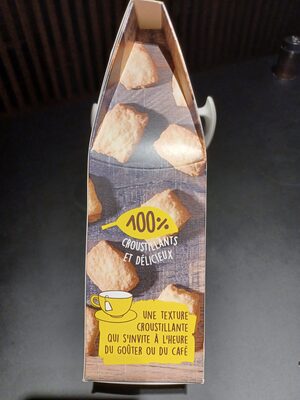
Packaging impact
Packaging materials
| Material | % | Packaging weight | Packaging weight per 100 g of product |
|---|---|---|---|
| Unknown | 100 % | ||
| Total | 100 % |
Data precision
Transportation
Origins of ingredients
Origins breakdown
| Origin | Percent of ingredients | Impact |
|---|---|---|
| France | 100 % | High |
Data Source
Data presented on this page is sourced from the Open Food Facts database. This platform does not alter the original dataset; its purpose is solely to enhance data visualization and user accessibility.
Product added on November 27, 2017 at 11:34:03 AM UTC by kiliweb .
Last edit on March 17, 2026 at 9:13:08 PM UTC by new-nutrition-bot .
Product page also edited by gooffys, kiliweb, navig491, new-nutrition-bot, openfoodfacts-contributors, roboto-app, yogoff, yuka.KoJaDoSoJMg_Jd_3zI4ywwO4H-L-XK5YMnJcog, yuka.SFo0RVQvNGlndE1sa2ZBQzRUSG82OTVyN1krSlJreTFJT1lCSVE9PQ.