

Parmentier de canard
Health
Nutrition
Nutri-Score
 Average nutritional quality
Nutri-Score data warning
Nutrient levels
Fat in moderate quantity (8.1%)
Saturated fat in moderate quantity (2.7%)
Sugars in low quantity (1.4%)
Salt in moderate quantity (0.72%)
Nutrition label

Nutrition facts
| Nutrition facts | As sold for 100 g / 100 ml | Compared to: Shepherd's pie with duck |
|---|---|---|
| Energy | 577 kJ (138 kcal) | 588.522 kJ (142 kcal) (-2%) |
| Fat | 8.1 g | 8.017 g (+1%) |
| Saturated fat | 2.7 g | 3.618 g (-25%) |
| Carbohydrates | 8.4 g | 9.804 g (-14%) |
| Sugars | 1.4 g | 1.69 g (-17%) |
| Dietary fiber | 1.1 g | ? |
| Proteins | 7.4 g | 7.151 g (+3%) |
| Salt | 0.72 g | 0.794 g (-9%) |
| Sodium | 0.288 g | 0.319 g (-10%) |
| Fruits, vegetables and legumes | ~ 9.15 % | ? |
Nutrition facts (Detailed data)
| Nutrition facts | As sold for 100 g / 100 ml | As sold Per 100 g (packaging) | As sold Per 100 g (estimate) |
|---|---|---|---|
| Energy | 577 kJ (138 kcal) | 577 kJ (138 kcal) | ~ 274.97985 kJ (65 kcal) |
| Fat | 8.1 g | 8.1 g | ~ 11.13552375 g |
| Saturated fat | 2.7 g | 2.7 g | ~ 2.4956385 g |
| Carbohydrates | 8.4 g | 8.4 g | ~ 5.67659875 g |
| Sugars | 1.4 g | 1.4 g | ~ 1.810371625 g |
| Dietary fiber | 1.1 g | 1.1 g | ~ 0.56576 g |
| Proteins | 7.4 g | 7.4 g | ~ 5.61196125 g |
| Salt | 0.72 g | 0.72 g | ~ 0.6933725075 g |
| Sodium | 0.288 g | 0.288 g | ~ 0.2768955975 g |
| Fruits, vegetables and legumes | ~ 9.15 % | ? | ~ 9.15 % |
Ingredients
Ingredients image
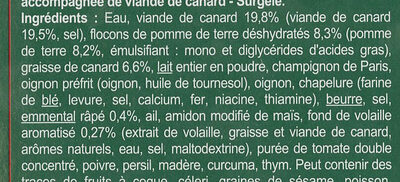
Ingredients list
Ingredient information
Allergens
Traces
Ingredients analysis
Palm oil content unknown
Contains non-vegan ingredients.
Contains non-vegetarian ingredients.
Food Processing
NOVA group
 Ultra-processed food and drink products
Elements that indicate the product is in NOVA group 4
How NOVA works
Additives
E14XX - Modified StarchEmulsifierStabiliserThickener
No additive description is available yet.
E471 - Mono- and diglycerides of fatty acidsEmulsifierStabiliser
Mono- and diglycerides of fatty acids (E471), are food additives commonly used as emulsifiers in various processed foods.
These compounds consist of glycerol molecules linked to one or two fatty acid chains, which help stabilize and blend water and oil-based ingredients. E471 enhances the texture and shelf life of products like margarine, baked goods, and ice cream, ensuring a smooth and consistent texture.
It is generally considered safe for consumption within established regulatory limits.
Environment
Green-Score, origins bonus, and transportation impact are shown for Worldwide .
Green Score
Overall grade
 Moderate environmental impact
About Green-Score
Current scope
Life cycle analysis
Average impact of the category
Shepherd's pie with duck, cooked • Score: 57/100Life-cycle reference
Overall environmental impact by stage (PEF)
The overall environmental impact figure (PEF) comes from ADEME's Agribalyse database, for the category: Shepherd's pie with duck, cooked. Source: ADEME Agribalyse Database.
| Stage | Impact |
|---|---|
| Agriculture | 66.7 % |
| Processing | 17.6 % |
| Packaging | 7.5 % |
| Transportation | 4.5 % |
| Distribution | 2.1 % |
| Consumption | 1.5 % |
Bonuses and maluses
Origins of ingredients
Packaging impact
Green-Score for this product
Green-Score for this product
Final score: 53/100Final score breakdown
Carbon footprint
Carbon footprint
Climate impact by stage (CO2e)
The carbon emission figure comes from ADEME's Agribalyse database, for the category: Shepherd's pie with duck, cooked. Source: ADEME Agribalyse Database.
| Stage | Impact |
|---|---|
| Agriculture | 62.5 % |
| Processing | 15.9 % |
| Packaging | 12.6 % |
| Transportation | 7.5 % |
| Distribution | 1.2 % |
| Consumption | 0.5 % |
Packaging

Packaging impact
Packaging components
| Shape | Material | Recycling | Impact |
|---|---|---|---|
| 1 Sleeve | Cardboard | Recycle | Low |
| 1 Film | Plastic | Discard | High |
| 1 Tray | Heavy Aluminium | Recycle | Medium |
Transportation
Origins of ingredients
Origins breakdown
| Origin | Percent of ingredients | Impact |
|---|---|---|
| France | 60 % | Medium |
| Unspecified | 40 % | Medium |
Forest footprint
Forest footprint
Deforestation risk details
Additional information
- Other information
- Etoile surgelé + Surgelé en toutes lettres + 600ge + % AR + Micro-ondes (12 min) + Four (50 min) + PICTO 2 personnes Carrefour propose une large gamme de délicieux plats cuisinés. Facile à préparer dans sa barquette au four à micro-ondes ou au four traditionnel, ce Parmentier de Canard est un vrai régal ! Canard origine FRANCE Carte de France
- Preparation
- Préparation : Sans décongélation préalable. Au four à micro-ondes : Sortez la barquette de l'étui et retirez le film protecteur. Posez la barquette dans le four à micro-ondes et faites cuire 12 minutes à 900 watts (14 à 15 minutes à 750 watts). Au four traditionnel : Préchauffez votre four 10 minutes à 180°C (th. 6). Sortez la barquette de l'étui et retirez le film protecteur. Posez la barquette dans le four et faites cuire 50 minutes à 180°C. Ne pas utiliser la position gril de votre four. Les temps de cuisson sont indicatifs, ils peuvent varier d'un appareil à l'autre.
- Conservation conditions
- Conservation : A consommer de préférence avant la date indiquée sur le côté de l'emballage. A conserver 24 heures au réfrigérateur, 3 jours dans le compartiment à glace du réfrigérateur, plusieurs mois à -18°C dans un congélateur*** ATTENTION, NE PAS RECONGELER APRES DECONGELATION.
- Customer service
- Interdis - TSA 91431 - 91343 MASSY Cedex - France
Data Source
Product data comes from Open Food Facts. Food Benchmark also adds translations, category comparisons and explanatory calculations.
The database is licensed under ODbL 1.0, individual contents under DbCL 1.0, and product photos under CC BY-SA 3.0.
Product added on January 4, 2018 at 11:37:24 AM UTC by kiliweb .
Last edit on March 17, 2026 at 10:34:44 PM UTC by new-nutrition-bot .
Product page also edited by carrefour, chevalstar, driveoff, ecoscore-impact-estimator, kiliweb, navig491, new-nutrition-bot, openfoodfacts-contributors, org-carrefour, roboto-app, yuka.ZDRrNlNZb2N2ZVlMbjhFRzV4L1AyK2d0Nm9LdEEyUHJkc3dvSVE9PQ.
Source List
- Carrefour
- carrefour