

Sirop saveur Noix de Coco
Health
Nutrition
Nutrient levels
Fat in low quantity (0%)
Saturated fat in low quantity (0%)
Sugars in high quantity (82%)
Salt in low quantity (0%)
Nutrition label
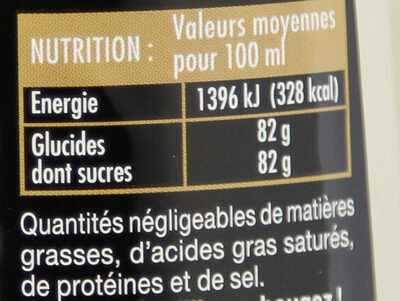
Nutrition facts
| Nutrition facts | As sold for 100 ml | Compared to: fr:Sirops de coco |
|---|---|---|
| Energy | 1396 kJ (328 kcal) | 1,214.211 kJ (284 kcal) (+15%) |
| Fat | ~ 0 g | 0.189 g (-100%) |
| Saturated fat | ~ 0 g | 0.002 g (-100%) |
| Carbohydrates | 82 g | 70.833 g (+16%) |
| Sugars | 82 g | ? |
| Dietary fiber | ? | ? |
| Proteins | ~ 0 g | 0.167 g (-100%) |
| Salt | ~ 0 g | 0.071 g (-100%) |
| Sodium | ~ 0 g | 0.028 g (-100%) |
| Fruits, vegetables and legumes | ~ 0 % | ? |
Nutrition facts (Detailed data)
| Nutrition facts | As sold for 100 ml | As sold Per 100 ml (packaging) | As sold Per 100 g (estimate) |
|---|---|---|---|
| Energy | 1396 kJ (328 kcal) | 1396 kJ (328 kcal) | ? |
| Fat | ~ 0 g | ~ 0 g | ? |
| Saturated fat | ~ 0 g | ~ 0 g | ? |
| Carbohydrates | 82 g | 82 g | ? |
| Sugars | 82 g | 82 g | ? |
| Dietary fiber | ? | ? | ? |
| Proteins | ~ 0 g | ~ 0 g | ? |
| Salt | ~ 0 g | ~ 0 g | ? |
| Sodium | ~ 0 g | ~ 0 g | ? |
| Fruits, vegetables and legumes | ~ 0 % | ? | ~ 0 % |
Ingredients
Ingredients image

Ingredients list
Ingredient information
Added sugars
Ingredients analysis
No ingredients containing palm oil.
Vegan status unknown
Vegetarian status unknown
Food Processing
NOVA group
 Ultra-processed food and drink products
Elements that indicate the product is in NOVA group 4
How NOVA works
Additives
E330 - Citric acidAntioxidantSequestrant
Citric acid is a natural organic acid found in citrus fruits such as lemons, oranges, and limes.
It is widely used in the food industry as a flavor enhancer, acidulant, and preservative due to its tart and refreshing taste.
Citric acid is safe for consumption when used in moderation and is considered a generally recognized as safe (GRAS) food additive by regulatory agencies worldwide.
E445 - Glycerol esters of wood rosinEmulsifierStabiliser
Glycerol ester of wood rosin, also known as glyceryl abietate or ester gum, is an oil-soluble food additive (E number E445). The food-grade material is used in foods, beverages, and cosmetics to keep oils in suspension in water, and its name may be shortened in the ingredient list as glycerol ester of rosin. It is also used as an ingredient in the production of chewing-gum and ice cream. Similar, less pure materials (glycerol ester of gum rosin) are used as a component of certain low-cost adhesives.To make the glycerol ester of wood rosin, refined wood rosin is reacted with glycerin to produce the glycerol ester. Glycerol ester of wood rosin is an alternative to brominated vegetable oil in citrus oil-flavored soft drinks. In some cases, both ingredients are used together.
Environment
Green-Score, origins bonus, and transportation impact are shown for Worldwide .
Green Score
Overall grade
 Very low environmental impact
About Green-Score
Current scope
Life cycle analysis
Average impact of the category
Syrup (mint, strawberries flavouredetc.), with sugar diluted in water • Score: 100/100Life-cycle reference
Overall environmental impact by stage (PEF)
The overall environmental impact figure (PEF) comes from ADEME's Agribalyse database, for the category: Syrup (mint, strawberries flavouredetc.), with sugar diluted in water. Source: ADEME Agribalyse Database.
| Stage | Impact |
|---|---|
| Agriculture | 64.4 % |
| Processing | 1.0 % |
| Packaging | 20.8 % |
| Transportation | 9.3 % |
| Distribution | 3.8 % |
| Consumption | 0.5 % |
Bonuses and maluses
Declared origins
Packaging impact
Green-Score for this product
Green-Score for this product
Final score: 93/100Final score breakdown
Carbon footprint
Carbon footprint
Climate impact by stage (CO2e)
The carbon emission figure comes from ADEME's Agribalyse database, for the category: Syrup (mint, strawberries flavouredetc.), with sugar diluted in water. Source: ADEME Agribalyse Database.
| Stage | Impact |
|---|---|
| Agriculture | 49.3 % |
| Processing | 2.3 % |
| Packaging | 28.8 % |
| Transportation | 17.3 % |
| Distribution | 1.9 % |
| Consumption | 0.2 % |
Packaging
Packaging impact
Packaging components
| Shape | Material | Recycling | Impact |
|---|---|---|---|
| Bottle | Glass | Unknown | Low |
Declared packaging
Transportation
Manufacturing locations
Declared origins
Forest footprint
Forest footprint
Deforestation risk details
Additional information
- Other information
- (*) = 28 doses équivalentes à 28 verres de 20cl. 1 verre de 20 cl dilué à 1+7 volumes d'eau. 1/7 eau 28 doses*
- Preparation
- Agitez avant emploi. Versez 1 volume de sirop pour 7 volumes d'eau plate ou gazeuse.
- Conservation conditions
- Avant ouverture, conservez votre bouteille à température ambiante. A consommer de préférence avant fin : voir sur le haut de la bouteille. Après ouverture, refermez-la bien et conservez-la au réfrigérateur pendant une période n'excédant pas 2 mois.
- Customer service
- Interdis - TSA 91431 - 91343 MASSY Cedex - France
Data Source
Product data comes from Open Food Facts. Food Benchmark also adds translations, category comparisons and explanatory calculations.
The database is licensed under ODbL 1.0, individual contents under DbCL 1.0, and product photos under CC BY-SA 3.0.
Product added on July 10, 2018 at 2:49:32 PM UTC by kiliweb .
Last edit on March 18, 2026 at 12:30:53 AM UTC by new-nutrition-bot .
Product page also edited by carrefour, khanagi, kiliweb, naruyoko, new-nutrition-bot, openfoodfacts-contributors, org-carrefour, packbot, roboto-app, sebleouf, segundo, yuka.RnBJRVNwazhtY0FhaDlvTzAwdi8xTXBmK0x5UEFWeXpGdkVBSWc9PQ.
Source List
- Carrefour
- carrefour