

Paëlla🥘royale
Health
Nutrition
Nutri-Score
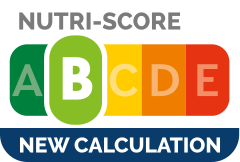 Good nutritional quality
Nutrient levels
Fat in moderate quantity (5%)
Saturated fat in low quantity (1.3%)
Sugars in low quantity (1.2%)
Salt in moderate quantity (0.8%)
Nutrition label
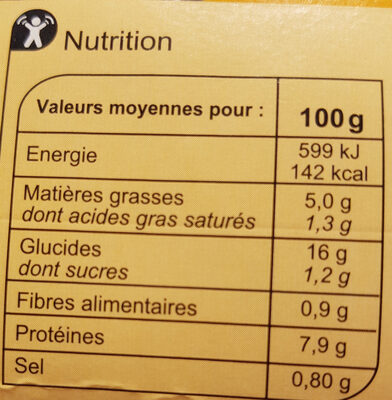
Nutrition facts
| Nutrition facts | As sold for 100 g / 100 ml | Compared to: Paella |
|---|---|---|
| Energy | 599 kJ (142 kcal) | 580.013 kJ (139 kcal) (+3%) |
| Fat | 5 g | 4.385 g (+14%) |
| Saturated fat | 1.3 g | 0.942 g (+38%) |
| Carbohydrates | 16 g | 16.805 g (-5%) |
| Sugars | 1.2 g | 1.219 g (-2%) |
| Dietary fiber | 0.9 g | ? |
| Proteins | 7.9 g | 6.756 g (+17%) |
| Salt | 0.8 g | 0.894 g (-11%) |
| Sodium | 0.32 g | 0.358 g (-11%) |
| Fruits, vegetables and legumes | ~ 16.10029296875 % | ? |
Nutrition facts (Detailed data)
| Nutrition facts | As sold for 100 g / 100 ml | As sold Per 100 g (packaging) | As sold Per 100 g (estimate) |
|---|---|---|---|
| Energy | 599 kJ (142 kcal) | 599 kJ (142 kcal) | ~ 357.1795 kJ (85 kcal) |
| Fat | 5 g | 5 g | ~ 4.202935 g |
| Saturated fat | 1.3 g | 1.3 g | ~ 1.0690715 g |
| Carbohydrates | 16 g | 16 g | ~ 15.32876 g |
| Sugars | 1.2 g | 1.2 g | ~ 1.02157 g |
| Dietary fiber | 0.9 g | 0.9 g | ~ 1.18941 g |
| Proteins | 7.9 g | 7.9 g | ~ 10 g |
| Salt | 0.8 g | 0.8 g | ~ 0.6165047 g |
| Sodium | 0.32 g | 0.32 g | ~ 0.2462276 g |
| Fruits, vegetables and legumes | ~ 16.10029296875 % | ? | ~ 16.10029296875 % |
Serving size
Ingredients
Ingredients image
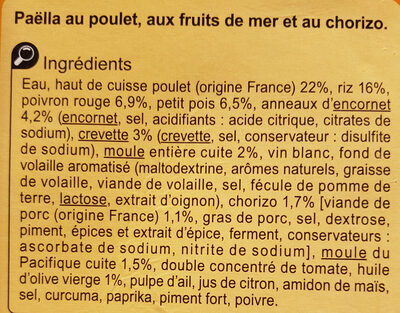
Ingredients list
Ingredient information
Added sugars
Allergens
Traces
Ingredients analysis
Palm oil content unknown
Contains non-vegan ingredients.
Unrecognized: fr:moule-du-pacifique-cuite
Contains non-vegetarian ingredients.
Unrecognized: fr:moule-du-pacifique-cuite
Food Processing
NOVA group
 Ultra-processed food and drink products
Elements that indicate the product is in NOVA group 4
How NOVA works
Additives
E223 - Sodium metabisulphite EFSA overexposure risk: highAntioxidantPreservative
SODIUM METABISULFITE or sodium pyrosulfite (IUPAC spelling; Br. E. sodium metabisulphite or sodium pyrosulphite) is an inorganic compound of chemical formula Na2S2O5.
E250 - Sodium nitrite EFSA overexposure risk: highPreservative
Sodium nitrite (E250) is a salt used for curing and preserving meat products.
It plays a critical role in preventing the growth of Clostridium botulinum, the bacterium responsible for botulism, in cured meats like bacon, ham, and sausages. It also provides the characteristic pink color and flavor.
However, nitrites can react with amines in the stomach to form nitrosamines, which are potent carcinogens. High intake of processed meats containing nitrites is associated with an increased risk of colorectal cancer. Regulatory bodies have set strict limits on its use in food.
E301 - Sodium ascorbateAntioxidant
SODIUM ASCORBATE is one of a number of mineral salts of ascorbic acid (vitamin C).
E330 - Citric acidAntioxidantSequestrant
Citric acid is a natural organic acid found in citrus fruits such as lemons, oranges, and limes.
It is widely used in the food industry as a flavor enhancer, acidulant, and preservative due to its tart and refreshing taste.
Citric acid is safe for consumption when used in moderation and is considered a generally recognized as safe (GRAS) food additive by regulatory agencies worldwide.
E331 - Sodium citratesEmulsifierSequestrantStabiliser
DISODIUM CITRATE, more properly, disodium hydrogen citrate, is an acid salt of citric acid with the chemical formula Na2C6H6O7. It is used as an antioxidant in food and to improve the effects of other antioxidants. It is also used as an acidity regulator and sequestrant. Typical products include gelatin, jam, sweets, ice cream, carbonated beverages, milk powder, wine, and processed cheeses.
Environment
Green-Score, origins bonus, and transportation impact are shown for Worldwide .
Green Score
Overall grade
 High environmental impact
About Green-Score
Current scope
Life cycle analysis
Average impact of the category
 Paëlla • Score: 54/100
Life-cycle reference
Overall environmental impact by stage (PEF)
The overall environmental impact figure (PEF) comes from ADEME's Agribalyse database, for the category: Paëlla. Source: ADEME Agribalyse Database.
| Stage | Impact |
|---|---|
| Agriculture | 74.1 % |
| Processing | 9.0 % |
| Packaging | 7.1 % |
| Transportation | 6.6 % |
| Distribution | 2.0 % |
| Consumption | 1.4 % |
Bonuses and maluses
Origins of ingredients
Packaging impact
Green-Score for this product
Green-Score for this product
Final score: 41/100Final score breakdown
Carbon footprint
Carbon footprint
Climate impact by stage (CO2e)
The carbon emission figure comes from ADEME's Agribalyse database, for the category: Paëlla. Source: ADEME Agribalyse Database.
| Stage | Impact |
|---|---|
| Agriculture | 60.1 % |
| Processing | 9.7 % |
| Packaging | 16.6 % |
| Transportation | 12.0 % |
| Distribution | 1.3 % |
| Consumption | 0.6 % |
Packaging

Packaging impact
Packaging materials
| Material | % | Packaging weight | Packaging weight per 100 g of product |
|---|---|---|---|
| Plastic | 56.85 % | 21.4 g | 5.35 g |
| Paper or cardboard | 43.15 % | 16.24 g | 4.06 g |
| Total | 100 % | 37.64 g | 9.41 g |
Packaging components
| Shape | Material | Recycling | Impact |
|---|---|---|---|
| 1 Sleeve (400 g) | Paperboard | Recycle | Low |
| 1 Film (400 g) | Plastic | Recycle | High |
| 1 Tray (400 g) | PP 5 Polypropylene | Recycle | High |
Declared packaging
Transportation
Origins of ingredients
Origins breakdown
| Origin | Percent of ingredients | Impact |
|---|---|---|
| Unknown | 77 % | High |
| France | 23 % | High |
Forest footprint
Forest footprint
Ingredients linked to forest pressure
| Ingredient | Type | Percent in product | Forest footprint |
|---|---|---|---|
| Haut DE Cuisse DE Poulet | Poulet Standard | 22.00 % | 0.54 |
Additional information
- Other information
- Picto 1 personne Picto micro ondes 3 minutes Cette recette typée à base de riz, d'un haut de cuisse de poulet et d'un mélange de fruits de mer, est agrémentée de poivrons rouges, de petits pois et de chorizo. Assaisonné d'huile d'olive vierge, vous pourrez apprécier toutes les saveurs de ce plat. Sans arôme artificiel Sans exhausteur de goût
- Preparation
- Au four à micro-ondes : Décollez légèrement l'opercule sur un demi-centimètre environ et faites réchauffer 3 min à 850W. Ne pas réutiliser un produit déjà réchauffé. Ne pas mettre la barquette au four traditionnel.
- Conservation conditions
- À consommer jusqu'au / N° de lot: voir sur le côté. À conserver entre 0°C et +4°C. À consommer immédiatement après ouverture. Conditionné sous atmosphère protectrice.
- Customer service
- Interdis - TSA 91431 - 91343 MASSY Cedex - France
Data Source
Product data comes from Open Food Facts. Food Benchmark also adds translations, category comparisons and explanatory calculations.
The database is licensed under ODbL 1.0, individual contents under DbCL 1.0, and product photos under CC BY-SA 3.0.
Product added on March 23, 2017 at 11:15:20 AM UTC by julie-yuka .
Last edit on March 17, 2026 at 10:46:49 PM UTC by new-nutrition-bot .
Product page also edited by additives-app-chakib, aleene, alexfauquette, carrefour, chevalstar, dorado-jerome, driveoff, ecoscore-impact-estimator, fgouget, julie-yuka, kiliweb, new-nutrition-bot, openfoodfacts-contributors, org-carrefour, quentinbrd, roboto-app, schnappoui, segundo.
Source List
- Carrefour
- carrefour