

Edulcorant de table à base de sucralose
Labels
 Not computed
 Ultra-processed food and drink products
 Green-Score not computed
Health
Nutrition
Nutrition label

Nutrition facts
| Nutrition facts | As sold for 100 g / 100 ml |
|---|---|
| Energy | 164 kJ (38 kcal) |
| FAT | 0 g |
| Saturated fat | 0 g |
| Carbohydrates | 80 g |
| Sugars | 80 g |
| Dietary fiber | 3.1 g |
| Proteins | 2.7 g |
| Salt | 53.7 g |
| Sodium | 21.48 g |
| Minerals | |
| Fruits, vegetables and legumes | ~ 0 % |
Nutrition facts (Detailed data)
| Nutrition facts | As sold for 100 g / 100 ml | As sold Per 100 g (packaging) | As sold Per 100 g (estimate) |
|---|---|---|---|
| Energy | 164 kJ (38 kcal) | 164 kJ (38 kcal) | ? |
| FAT | 0 g | 0 g | ? |
| Saturated fat | 0 g | 0 g | ? |
| Carbohydrates | 80 g | 80 g | ? |
| Sugars | 80 g | 80 g | ? |
| Added sugars | ~ 0 g | ? | ~ 0 g |
| Dietary fiber | 3.1 g | 3.1 g | ? |
| Proteins | 2.7 g | 2.7 g | ? |
| Salt | 53.7 g | 53.7 g | ? |
| Sodium | 21.48 g | 21.48 g | ? |
| Minerals | |||
| Fruits, vegetables and legumes | ~ 0 % | ? | ~ 0 % |
Serving size
Estimated Activity Time
Approximate time needed to burn the energy in 100 g / 100 ml: 164 kJ. Reference adult weight: 70 kg. Energy density: Low.
Ingredients
Ingredients image
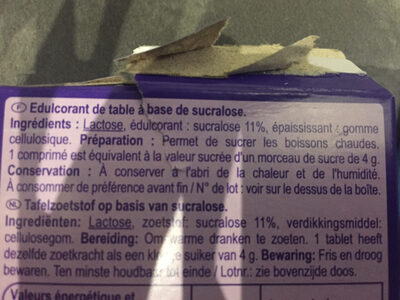
Ingredients list
Ingredient information
Allergens
Ingredients analysis
No ingredients containing palm oil.
No non-vegan ingredients.
No non-vegetarian ingredients.
Food Processing
NOVA group
Ultra-processed food and drink productsElements that indicate the product is in NOVA group 4
How NOVA works
Additives
E331 - Sodium citratesEmulsifierSequestrantStabiliser
DISODIUM CITRATE, more properly, disodium hydrogen citrate, is an acid salt of citric acid with the chemical formula Na2C6H6O7. It is used as an antioxidant in food and to improve the effects of other antioxidants. It is also used as an acidity regulator and sequestrant. Typical products include gelatin, jam, sweets, ice cream, carbonated beverages, milk powder, wine, and processed cheeses.
E414 - Acacia gumCarrierEmulsifierStabiliserThickener
Gum arabic, also known as acacia gum, arabic gum, gum acacia, acacia, Senegal gum and Indian gum, and by other names, is a natural gum consisting of the hardened sap of various species of the acacia tree. Originally, gum arabic was collected from Acacia nilotica which was called the "gum arabic tree"; in the present day, gum arabic is collected from acacia species, predominantly Acacia senegal and Vachellia (Acacia) seyal; the term "gum arabic" does not indicate a particular botanical source. In a few cases so‐called "gum arabic" may not even have been collected from Acacia species, but may originate from Combretum, Albizia or some other genus. Producers harvest the gum commercially from wild trees, mostly in Sudan (80%) and throughout the Sahel, from Senegal to Somalia—though it is historically cultivated in Arabia and West Asia. Gum arabic is a complex mixture of glycoproteins and polysaccharides. It is the original source of the sugars arabinose and ribose, both of which were first discovered and isolated from it, and are named after it. Gum arabic is soluble in water. It is edible, and used primarily in the food industry as a stabilizer, with EU E number E414. Gum arabic is a key ingredient in traditional lithography and is used in printing, paint production, glue, cosmetics and various industrial applications, including viscosity control in inks and in textile industries, though less expensive materials compete with it for many of these roles. While gum arabic is now produced throughout the African Sahel, it is still harvested and used in the Middle East.
E500 - Sodium carbonatesStabiliserThickener
Sodium carbonates (E500) are compounds commonly used in food preparation as leavening agents, helping baked goods rise by releasing carbon dioxide when they interact with acids.
Often found in baking soda, they regulate the pH of food, preventing it from becoming too acidic or too alkaline. In the culinary world, sodium carbonates can also enhance the texture and structure of foods, such as noodles, by modifying the gluten network.
Generally recognized as safe, sodium carbonates are non-toxic when consumed in typical amounts found in food.
E955 - SucraloseSweetener
Sucralose is an artificial sweetener and sugar substitute. The majority of ingested sucralose is not broken down by the body, so it is noncaloric. In the European Union, it is also known under the E number E955. It is produced by chlorination of sucrose. Sucralose is about 320 to 1,000 times sweeter than sucrose, three times as sweet as both aspartame and acesulfame potassium, and twice as sweet as sodium saccharin. Evidence of benefit is lacking for long-term weight loss with some data supporting weight gain and heart disease risks.It is stable under heat and over a broad range of pH conditions. Therefore, it can be used in baking or in products that require a long shelf life. The commercial success of sucralose-based products stems from its favorable comparison to other low-calorie sweeteners in terms of taste, stability, and safety. Common brand names of sucralose-based sweeteners are Splenda, Zerocal, Sukrana, SucraPlus, Candys, Cukren, and Nevella. Canderel Yellow also contains sucralose, but the original Canderel and Green Canderel do not.
Environment
Green-Score, origins bonus, and transportation impact are shown for Worldwide .
Green Score
Overall grade
Unknown environmental impactAbout Green-Score
Current scope
Green-Score availability
Bonuses and maluses
Declared origins
Packaging impact
Packaging
Packaging impact
Packaging materials
| Material | % | Packaging weight | Packaging weight per 100 g of product |
|---|---|---|---|
| Unknown | |||
| Plastic | |||
| Total |
Data precision
Transportation
Declared origins
Data Source
Data presented on this page is sourced from the Open Food Facts database. This platform does not alter the original dataset; its purpose is solely to enhance data visualization and user accessibility.
Product added on March 23, 2017 at 2:03:07 PM UTC by kiliweb .
Last edit on March 17, 2026 at 8:42:07 PM UTC by new-nutrition-bot .
Product page also edited by 150313, corrigo, gmlaa, kiliweb, llegris, navig491, new-nutrition-bot, openfoodfacts-contributors, org-carrefour, parisi, quechoisir, teolemon, yuka.YVA0aUhhNDhqK1l5cThjZjBRLzBvL3hVK0srRVpsMm5JcklXSVE9PQ.
Source List
- carrefour