

Bloc de Foie Gras de Canard du Sud-Ouest
Health
Nutrition
Nutri-Score
 Lower nutritional quality
Nutri-Score data warning
Nutrient levels
Fat in high quantity (55%)
Saturated fat in high quantity (23%)
Sugars in low quantity (1.1%)
Salt in moderate quantity (1.3%)
Nutrition label

Nutrition facts
| Nutrition facts | As sold for 100 g / 100 ml | Compared to: fr:Bloc de foie gras avec morceaux |
|---|---|---|
| Energy | 2168 kJ (526 kcal) | 2,056.918 kJ (498 kcal) (+5%) |
| Fat | 55 g | 51.686 g (+6%) |
| Saturated fat | 23 g | 22.285 g (+3%) |
| Carbohydrates | 1.8 g | 2.193 g (-18%) |
| Sugars | 1.1 g | 1.271 g (-13%) |
| Dietary fiber | 0 g | ? |
| Proteins | 6 g | 6.263 g (-4%) |
| Salt | 1.3 g | 1.221 g (+6%) |
| Sodium | 0.52 g | 0.488 g (+7%) |
| Fruits, vegetables and legumes | ~ 0 % | ? |
Nutrition facts (Detailed data)
| Nutrition facts | As sold for 100 g / 100 ml | As sold Per 100 g (packaging) | As sold Per 100 g (estimate) |
|---|---|---|---|
| Energy | 2168 kJ (526 kcal) | 2168 kJ (526 kcal) | ? |
| Fat | 55 g | 55 g | ? |
| Saturated fat | 23 g | 23 g | ? |
| Carbohydrates | 1.8 g | 1.8 g | ? |
| Sugars | 1.1 g | 1.1 g | ? |
| Dietary fiber | 0 g | 0 g | ? |
| Proteins | 6 g | 6 g | ? |
| Salt | 1.3 g | 1.3 g | ? |
| Sodium | 0.52 g | 0.52 g | ? |
| Fruits, vegetables and legumes | ~ 0 % | ? | ~ 0 % |
Ingredients
Ingredients image
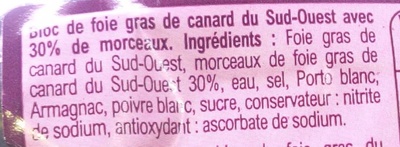
Ingredients list
Ingredient information
Added sugars
Allergens
Ingredients analysis
No ingredients containing palm oil.
Contains non-vegan ingredients.
Unrecognized: fr:porto-blanc
Contains non-vegetarian ingredients.
Unrecognized: fr:porto-blanc
Food Processing
NOVA group
 Processed culinary ingredients
Elements that indicate the product is in NOVA group 2
How NOVA works
Additives
E250 - Sodium nitrite EFSA overexposure risk: highPreservative
Sodium nitrite (E250) is a salt used for curing and preserving meat products.
It plays a critical role in preventing the growth of Clostridium botulinum, the bacterium responsible for botulism, in cured meats like bacon, ham, and sausages. It also provides the characteristic pink color and flavor.
However, nitrites can react with amines in the stomach to form nitrosamines, which are potent carcinogens. High intake of processed meats containing nitrites is associated with an increased risk of colorectal cancer. Regulatory bodies have set strict limits on its use in food.
E301 - Sodium ascorbateAntioxidant
SODIUM ASCORBATE is one of a number of mineral salts of ascorbic acid (vitamin C).
Environment
Green-Score, origins bonus, and transportation impact are shown for Worldwide .
Green Score
Overall grade
 High environmental impact
About Green-Score
Current scope
Life cycle analysis
Average impact of the category
Preserved duck • Score: 38/100Life-cycle reference
Overall environmental impact by stage (PEF)
The overall environmental impact figure (PEF) comes from ADEME's Agribalyse database, for the category: Preserved duck. Source: ADEME Agribalyse Database.
| Stage | Impact |
|---|---|
| Agriculture | 52.5 % |
| Processing | 41.5 % |
| Packaging | 2.9 % |
| Transportation | 1.5 % |
| Distribution | 0.3 % |
| Consumption | 1.4 % |
Bonuses and maluses
Origins of ingredients
Packaging impact
Green-Score for this product
Green-Score for this product
Final score: 39/100Final score breakdown
Carbon footprint
Carbon footprint
Climate impact by stage (CO2e)
The carbon emission figure comes from ADEME's Agribalyse database, for the category: Preserved duck. Source: ADEME Agribalyse Database.
| Stage | Impact |
|---|---|
| Agriculture | 37.1 % |
| Processing | 56.1 % |
| Packaging | 3.6 % |
| Transportation | 2.4 % |
| Distribution | 0.2 % |
| Consumption | 0.7 % |
Packaging
Packaging impact
Packaging components
| Shape | Material | Recycling | Impact |
|---|---|---|---|
| Unknown | Heavy Aluminium | Recycle | Medium |
Declared packaging
Data precision
Transportation
Manufacturing locations
Origins of ingredients
Origins breakdown
| Origin | Percent of ingredients | Impact |
|---|---|---|
| France | 100 % | Medium |
Forest footprint
Forest footprint
Deforestation risk details
Additional information
- Other information
- Logo IGP CANARD A FOIE GRAS DU SUD-OUEST (CHALOSSE GASCOGNE GERS LANDES PERIGORD QUERCY) Avec morceaux picto 5 personnes Picto Origine certifiée Sud-Ouest
- Preparation
- Utilisation : Sortez le bloc de foie gras de votre réfrigérateur 15 minutes environ avant dégustation. Tranchez à l'aide d'un couteau à lame fine sans dents préalablement trempée dans de l'eau chaude.
- Conservation conditions
- À conserver entre 0°C et +4°C. À consommer dans les 24 heures après ouverture.
- Customer service
- Interdis - TSA 91431 - 91343 MASSY Cedex - France
Data Source
Product data comes from Open Food Facts. Food Benchmark also adds translations, category comparisons and explanatory calculations.
The database is licensed under ODbL 1.0, individual contents under DbCL 1.0, and product photos under CC BY-SA 3.0.
Product added on December 18, 2015 at 4:58:07 PM UTC by sebleouf .
Last edit on March 17, 2026 at 10:41:36 PM UTC by new-nutrition-bot .
Product page also edited by carrefour, coq, driveoff, ecoscore-impact-estimator, lanskaya, moon-rabbit, new-nutrition-bot, openfoodfacts-contributors, org-carrefour, packbot, roboto-app, sebleouf, segundo, yuka.U2J3eElab0ZtUDhHa2ZZYzNqei94ZU41MkpLMFFINldLTFFYSVE9PQ, yuka.U2ZrYVR2NDVpdWc0eC9FYXdqcnA4OUJlN3ArTVhqcUhFUGdoSVE9PQ.
Source List
- Carrefour
- carrefour