
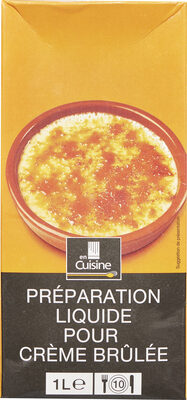
Préparation liquide pour crème brûlée
Health
Nutrition
Nutrient levels
Fat in moderate quantity (13%)
Saturated fat in high quantity (9.2%)
Sugars in high quantity (13%)
Salt in low quantity (0.1%)
Nutrition facts
| Nutrition facts | As sold for 100 ml | Compared to: Dessert mixes |
|---|---|---|
| Energy | 847 kJ (203 kcal) | 1,246.27 kJ (297 kcal) (-32%) |
| Fat | 13 g | 6.33 g (+105%) |
| Saturated fat | 9.2 g | 2.552 g (+261%) |
| Carbohydrates | 18 g | 49.602 g (-64%) |
| Sugars | 13 g | 23.826 g (-45%) |
| Dietary fiber | ~ 0.4925 g | ? |
| Proteins | 2.6 g | 5.643 g (-54%) |
| Salt | 0.1 g | 0.615 g (-84%) |
| Sodium | 0.04 g | 0.247 g (-84%) |
| Fruits, vegetables and legumes | ~ 0 % | ? |
Nutrition facts (Detailed data)
| Nutrition facts | As sold for 100 ml | As sold Per 100 ml (packaging) | As sold Per 100 g (estimate) |
|---|---|---|---|
| Energy | 847 kJ (203 kcal) | 847 kJ (203 kcal) | ~ 787.6125 kJ (188 kcal) |
| Fat | 13 g | 13 g | ~ 11.18125 g |
| Saturated fat | 9.2 g | 9.2 g | ~ 7.4671175 g |
| Carbohydrates | 18 g | 18 g | ~ 18.154475 g |
| Sugars | 13 g | 13 g | ~ 17.1419 g |
| Dietary fiber | ~ 0.4925 g | ? | ~ 0.4925 g |
| Proteins | 2.6 g | 2.6 g | ~ 2.779225 g |
| Salt | 0.1 g | 0.1 g | ~ 0.080507 g |
| Sodium | 0.04 g | 0.04 g | ~ 0.032279725 g |
| Fruits, vegetables and legumes | ~ 0 % | ? | ~ 0 % |
Ingredients
Ingredients list
Ingredient information
Added sugars
Allergens
Ingredients analysis
No ingredients containing palm oil.
Contains non-vegan ingredients.
Vegetarian status unknown
Food Processing
NOVA group
 Ultra-processed food and drink products
Elements that indicate the product is in NOVA group 4
How NOVA works
Additives
E101 - RiboflavinColour
Riboflavin, also known as vitamin B2, is a vitamin found in food and used as a dietary supplement. Food sources include eggs, green vegetables, milk and other dairy product, meat, mushrooms, and almonds. Some countries require its addition to grains. As a supplement it is used to prevent and treat riboflavin deficiency and prevent migraines. It may be given by mouth or injection.It is nearly always well tolerated. Normal doses are safe during pregnancy. Riboflavin is in the vitamin B group. It is required by the body for cellular respiration.Riboflavin was discovered in 1920, isolated in 1933, and first made in 1935. It is on the World Health Organization's List of Essential Medicines, the most effective and safe medicines needed in a health system. Riboflavin is available as a generic medication and over the counter. In the United States a month of supplements costs less than 25 USD.
E101i - RiboflavinColour
No additive description is available yet.
E14XX - Modified StarchEmulsifierStabiliserThickener
No additive description is available yet.
E160b - AnnattoColour
No additive description is available yet.
E160bii - Annatto norbixinColour
No additive description is available yet.
E407 - Carrageenan EFSA overexposure risk: highCarrierEmulsifierHumectantStabiliserThickener
Carrageenan (E407), derived from red seaweed, is widely employed in the food industry as a gelling, thickening, and stabilizing agent, notably in dairy and meat products.
It can exist in various forms, each imparting distinct textural properties to food.
However, its degraded form, often referred to as poligeenan, has raised health concerns due to its potential inflammatory effects and its classification as a possible human carcinogen (Group 2B) by the International Agency for Research on Cancer (IARC).
Nevertheless, food-grade carrageenan has been deemed safe by various regulatory bodies when consumed in amounts typically found in food.
Environment
Green-Score, origins bonus, and transportation impact are shown for Worldwide .
Green Score
Overall grade
 Unknown environmental impact
About Green-Score
Current scope
Green-Score availability
Bonuses and maluses
Declared origins
Packaging impact
Packaging
Packaging impact
Packaging components
| Shape | Material | Recycling | Impact |
|---|---|---|---|
| Brick | Tetra PAK | Unknown | Medium |
Declared packaging
Transportation
Declared origins
Forest footprint
Forest footprint
Ingredients linked to forest pressure
| Ingredient | Type | Percent in product | Forest footprint |
|---|---|---|---|
| EGG Yolk | Oeufs Importés | 1.50 % | 0.00 |
Additional information
- Preparation
- Chauffez à feu doux jusqu'à la première ébullition en remuant à la spatule. Dressez aussitôt dans les plats à crème brûlée. Laissez reposer à température ambiante pendant 20 minutes environ. Réservez au froid 3 heures minimum. Saupoudrez de cassonade puis caramélisez au chalumeau juste avant de servir.
- Conservation conditions
- A consommer de préférence avant le / N°de lot : voir sur le dessus de la brique. Avant ouverture, peut se conserver à température ambiante (max +18°C). Après ouverture, à conserver entre +2°C et +6°C et consommer dans les 48h. Ne pas congeler.
- Customer service
- Interdis - TSA 91431 - 91343 MASSY Cedex - France
Data Source
Product data comes from Open Food Facts. Food Benchmark also adds translations, category comparisons and explanatory calculations.
The database is licensed under ODbL 1.0, individual contents under DbCL 1.0, and product photos under CC BY-SA 3.0.
Product added on January 27, 2019 at 6:39:39 PM UTC by carrefour .
Last edit on March 18, 2026 at 12:57:53 AM UTC by new-nutrition-bot .
Product page also edited by carrefour, ecoscore-impact-estimator, fixbot, foodless, kiliweb, moon-rabbit, new-nutrition-bot, org-carrefour, packbot, roboto-app, worldtest.
Source List
- Carrefour
- carrefour