
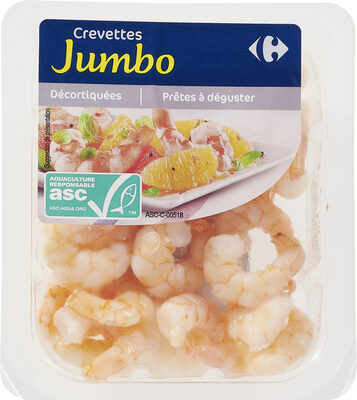
Crevettes Jumbo
Health
Nutrition
Nutri-Score
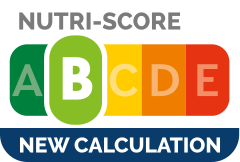 Good nutritional quality
Nutri-Score data warning
Nutrient levels
Fat in low quantity (1%)
Saturated fat in low quantity (0.3%)
Sugars in low quantity (0%)
Salt in high quantity (1.8%)
Nutrition label

Nutrition facts
| Nutrition facts | As sold for 100 g / 100 ml | Compared to: Prawns |
|---|---|---|
| Energy | 377 kJ (89 kcal) | 426.442 kJ (102 kcal) (-12%) |
| Fat | 1 g | 2.8 g (-64%) |
| Saturated fat | 0.3 g | 0.519 g (-42%) |
| Carbohydrates | 0.8 g | 1.118 g (-28%) |
| Sugars | 0 g | 0.496 g (-100%) |
| Dietary fiber | 1 g | ? |
| Proteins | 20 g | 16.461 g (+21%) |
| Salt | 1.8 g | 1.276 g (+41%) |
| Sodium | 0.72 g | 0.509 g (+41%) |
| Fruits, vegetables and legumes | ~ 0 % | ? |
Nutrition facts (Detailed data)
| Nutrition facts | As sold for 100 g / 100 ml | As sold Per 100 g (packaging) | As sold Per 100 g (estimate) |
|---|---|---|---|
| Energy | 377 kJ (89 kcal) | 377 kJ (89 kcal) | ~ 407.4 kJ (96 kcal) |
| Fat | 1 g | 1 g | ~ 0.8148 g |
| Saturated fat | 0.3 g | 0.3 g | ~ 0.1843 g |
| Carbohydrates | 0.8 g | 0.8 g | ~ 3.1137 g |
| Sugars | 0 g | 0 g | ~ 0 g |
| Dietary fiber | 1 g | 1 g | ~ 0 g |
| Proteins | 20 g | 20 g | ~ 19.109 g |
| Salt | 1.8 g | 1.8 g | ~ 2.3925 g |
| Sodium | 0.72 g | 0.72 g | ~ 0.95854 g |
| Fruits, vegetables and legumes | ~ 0 % | ? | ~ 0 % |
Ingredients
Ingredients image

Ingredients list
Ingredient information
Allergens
Ingredients analysis
Palm oil content unknown
Unrecognized: fr:elevees-au-vietnam, fr:inde, fr:venezuela, fr:equateur, fr:indonesie, fr:honduras, fr:perou, fr:nicaragua, fr:guatemala
Contains non-vegan ingredients.
Unrecognized: fr:elevees-au-vietnam, fr:inde, fr:venezuela, fr:equateur, fr:indonesie, fr:honduras, fr:perou, fr:nicaragua, fr:guatemala
Contains non-vegetarian ingredients.
Unrecognized: fr:elevees-au-vietnam, fr:inde, fr:venezuela, fr:equateur, fr:indonesie, fr:honduras, fr:perou, fr:nicaragua, fr:guatemala
Food Processing
NOVA group
How NOVA works
Additives
E223 - Sodium metabisulphite EFSA overexposure risk: highAntioxidantPreservative
SODIUM METABISULFITE or sodium pyrosulfite (IUPAC spelling; Br. E. sodium metabisulphite or sodium pyrosulphite) is an inorganic compound of chemical formula Na2S2O5.
E260 - Acetic acidPreservative
ACETIC ACID, systematically named ethanoic acid, is a colourless liquid organic compound with the chemical formula CH3COOH (also written as CH3CO2H or C2H4O2).
E270 - Lactic acid
LACTIC ACID is an organic compound with the formula CH3CH(OH)CO2H. In the form of its conjugate base called lactate (this is thus different and kept as a separate ingredient). Lactic acid is chiral, consisting of two optical isomers. One is known as L-(+)-lactic acid or (S)-lactic acid and the other, its mirror image, is D-(−)-lactic acid or (R)-lactic acid in food the L-variant is used
Environment
Green-Score, origins bonus, and transportation impact are shown for Worldwide .
Green Score
Overall grade
 Very high environmental impact
About Green-Score
Current scope
Life cycle analysis
Average impact of the category
Shrimp or prawn, raw • Score: 0/100Life-cycle reference
Overall environmental impact by stage (PEF)
The overall environmental impact figure (PEF) comes from ADEME's Agribalyse database, for the category: Shrimp or prawn, raw. Source: ADEME Agribalyse Database.
| Stage | Impact |
|---|---|
| Agriculture | 94.2 % |
| Processing | 0.0 % |
| Packaging | 1.3 % |
| Transportation | 3.0 % |
| Distribution | 0.6 % |
| Consumption | 0.7 % |
Bonuses and maluses
Production system
Origins of ingredients
Packaging impact
Green-Score for this product
Green-Score for this product
Final score: 0/100Final score breakdown
Carbon footprint
Carbon footprint
Climate impact by stage (CO2e)
The carbon emission figure comes from ADEME's Agribalyse database, for the category: Shrimp or prawn, raw. Source: ADEME Agribalyse Database.
| Stage | Impact |
|---|---|
| Agriculture | 88.2 % |
| Processing | 0.0 % |
| Packaging | 3.4 % |
| Transportation | 6.2 % |
| Distribution | 0.4 % |
| Consumption | 2.0 % |
Packaging

Packaging impact
Packaging components
| Shape | Material | Recycling | Impact |
|---|---|---|---|
| BAG | Plastic | Unknown | High |
Declared packaging
Transportation
Manufacturing locations
Origins of ingredients
Origins breakdown
| Origin | Percent of ingredients | Impact |
|---|---|---|
| China | 33 % | High |
| India | 33 % | High |
| Thailand | 33 % | High |
Forest footprint
Forest footprint
Deforestation risk details
Additional information
- Other information
- Ce produit répond aux normes du référentiel ASC pour l'aquaculture responsable. www.asc-aqua.org. ASC-C-00518. Logo ASC + N°ASC-C-00518. Décortiquées Prêtes à déguster
- Recipe idea
- A consommer en salade froide, en plat chaud avec du riz ou en brochettes.
- Conservation conditions
- À consommer jusqu'au / N° de lot : voir sur le dessus de l'emballage. À conserver entre 0°C et +4°C. À consommer dès l'ouverture. Conditionné sous atmosphère protectrice.
- Customer service
- Interdis - TSA 91431 - 91343 MASSY Cedex - France
Data Source
Product data comes from Open Food Facts. Food Benchmark also adds translations, category comparisons and explanatory calculations.
The database is licensed under ODbL 1.0, individual contents under DbCL 1.0, and product photos under CC BY-SA 3.0.
Product added on August 23, 2013 at 10:07:50 AM UTC by andre .
Last edit on March 17, 2026 at 10:51:30 AM UTC by new-nutrition-bot .
Product page also edited by andre, carrefour, coff, date-limite-app, driveoff, ecoscore-impact-estimator, foodless, foodvisor, kiliweb, manu1400, naruyoko, new-nutrition-bot, openfoodfacts-contributors, org-carrefour, packbot, quechoisir, roboto-app, sebleouf.
Source List
- Carrefour
- carrefour