
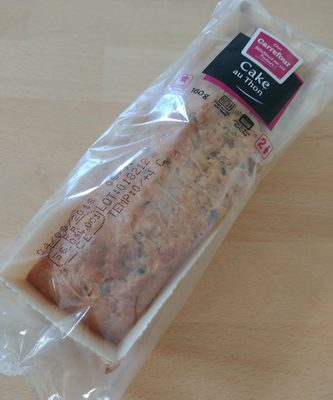
Cake apéritif THON
Health
Nutrition
Nutri-Score
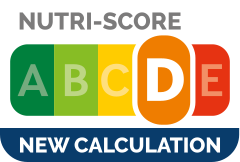 Lower nutritional quality
Nutri-Score data warning
Nutrient levels
Fat in moderate quantity (20%)
Saturated fat in moderate quantity (3.4%)
Sugars in low quantity (3.4%)
Salt in moderate quantity (1.5%)
Nutrition label
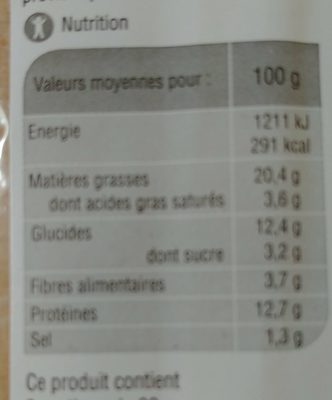
Nutrition facts
| Nutrition facts | As sold for 100 g / 100 ml | Compared to: savoury-cake-with-cheese-vegetables-meat-fish-poultry |
|---|---|---|
| Energy | 1248 kJ (300 kcal) | 1,196.544 kJ (288 kcal) (+4%) |
| Fat | 20 g | 19.45 g (+3%) |
| Saturated fat | 3.4 g | 4.45 g (-24%) |
| Carbohydrates | 14 g | 15.325 g (-9%) |
| Sugars | 3.4 g | 2.575 g (+32%) |
| Dietary fiber | 4 g | ? |
| Proteins | 14 g | 11 g (+27%) |
| Salt | 1.5 g | 1.457 g (+3%) |
| Sodium | 0.6 g | 0.583 g (+3%) |
| Fruits, vegetables and legumes | ~ 7.0433349609375 % | ? |
Nutrition facts (Detailed data)
| Nutrition facts | As sold for 100 g / 100 ml | As sold Per 100 g (packaging) | As sold Per 100 g (estimate) |
|---|---|---|---|
| Energy | 1248 kJ (300 kcal) | 1248 kJ (300 kcal) | ? |
| Fat | 20 g | 20 g | ? |
| Saturated fat | 3.4 g | 3.4 g | ? |
| Carbohydrates | 14 g | 14 g | ? |
| Sugars | 3.4 g | 3.4 g | ? |
| Dietary fiber | 4 g | 4 g | ? |
| Proteins | 14 g | 14 g | ? |
| Salt | 1.5 g | 1.5 g | ? |
| Sodium | 0.6 g | 0.6 g | ? |
| Fruits, vegetables and legumes | ~ 7.0433349609375 % | ? | ~ 7.0433349609375 % |
Ingredients
Ingredients image
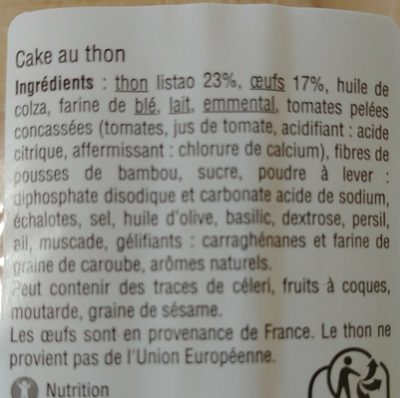
Ingredients list
Ingredient information
Added sugars
Allergens
Traces
Ingredients analysis
No ingredients containing palm oil.
Contains non-vegan ingredients.
Unrecognized: fr:listao, fr:oeufs-entiers-issus-de-poules-elevees-en-plein-air
Contains non-vegetarian ingredients.
Unrecognized: fr:listao, fr:oeufs-entiers-issus-de-poules-elevees-en-plein-air
Food Processing
NOVA group
 Ultra-processed food and drink products
Elements that indicate the product is in NOVA group 4
How NOVA works
Additives
E330 - Citric acidAntioxidantSequestrant
Citric acid is a natural organic acid found in citrus fruits such as lemons, oranges, and limes.
It is widely used in the food industry as a flavor enhancer, acidulant, and preservative due to its tart and refreshing taste.
Citric acid is safe for consumption when used in moderation and is considered a generally recognized as safe (GRAS) food additive by regulatory agencies worldwide.
E450 - Diphosphates EFSA overexposure risk: highEmulsifierHumectantSequestrantStabiliserThickener
Diphosphates (E450) are food additives often utilized to modify the texture of products, acting as leavening agents in baking and preventing the coagulation of canned food.
These salts can stabilize whipped cream and are also found in powdered products to maintain their flow properties. They are commonly present in baked goods, processed meats, and soft drinks.
Derived from phosphoric acid, they're part of our daily phosphate intake, which often surpasses recommended levels due to the prevalence of phosphates in processed foods and drinks.
Excessive phosphate consumption is linked to health issues, such as impaired kidney function and weakened bone health. Though diphosphates are generally regarded as safe when consumed within established acceptable daily intakes, it's imperative to monitor overall phosphate consumption to maintain optimal health.
E450i - Disodium diphosphateEmulsifierHumectantSequestrantStabiliserThickener
No additive description is available yet.
E500 - Sodium carbonatesStabiliserThickener
Sodium carbonates (E500) are compounds commonly used in food preparation as leavening agents, helping baked goods rise by releasing carbon dioxide when they interact with acids.
Often found in baking soda, they regulate the pH of food, preventing it from becoming too acidic or too alkaline. In the culinary world, sodium carbonates can also enhance the texture and structure of foods, such as noodles, by modifying the gluten network.
Generally recognized as safe, sodium carbonates are non-toxic when consumed in typical amounts found in food.
E509 - Calcium chloride EFSA overexposure risk: moderateStabiliserThickenerCoagulant
Calcium chloride is an inorganic compound, a salt with the chemical formula CaCl2. It is a colorless crystalline solid at room temperature, highly soluble in water. Calcium chloride is commonly encountered as a hydrated solid with generic formula CaCl2(H2O)x, where x = 0, 1, 2, 4, and 6. These compounds are mainly used for de-icing and dust control. Because the anhydrous salt is hygroscopic, it is used as a desiccant.
Environment
Green-Score, origins bonus, and transportation impact are shown for Worldwide .
Green Score
Overall grade
 Unknown environmental impact
About Green-Score
Current scope
Green-Score availability
Bonuses and maluses
Origins of ingredients
Packaging impact
Packaging
Packaging impact
Packaging components
| Shape | Material | Recycling | Impact |
|---|---|---|---|
| Packaging | Plastic | Unknown | High |
| Mold | Cardboard | Unknown | Low |
Declared packaging
Transportation
Origins of ingredients
Origins breakdown
| Origin | Percent of ingredients | Impact |
|---|---|---|
| France | 100 % | Medium |
Forest footprint
Forest footprint
Deforestation risk details
Additional information
- Preparation
- Utilisation: Sortez le cake du réfrigérateur 15 min avant dégustation. Pour apprécier toute sa saveur, nous vous conseillons de le trancher et de le réchauffer 10 min au four préchauffé à 150°C (Th.5).
- Conservation conditions
- À consommer jusqu'au/ N° de lot : Voir sur le sachet. À conserver entre 0°C et 4°C. À consommer rapidement après ouverture. Conditionné sous atmosphère protectrice.
- Customer service
- Interdis - TSA 91431 - 91343 MASSY Cedex - France
Data Source
Product data comes from Open Food Facts. Food Benchmark also adds translations, category comparisons and explanatory calculations.
The database is licensed under ODbL 1.0, individual contents under DbCL 1.0, and product photos under CC BY-SA 3.0.
Product added on March 26, 2017 at 12:44:28 PM UTC by kiliweb .
Last edit on March 17, 2026 at 11:55:35 PM UTC by new-nutrition-bot .
Product page also edited by beniben, desan, driveoff, fnourry, foodless, kiliweb, laura-chaud, new-nutrition-bot, openfoodfacts-contributors, org-carrefour, packbot, yuka.YklRa09md1lucUZVeE1NVHdoUGw0dFZGM01HU1UwZXZCdEVVSVE9PQ.
Source List
- carrefour