
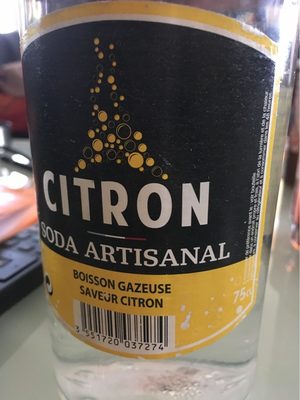
Soda artisanal citron
Labels
 Bad nutritional quality
 Ultra-processed food and drink products
 Green-Score not computed
Health
Nutrition
Label
Bad nutritional qualityNutrient levels
Fat in low quantity (0%)
Saturated fat in low quantity (0%)
Sugars in high quantity (9%)
Salt in low quantity (0.01%)
Nutrition facts
| Nutrition facts | As sold for 100 g / 100 ml |
|---|---|
| Energy | ~ 153 kJ (36 kcal) |
| FAT | 0 g |
| Saturated fat | 0 g |
| Carbohydrates | 9 g |
| Sugars | 9 g |
| Dietary fiber | 0 g |
| Proteins | 0 g |
| Salt | 0.01 g |
| Sodium | 0 g |
| Minerals | |
| Fruits, vegetables and legumes | ~ 0 % |
Nutrition facts (Detailed data)
| Nutrition facts | As sold for 100 g / 100 ml | As sold Per 100 g (packaging) | As sold Per 100 g (estimate) |
|---|---|---|---|
| Energy | ~ 153 kJ (36 kcal) | ? (36 kcal) | ? |
| FAT | 0 g | 0 g | ? |
| Saturated fat | 0 g | 0 g | ? |
| Carbohydrates | 9 g | 9 g | ? |
| Sugars | 9 g | 9 g | ? |
| Added sugars | ~ 4.5 g | ? | ~ 4.5 g |
| Dietary fiber | 0 g | 0 g | ? |
| Proteins | 0 g | 0 g | ? |
| Salt | 0.01 g | 0.01 g | ? |
| Sodium | 0 g | 0 g | ? |
| Minerals | |||
| Fruits, vegetables and legumes | ~ 0 % | ? | ~ 0 % |
Estimated Activity Time
Approximate time needed to burn the energy in 100 g / 100 ml: 153 kJ. Reference adult weight: 70 kg. Energy density: Moderate.
Ingredients
Ingredients image

Ingredients list
Ingredient information
Ingredients analysis
No ingredients containing palm oil.
Vegan status unknown
Vegetarian status unknown
Food Processing
NOVA group
Ultra-processed food and drink productsElements that indicate the product is in NOVA group 4
How NOVA works
Additives
E100 - CurcuminColour
No additive description is available yet.
E101 - RiboflavinColour
Riboflavin, also known as vitamin B2, is a vitamin found in food and used as a dietary supplement. Food sources include eggs, green vegetables, milk and other dairy product, meat, mushrooms, and almonds. Some countries require its addition to grains. As a supplement it is used to prevent and treat riboflavin deficiency and prevent migraines. It may be given by mouth or injection.It is nearly always well tolerated. Normal doses are safe during pregnancy. Riboflavin is in the vitamin B group. It is required by the body for cellular respiration.Riboflavin was discovered in 1920, isolated in 1933, and first made in 1935. It is on the World Health Organization's List of Essential Medicines, the most effective and safe medicines needed in a health system. Riboflavin is available as a generic medication and over the counter. In the United States a month of supplements costs less than 25 USD.
E101i - RiboflavinColour
No additive description is available yet.
E300 - Ascorbic acidAntioxidantSequestrant
No additive description is available yet.
E330 - Citric acidAntioxidantSequestrant
Citric acid is a natural organic acid found in citrus fruits such as lemons, oranges, and limes.
It is widely used in the food industry as a flavor enhancer, acidulant, and preservative due to its tart and refreshing taste.
Citric acid is safe for consumption when used in moderation and is considered a generally recognized as safe (GRAS) food additive by regulatory agencies worldwide.
E445 - Glycerol esters of wood rosinEmulsifierStabiliser
Glycerol ester of wood rosin, also known as glyceryl abietate or ester gum, is an oil-soluble food additive (E number E445). The food-grade material is used in foods, beverages, and cosmetics to keep oils in suspension in water, and its name may be shortened in the ingredient list as glycerol ester of rosin. It is also used as an ingredient in the production of chewing-gum and ice cream. Similar, less pure materials (glycerol ester of gum rosin) are used as a component of certain low-cost adhesives.To make the glycerol ester of wood rosin, refined wood rosin is reacted with glycerin to produce the glycerol ester. Glycerol ester of wood rosin is an alternative to brominated vegetable oil in citrus oil-flavored soft drinks. In some cases, both ingredients are used together.
Environment
Green-Score, origins bonus, and transportation impact are shown for Worldwide .
Green Score
Overall grade
Unknown environmental impactAbout Green-Score
Current scope
Green-Score availability
Bonuses and maluses
Declared origins
Packaging impact
Packaging
Packaging impact
Data precision
Transportation
Declared origins
Data Source
Data presented on this page is sourced from the Open Food Facts database. This platform does not alter the original dataset; its purpose is solely to enhance data visualization and user accessibility.
Product added on February 16, 2018 at 2:04:39 PM UTC by kiliweb .
Last edit on March 17, 2026 at 8:50:58 PM UTC by new-nutrition-bot .
Product page also edited by kiliweb, new-nutrition-bot, openfoodfacts-contributors, roboto-app, yuka.WHY0dUxyd1pqK01raHZRbG9DM3oxZFl2NTVqNGMyK2FlN0k2SVE9PQ.