

Le Paris Brest - Praliné
Health
Nutrition
Nutri-Score
 Lower nutritional quality
Nutri-Score data warning
Nutrient levels
Fat in moderate quantity (14.6%)
Saturated fat in high quantity (11.3%)
Sugars in high quantity (13.9%)
Salt in moderate quantity (0.37%)
Nutrition label
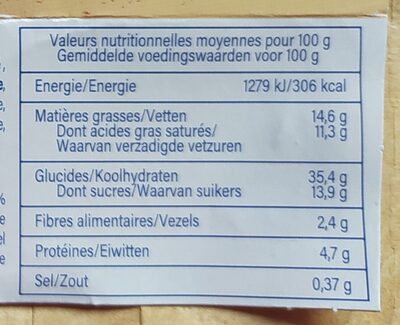
Nutrition facts
| Nutrition facts | As sold for 100 g / 100 ml | Compared to: Paris-Brest |
|---|---|---|
| Energy | ~ 1241.1 kJ (306 kcal) | 1,467.279 kJ (342 kcal) (-15%) |
| Fat | 14.6 g | 24.593 g (-41%) |
| Saturated fat | 11.3 g | 12.411 g (-9%) |
| Carbohydrates | 35.4 g | 25.654 g (+38%) |
| Sugars | 13.9 g | 16.138 g (-14%) |
| Dietary fiber | 2.4 g | ? |
| Proteins | 4.7 g | 5.514 g (-15%) |
| Salt | 0.37 g | 0.33 g (+12%) |
| Sodium | 0.148 g | 0.133 g (+11%) |
| Fruits, vegetables and legumes | ~ 4.4 % | ? |
Nutrition facts (Detailed data)
| Nutrition facts | As sold for 100 g / 100 ml | As sold Per 100 g (packaging) | As sold Per 100 g (estimate) |
|---|---|---|---|
| Energy | ~ 1241.1 kJ (306 kcal) | ? (306 kcal) | ? |
| Fat | 14.6 g | 14.6 g | ? |
| Saturated fat | 11.3 g | 11.3 g | ? |
| Carbohydrates | 35.4 g | 35.4 g | ? |
| Sugars | 13.9 g | 13.9 g | ? |
| Dietary fiber | 2.4 g | 2.4 g | ? |
| Proteins | 4.7 g | 4.7 g | ? |
| Salt | 0.37 g | 0.37 g | ? |
| Sodium | 0.148 g | 0.148 g | ? |
| Fruits, vegetables and legumes | ~ 4.4 % | ? | ~ 4.4 % |
Serving size
Ingredients
Ingredients image

Ingredients list
Ingredient information
Added sugars
Allergens
Traces
Ingredients analysis
Palm oil content unknown
Contains non-vegan ingredients.
Unrecognized: en:hazelnut-praline
Vegetarian status unknown
Unrecognized: en:hazelnut-praline
Food Processing
NOVA group
 Ultra-processed food and drink products
Elements that indicate the product is in NOVA group 4
How NOVA works
Additives
E270 - Lactic acid
LACTIC ACID is an organic compound with the formula CH3CH(OH)CO2H. In the form of its conjugate base called lactate (this is thus different and kept as a separate ingredient). Lactic acid is chiral, consisting of two optical isomers. One is known as L-(+)-lactic acid or (S)-lactic acid and the other, its mirror image, is D-(−)-lactic acid or (R)-lactic acid in food the L-variant is used
E330 - Citric acidAntioxidantSequestrant
Citric acid is a natural organic acid found in citrus fruits such as lemons, oranges, and limes.
It is widely used in the food industry as a flavor enhancer, acidulant, and preservative due to its tart and refreshing taste.
Citric acid is safe for consumption when used in moderation and is considered a generally recognized as safe (GRAS) food additive by regulatory agencies worldwide.
E407 - Carrageenan EFSA overexposure risk: highCarrierEmulsifierHumectantStabiliserThickener
Carrageenan (E407), derived from red seaweed, is widely employed in the food industry as a gelling, thickening, and stabilizing agent, notably in dairy and meat products.
It can exist in various forms, each imparting distinct textural properties to food.
However, its degraded form, often referred to as poligeenan, has raised health concerns due to its potential inflammatory effects and its classification as a possible human carcinogen (Group 2B) by the International Agency for Research on Cancer (IARC).
Nevertheless, food-grade carrageenan has been deemed safe by various regulatory bodies when consumed in amounts typically found in food.
E415 - Xanthan gumEmulsifierStabiliserThickener
Xanthan gum (E415) is a natural polysaccharide derived from fermented sugars, often used in the food industry as a thickening and stabilizing agent.
This versatile food additive enhances texture and prevents ingredient separation in a wide range of products, including salad dressings, sauces, and gluten-free baked goods.
It is considered safe for consumption even at high intake amounts.
E450 - Diphosphates EFSA overexposure risk: highEmulsifierHumectantSequestrantStabiliserThickener
Diphosphates (E450) are food additives often utilized to modify the texture of products, acting as leavening agents in baking and preventing the coagulation of canned food.
These salts can stabilize whipped cream and are also found in powdered products to maintain their flow properties. They are commonly present in baked goods, processed meats, and soft drinks.
Derived from phosphoric acid, they're part of our daily phosphate intake, which often surpasses recommended levels due to the prevalence of phosphates in processed foods and drinks.
Excessive phosphate consumption is linked to health issues, such as impaired kidney function and weakened bone health. Though diphosphates are generally regarded as safe when consumed within established acceptable daily intakes, it's imperative to monitor overall phosphate consumption to maintain optimal health.
E471 - Mono- and diglycerides of fatty acidsEmulsifierStabiliser
Mono- and diglycerides of fatty acids (E471), are food additives commonly used as emulsifiers in various processed foods.
These compounds consist of glycerol molecules linked to one or two fatty acid chains, which help stabilize and blend water and oil-based ingredients. E471 enhances the texture and shelf life of products like margarine, baked goods, and ice cream, ensuring a smooth and consistent texture.
It is generally considered safe for consumption within established regulatory limits.
E472b - Lactic acid esters of mono- and diglycerides of fatty acidsEmulsifierSequestrantStabiliser
No additive description is available yet.
E500 - Sodium carbonatesStabiliserThickener
Sodium carbonates (E500) are compounds commonly used in food preparation as leavening agents, helping baked goods rise by releasing carbon dioxide when they interact with acids.
Often found in baking soda, they regulate the pH of food, preventing it from becoming too acidic or too alkaline. In the culinary world, sodium carbonates can also enhance the texture and structure of foods, such as noodles, by modifying the gluten network.
Generally recognized as safe, sodium carbonates are non-toxic when consumed in typical amounts found in food.
Environment
Green-Score, origins bonus, and transportation impact are shown for Worldwide .
Green Score
Overall grade
 Moderate environmental impact
About Green-Score
Current scope
Life cycle analysis
Average impact of the category
 Chou pastry with praline flavoured creme • Score: 66/100
Life-cycle reference
Overall environmental impact by stage (PEF)
The overall environmental impact figure (PEF) comes from ADEME's Agribalyse database, for the category: Chou pastry with praline flavoured creme. Source: ADEME Agribalyse Database.
| Stage | Impact |
|---|---|
| Agriculture | 59.1 % |
| Processing | 11.0 % |
| Packaging | 24.4 % |
| Transportation | 3.9 % |
| Distribution | 1.4 % |
| Consumption | 0.0 % |
Bonuses and maluses
Origins of ingredients
Packaging impact
Green-Score for this product
Green-Score for this product
Final score: 58/100Final score breakdown
Carbon footprint
Carbon footprint
Climate impact by stage (CO2e)
The carbon emission figure comes from ADEME's Agribalyse database, for the category: Chou pastry with praline flavoured creme. Source: ADEME Agribalyse Database.
| Stage | Impact |
|---|---|
| Agriculture | 77.3 % |
| Processing | 5.0 % |
| Packaging | 13.0 % |
| Transportation | 4.2 % |
| Distribution | 0.6 % |
| Consumption | 0.0 % |
Packaging

Packaging impact
Packaging components
| Shape | Material | Recycling | Impact |
|---|---|---|---|
| POT | Plastic | Unknown | High |
| Sleeve | Cardboard | Unknown | Low |
| Seal | Plastic | Unknown | High |
Transportation
Manufacturing locations
Origins of ingredients
Origins breakdown
| Origin | Percent of ingredients | Impact |
|---|---|---|
| France | 100 % | Medium |
Forest footprint
Forest footprint
Ingredients linked to forest pressure
| Ingredient | Type | Percent in product | Forest footprint |
|---|---|---|---|
| EGG | Oeufs standards | 0.00 % | 0.00 |
| EGG Yolk | Oeufs standards | 0.00 % | 0.00 |
Data Source
Product data comes from Open Food Facts. Food Benchmark also adds translations, category comparisons and explanatory calculations.
The database is licensed under ODbL 1.0, individual contents under DbCL 1.0, and product photos under CC BY-SA 3.0.
Product added on December 30, 2016 at 1:38:26 PM UTC by openfoodfacts-contributors .
Last edit on March 17, 2026 at 11:00:21 PM UTC by new-nutrition-bot .
Product page also edited by additives-app-chakib, availableattheend, beniben, blap, date-limite-app, desaalex8, dorado-jerome, driveoff, ecoscore-impact-estimator, foodless, foodvisor, g123k, guezguez-majed, kiliweb, magasins-u, new-nutrition-bot, openfoodfacts-contributors, packbot, quechoisir, roboto-app, sasa, segundo, thaleron, yuka.RjRBNUhwWS9uYUlxb2NNMDN4UGwxOUpleUpLVFoxK25PK0VSSWc9PQ, yuka.SElzRVFZSmFwZGtzbGNNZTl4SFUvK0ovMlppQ1FVK2FBZlVmSVE9PQ.