

Dessert lacté aux fruits stérilisé UHT - Ananas
Labels
 Moderate nutritional quality
 Ultra-processed food and drink products
 Green-Score not computed
Health
Nutrition
Label
Moderate nutritional qualityNutrient levels
Fat in low quantity (1.5%)
Saturated fat in low quantity (1%)
Sugars in high quantity (15.3%)
Salt in low quantity (0.1%)
Nutrition label
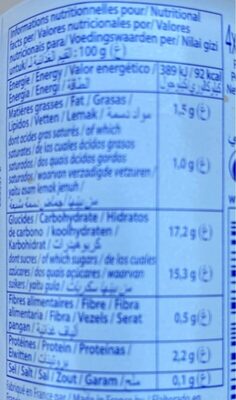
Nutrition facts
| Nutrition facts | As sold for 100 g / 100 ml |
|---|---|
| Energy | 389 kJ (92 kcal) |
| FAT | 1.5 g |
| Saturated fat | 1 g |
| Carbohydrates | 17.2 g |
| Sugars | 15.3 g |
| Dietary fiber | 0.5 g |
| Proteins | 2.2 g |
| Salt | 0.1 g |
| Sodium | 0.04 g |
| Minerals | |
| Fruits, vegetables and legumes | ~ 6 % |
Nutrition facts (Detailed data)
| Nutrition facts | As sold for 100 g / 100 ml | As sold Per 100 g (packaging) | As sold Per 100 g (estimate) |
|---|---|---|---|
| Energy | 389 kJ (92 kcal) | 389 kJ (92 kcal) | ? |
| FAT | 1.5 g | 1.5 g | ? |
| Saturated fat | 1 g | 1 g | ? |
| Carbohydrates | 17.2 g | 17.2 g | ? |
| Sugars | 15.3 g | 15.3 g | ? |
| Added sugars | ~ 10.65 g | ? | ~ 10.65 g |
| Dietary fiber | 0.5 g | 0.5 g | ? |
| Proteins | 2.2 g | 2.2 g | ? |
| Salt | 0.1 g | 0.1 g | ? |
| Sodium | 0.04 g | 0.04 g | ? |
| Minerals | |||
| Fruits, vegetables and legumes | ~ 6 % | ? | ~ 6 % |
Serving size
Estimated Activity Time
Approximate time needed to burn the energy in 100 g / 100 ml: 389 kJ. Reference adult weight: 70 kg. Energy density: Low.
Ingredients
Ingredients image
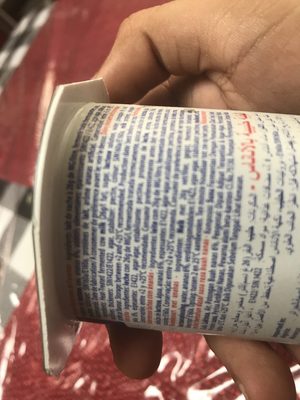
Ingredients list
Ingredient information
Allergens
Ingredients analysis
Palm oil content unknown
Contains non-vegan ingredients.
Unrecognized: fr:lait-de-vache-a-26g-de-mg, fr:litre, fr:fermente-traite-thermiquement, fr:solution-de-lactose, fr:arome-ananas-artificiel
Vegetarian status unknown
Unrecognized: fr:lait-de-vache-a-26g-de-mg, fr:litre, fr:fermente-traite-thermiquement, fr:solution-de-lactose, fr:arome-ananas-artificiel
Food Processing
NOVA group
Ultra-processed food and drink productsElements that indicate the product is in NOVA group 4
How NOVA works
Additives
E1422 - Acetylated distarch adipateEmulsifierStabiliserThickener
Acetylated distarch adipate (E1422), is a starch that is treated with acetic anhydride and adipic acid anhydride to resist high temperatures. It is used in foods as a bulking agent, stabilizer and a thickener. No acceptable daily intake for human consumption has been determined.
E160a - caroteneColour
β-Carotene is an organic, strongly colored red-orange pigment abundant in plants and fruits. It is a member of the carotenes, which are terpenoids (isoprenoids), synthesized biochemically from eight isoprene units and thus having 40 carbons. Among the carotenes, β-carotene is distinguished by having beta-rings at both ends of the molecule. β-Carotene is biosynthesized from geranylgeranyl pyrophosphate.β-Carotene is the most common form of carotene in plants. When used as a food coloring, it has the E number E160a. The structure was deduced by Karrer et al. in 1930. In nature, β-carotene is a precursor (inactive form) to vitamin A via the action of beta-carotene 15,15'-monooxygenase.Isolation of β-carotene from fruits abundant in carotenoids is commonly done using column chromatography. It can also be extracted from the beta-carotene rich algae, Dunaliella salina. The separation of β-carotene from the mixture of other carotenoids is based on the polarity of a compound. β-Carotene is a non-polar compound, so it is separated with a non-polar solvent such as hexane. Being highly conjugated, it is deeply colored, and as a hydrocarbon lacking functional groups, it is very lipophilic.
E406 - AgarCarrierEmulsifierHumectantStabiliserThickener
Agar (pronounced , sometimes ) or agar-agar is a jelly-like substance, obtained from red algae.Agar is a mixture of two components: the linear polysaccharide agarose, and a heterogeneous mixture of smaller molecules called agaropectin. It forms the supporting structure in the cell walls of certain species of algae, and is released on boiling. These algae are known as agarophytes, and belong to the Rhodophyta (red algae) phylum.Agar has been used as an ingredient in desserts throughout Asia, and also as a solid substrate to contain culture media for microbiological work. Agar can be used as a laxative, an appetite suppressant, a vegetarian substitute for gelatin, a thickener for soups, in fruit preserves, ice cream, and other desserts, as a clarifying agent in brewing, and for sizing paper and fabrics.The gelling agent in agar is an unbranched polysaccharide obtained from the cell walls of some species of red algae, primarily from tengusa (Gelidiaceae) and ogonori (Gracilaria). For commercial purposes, it is derived primarily from ogonori. In chemical terms, agar is a polymer made up of subunits of the sugar galactose.
E440 - PectinsEmulsifierStabiliserThickener
Pectins (E440) are natural carbohydrates, predominantly found in fruits, that act as gelling agents in the food industry, creating the desirable jelly-like texture in jams, jellies, and marmalades.
Pectins stabilize and thicken various food products, such as desserts, confectioneries, and beverages, ensuring a uniform consistency and quality.
Recognized as safe by various health authorities, pectins have been widely used without notable adverse effects when consumed in typical dietary amounts.
Environment
Green-Score, origins bonus, and transportation impact are shown for Worldwide .
Green Score
Overall grade
Unknown environmental impactAbout Green-Score
Current scope
Green-Score availability
Bonuses and maluses
Origins of ingredients
Packaging impact
Packaging
Packaging impact
Packaging materials
| Material | % | Packaging weight | Packaging weight per 100 g of product |
|---|---|---|---|
| Plastic | |||
| Unknown | |||
| Paper or cardboard | |||
| Total |
Declared packaging
Data precision
Transportation
Manufacturing locations
Origins of ingredients
Origins breakdown
| Origin | Percent of ingredients | Impact |
|---|---|---|
| France | 100 % | Medium |
Data Source
Data presented on this page is sourced from the Open Food Facts database. This platform does not alter the original dataset; its purpose is solely to enhance data visualization and user accessibility.
Product added on October 30, 2017 at 1:41:44 PM UTC by kiliweb .
Last edit on March 17, 2026 at 8:58:12 PM UTC by new-nutrition-bot .
Product page also edited by kiliweb, moon-rabbit, new-nutrition-bot, openfoodfacts-contributors, org-elle-vire, packbot, roboto-app, yuka.SHJsYU5Mb0R1L0kxd3NNRHdRdm93ZTRvNHNPNWNWK1ZkT0VzSVE9PQ, yuka.U5wfHPK0QdUORMiK_KQ73ha6HrnuOMNGQFM9og, yuka.Vm9rWVRmb3JyLzlUdFAwZzJpK0Z4WXhKMWErVFRVYXZNK3NqSVE9PQ.
Source List
- elle-vire