
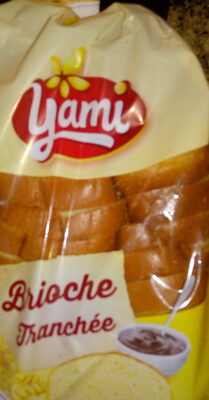
Brioche tranchée 420g aux œufs frais
Health
Nutrition
Nutri-Score data warning
Nutrition label

Nutrition facts
| Nutrition facts | As sold for 100 g / 100 ml |
|---|---|
| Energy | ~ 1493.7 kJ (348 kcal) |
| Fat | 12.3 g |
| Saturated fat | 6.9 g |
| Carbohydrates | 49.9 g |
| Sugars | 9.4 g |
| Dietary fiber | 1.9 g |
| Proteins | 10.3 g |
| Salt | 1.1 g |
| Sodium | 0.44 g |
| Fruits, vegetables and legumes | ~ 0 % |
Nutrition facts (Detailed data)
| Nutrition facts | As sold for 100 g / 100 ml | As sold Per 100 g (packaging) | As sold Per 100 g (estimate) |
|---|---|---|---|
| Energy | ~ 1493.7 kJ (348 kcal) | ? (348 kcal) | ? |
| Fat | 12.3 g | 12.3 g | ? |
| Saturated fat | 6.9 g | 6.9 g | ? |
| Carbohydrates | 49.9 g | 49.9 g | ? |
| Sugars | 9.4 g | 9.4 g | ? |
| Dietary fiber | 1.9 g | 1.9 g | ? |
| Proteins | 10.3 g | 10.3 g | ? |
| Salt | 1.1 g | 1.1 g | ? |
| Sodium | 0.44 g | 0.44 g | ? |
| Fruits, vegetables and legumes | ~ 0 % | ? | ~ 0 % |
Ingredients
Ingredients image

Ingredients list
Ingredient information
Added sugars
Allergens
Ingredients analysis
Palm oil content unknown
Contains non-vegan ingredients.
Unrecognized: fr:j-farine-de-blergluten-de-ble, fr:beurre-concenuee, fr:entiers-liquides, fr:mono-et-digtycerides-d-acides-gras, fr:monostearate-de-sorbitan, fr:ellulose, fr:beta, fr:levure-desacuvee, fr:aseinate-de-caldum
Vegetarian status unknown
Unrecognized: fr:j-farine-de-blergluten-de-ble, fr:beurre-concenuee, fr:entiers-liquides, fr:mono-et-digtycerides-d-acides-gras, fr:monostearate-de-sorbitan, fr:ellulose, fr:beta, fr:levure-desacuvee, fr:aseinate-de-caldum
Food Processing
NOVA group
 Ultra-processed food and drink products
Elements that indicate the product is in NOVA group 4
How NOVA works
Additives
E100 - CurcuminColour
No additive description is available yet.
E160a - caroteneColour
β-Carotene is an organic, strongly colored red-orange pigment abundant in plants and fruits. It is a member of the carotenes, which are terpenoids (isoprenoids), synthesized biochemically from eight isoprene units and thus having 40 carbons. Among the carotenes, β-carotene is distinguished by having beta-rings at both ends of the molecule. β-Carotene is biosynthesized from geranylgeranyl pyrophosphate.β-Carotene is the most common form of carotene in plants. When used as a food coloring, it has the E number E160a. The structure was deduced by Karrer et al. in 1930. In nature, β-carotene is a precursor (inactive form) to vitamin A via the action of beta-carotene 15,15'-monooxygenase.Isolation of β-carotene from fruits abundant in carotenoids is commonly done using column chromatography. It can also be extracted from the beta-carotene rich algae, Dunaliella salina. The separation of β-carotene from the mixture of other carotenoids is based on the polarity of a compound. β-Carotene is a non-polar compound, so it is separated with a non-polar solvent such as hexane. Being highly conjugated, it is deeply colored, and as a hydrocarbon lacking functional groups, it is very lipophilic.
E282 - calcium propionatePreservative
CALCIUM PROPIONATE has the formula Ca(C2H5COO)2. Calcium propionate is used as a preservative in a wide variety of products, including but not limited to:bread, other baked goods, processed meat, whey, and other dairy products.
E300 - Ascorbic acidAntioxidantSequestrant
No additive description is available yet.
E481 - Sodium stearoyl-2-lactylate EFSA overexposure risk: highEmulsifierStabiliser
Sodium stearoyl-2-lactylate (sodium stearoyl lactylate or SSL) is a versatile, FDA approved food additive used to improve the mix tolerance and volume of processed foods. It is one type of a commercially available lactylate. SSL is non-toxic, biodegradable, and typically manufactured using biorenewable feedstocks. Because SSL is a safe and highly effective food additive, it is used in a wide variety of products ranging from baked goods and desserts to pet foods.As described by the Food Chemicals Codex 7th edition, SSL is a cream-colored powder or brittle solid. SSL is currently manufactured by the esterification of stearic acid with lactic acid and partially neutralized with either food-grade soda ash (sodium carbonate) or caustic soda (concentrated sodium hydroxide). Commercial grade SSL is a mixture of sodium salts of stearoyl lactylic acids and minor proportions of other sodium salts of related acids. The HLB for SSL is 10-12. SSL is slightly hygroscopic, soluble in ethanol and in hot oil or fat, and dispersible in warm water. These properties are the reason that SSL is an excellent emulsifier for fat-in-water emulsions and can also function as a humectant.
Environment
Green-Score, origins bonus, and transportation impact are shown for Worldwide .
Green Score
Overall grade
 Unknown environmental impact
About Green-Score
Current scope
Green-Score availability
Bonuses and maluses
Declared origins
Packaging impact
Packaging
Packaging impact
Data precision
Transportation
Declared origins
Forest footprint
Forest footprint
Ingredients linked to forest pressure
| Ingredient | Type | Percent in product | Forest footprint |
|---|---|---|---|
| EGG | Oeufs Importés | 4.70 % | 0.00 |
Data Source
Product data comes from Open Food Facts. Food Benchmark also adds translations, category comparisons and explanatory calculations.
The database is licensed under ODbL 1.0, individual contents under DbCL 1.0, and product photos under CC BY-SA 3.0.
Product added on October 13, 2017 at 4:26:04 AM UTC by kiliweb .
Last edit on March 17, 2026 at 8:33:12 AM UTC by new-nutrition-bot .
Product page also edited by foodless, kiliweb, new-nutrition-bot, openfoodfacts-contributors, scanbot, yuka.YXJoZEZwMWZ2NklobWZjYi93T0wrK3RLMWJHNVQzTzFNdTRlSWc9PQ.