
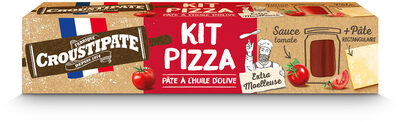
Kit Pizza
Health
Nutrition
Nutri-Score
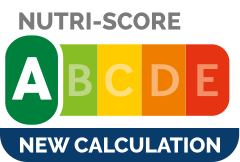 Very good nutritional quality
Nutri-Score data warning
Nutrient levels
Fat in moderate quantity (3.6%)
Saturated fat in low quantity (0.5%)
Sugars in low quantity (3.6%)
Salt in moderate quantity (0.79%)
Nutrition label
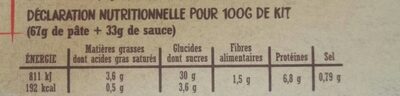
Nutrition facts
| Nutrition facts | As sold for 100 g / 100 ml | Compared to: fr:Kits pour pizzas |
|---|---|---|
| Energy | ~ 770.8 kJ (192 kcal) | 839.758 kJ (212 kcal) (-8%) |
| Fat | 3.6 g | 4.908 g (-27%) |
| Saturated fat | 0.5 g | 0.583 g (-14%) |
| Carbohydrates | 30 g | 30.117 g (~0%) |
| Sugars | 3.6 g | 2.133 g (+69%) |
| Dietary fiber | 1.5 g | ? |
| Proteins | 6.8 g | 5.8 g (+17%) |
| Salt | 0.79 g | 1.442 g (-45%) |
| Sodium | 0.316 g | 0.587 g (-46%) |
| Fruits, vegetables and legumes | ~ 94.3 % | ? |
Nutrition facts (Detailed data)
| Nutrition facts | As sold for 100 g / 100 ml | As sold Per 100 g (packaging) | As sold Per 100 g (estimate) |
|---|---|---|---|
| Energy | ~ 770.8 kJ (192 kcal) | ? (192 kcal) | ? |
| Fat | 3.6 g | 3.6 g | ? |
| Saturated fat | 0.5 g | 0.5 g | ? |
| Carbohydrates | 30 g | 30 g | ? |
| Sugars | 3.6 g | 3.6 g | ? |
| Dietary fiber | 1.5 g | 1.5 g | ? |
| Proteins | 6.8 g | 6.8 g | ? |
| Salt | 0.79 g | 0.79 g | ? |
| Sodium | 0.316 g | 0.316 g | ? |
| Fruits, vegetables and legumes | ~ 94.3 % | ? | ~ 94.3 % |
Ingredients
Ingredients image

Ingredients list
Ingredient information
Added sugars
Allergens
Traces
Ingredients analysis
No ingredients containing palm oil.
Vegan status unknown
Vegetarian status unknown
Food Processing
NOVA group
 Ultra-processed food and drink products
Elements that indicate the product is in NOVA group 4
How NOVA works
Additives
E1510 - Ethanol
Ethanol, also called alcohol, ethyl alcohol, grain alcohol, and drinking alcohol, is a chemical compound, a simple alcohol with the chemical formula C2H5OH. Its formula can be also written as CH3−CH2−OH or C2H5−OH (an ethyl group linked to a hydroxyl group), and is often abbreviated as EtOH. Ethanol is a volatile, flammable, colorless liquid with a slight characteristic odor. It is a psychoactive substance and is the principal type of alcohol found in alcoholic drinks. Ethanol is naturally produced by the fermentation of sugars by yeasts or via petrochemical processes, and is most commonly consumed as a popular recreational drug. It also has medical applications as an antiseptic and disinfectant. The compound is widely used as a chemical solvent, either for scientific chemical testing or in synthesis of other organic compounds, and is a vital substance used across many different kinds of manufacturing industries. Ethanol is also used as a clean-burning fuel source.
E500 - Sodium carbonatesStabiliserThickener
Sodium carbonates (E500) are compounds commonly used in food preparation as leavening agents, helping baked goods rise by releasing carbon dioxide when they interact with acids.
Often found in baking soda, they regulate the pH of food, preventing it from becoming too acidic or too alkaline. In the culinary world, sodium carbonates can also enhance the texture and structure of foods, such as noodles, by modifying the gluten network.
Generally recognized as safe, sodium carbonates are non-toxic when consumed in typical amounts found in food.
E575 - Glucono-delta-lactoneSequestrant
Glucono delta-lactone (GDL), also known as gluconolactone, is a food additive with the E number E575 used as a sequestrant, an acidifier, or a curing, pickling, or leavening agent. It is a lactone of D-gluconic acid. Pure GDL is a white odorless crystalline powder. GDL has been marketed for use in feta cheese. GDL is neutral, but hydrolyses in water to gluconic acid which is acidic, adding a tangy taste to foods, though it has roughly a third of the sourness of citric acid. It is metabolized to 6-phospho-D-gluconate; one gram of GDL yields roughly the same amount of metabolic energy as one gram of sugar. Upon addition to water, GDL is partially hydrolysed to gluconic acid, with the balance between the lactone form and the acid form established as a chemical equilibrium. The rate of hydrolysis of GDL is increased by heat and high pH.The yeast Saccharomyces bulderi can be used to ferment gluconolactone to ethanol and carbon dioxide. The pH value greatly affects culture growth. Gluconolactone at 1 or 2% in a mineral media solution causes the pH to drop below 3.It is also a complete inhibitor of the enzyme amygdalin beta-glucosidase at concentrations of 1 mM.
Environment
Green-Score, origins bonus, and transportation impact are shown for Worldwide .
Green Score
Overall grade
 Unknown environmental impact
About Green-Score
Current scope
Green-Score availability
Bonuses and maluses
Origins of ingredients
Packaging impact
Packaging
Packaging impact
Packaging components
| Shape | Material | Recycling | Impact |
|---|---|---|---|
| 1 Sleeve | Cardboard | Recycle | Low |
| 1 BOX | Cardboard | Discard | Low |
| 1 Individual POT | Glass | Recycle | Low |
| 1 Capsule | Metal | Recycle | High |
Declared packaging
Data precision
Transportation
Manufacturing locations
Origins of ingredients
Origins breakdown
| Origin | Percent of ingredients | Impact |
|---|---|---|
| France | 100 % | Medium |
Forest footprint
Forest footprint
Deforestation risk details
Data Source
Product data comes from Open Food Facts. Food Benchmark also adds translations, category comparisons and explanatory calculations.
The database is licensed under ODbL 1.0, individual contents under DbCL 1.0, and product photos under CC BY-SA 3.0.
Product added on October 5, 2012 at 10:23:13 AM UTC by openfoodfacts-contributors .
Last edit on March 17, 2026 at 10:19:56 AM UTC by new-nutrition-bot .
Product page also edited by andre, bar-yolaina-gmail-com, beniben, date-limite-app, driveoff, elementw, inf, kiliweb, magasins-u, manu1400, max95, mickski, new-nutrition-bot, openfoodfacts-contributors, packbot, psine, quentinbrd, raphael0202, roboto-app, segundo, tacite, tacite-mass-editor, ybar, yuka.UXJzQkxKb2RqK0VOc3RvRTl4anVxdjB1MjRPcEFGcVlKZTRjSVE9PQ, yuka.UmJJNEFyOGxoc0VSdk5nVDB5N3dvUGxTOTQvNWIyS0ZFcllOSWc9PQ, yuka.VEp3c0c0Z1BudFFydVBJVjhDM3YyOHRXeXFLbVZ6bnBDZUV6SUE9PQ, yuka.VktJRkRZTWwrZk1Yc1BNQzN3N3ErL0pROWNTeFpEbm9MTmM3SUE9PQ, yuka.VzZ3UUh2czYvOEVTb3ZjTzNpalM1ZWxKeUppWVhUdVNET0FzSVE9PQ, yuka.WDdvNVNvVWlndjBUcC9KajN3ejRvdmRMMTVDM1JUS09lL0VOSVE9PQ, yuka.YWF3dEtQOE45c1pUdzhZbDN3amUvY29sNDhTWVVtaXpNOWd6SVE9PQ, yuka.ZlpvWlM2RlIvdllJaDhObS9BM3RwZWhwLzhDV1UyZVhJdXd4SUE9PQ, yuka.sY2b0xO6T85zoF3NwEKvlndVQobhkxPoHhHVslS67dCgDLLJY455wpPQOKs.