

Croustillants - Palets Bretons
Health
Nutrition
Nutri-Score
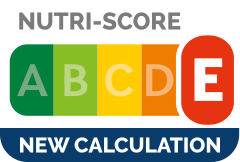 Lower nutritional quality
Nutri-Score data warning
Nutrient levels
Fat in high quantity (28%)
Saturated fat in high quantity (17%)
Sugars in high quantity (42%)
Salt in moderate quantity (0.45%)
Nutrition facts
| Nutrition facts | As sold for 100 g / 100 ml | Compared to: Brittany-style palet biscuits |
|---|---|---|
| Energy | ~ 2061.1 kJ (492 kcal) | 2,089.745 kJ (499 kcal) (-1%) |
| Fat | 28 g | 25.352 g (+10%) |
| Saturated fat | 17 g | 16.329 g (+4%) |
| Carbohydrates | 53 g | 60.703 g (-13%) |
| Sugars | 42 g | 25.867 g (+62%) |
| Dietary fiber | 0 g | ? |
| Proteins | 7.3 g | 6.094 g (+20%) |
| Salt | 0.45 g | 0.85 g (-47%) |
| Sodium | 0.18 g | 0.338 g (-47%) |
| Fruits, vegetables and legumes | ~ 0 % | ? |
Nutrition facts (Detailed data)
| Nutrition facts | As sold for 100 g / 100 ml | As sold Per 100 g (packaging) | As sold Per 100 g (estimate) |
|---|---|---|---|
| Energy | ~ 2061.1 kJ (492 kcal) | ? (492 kcal) | ? |
| Fat | 28 g | 28 g | ? |
| Saturated fat | 17 g | 17 g | ? |
| Carbohydrates | 53 g | 53 g | ? |
| Sugars | 42 g | 42 g | ? |
| Dietary fiber | 0 g | 0 g | ? |
| Proteins | 7.3 g | 7.3 g | ? |
| Salt | 0.45 g | 0.45 g | ? |
| Sodium | 0.18 g | 0.18 g | ? |
| Fruits, vegetables and legumes | ~ 0 % | ? | ~ 0 % |
Ingredients
Ingredients image

Ingredients list
Ingredient information
Added sugars
Allergens
Traces
Ingredients analysis
No ingredients containing palm oil.
Unrecognized: fr:farine-de-ble-gluten-deb, fr:e-sucre, fr:e-poudre-a-lever, fr:bicarbonate-eso-in-correcteur-d-acidite, fr:carbonatede-calcium, fr:palets-pur-beurre-5-rine-beurre-patissier, fr:blancs-d-oeufs-s-uresa-ever, fr:de-sodium, fr:malt-d-or-euorant, fr:agents-d-enrobaae, fr:gomme-que, fr:des-rainesde-a-coques
Contains non-vegan ingredients.
Unrecognized: fr:e-sucre, fr:bicarbonate-eso-in-correcteur-d-acidite, fr:carbonatede-calcium, fr:palets-pur-beurre-5-rine-beurre-patissier, fr:de-sodium, fr:gomme-que, fr:des-rainesde-a-coques
Contains non-vegetarian ingredients.
Unrecognized: fr:e-sucre, fr:bicarbonate-eso-in-correcteur-d-acidite, fr:carbonatede-calcium, fr:palets-pur-beurre-5-rine-beurre-patissier, fr:de-sodium, fr:gomme-que, fr:des-rainesde-a-coques
Food Processing
NOVA group
 Ultra-processed food and drink products
Elements that indicate the product is in NOVA group 4
How NOVA works
Additives
E160 - Carotenoids
No additive description is available yet.
E904 - Shellac
Shellac is a resin secreted by the female lac bug, on trees in the forests of India and Thailand. It is processed and sold as dry flakes (pictured) and dissolved in alcohol to make liquid shellac, which is used as a brush-on colorant, food glaze and wood finish. Shellac functions as a tough natural primer, sanding sealant, tannin-blocker, odour-blocker, stain, and high-gloss varnish. Shellac was once used in electrical applications as it possesses good insulation qualities and it seals out moisture. Phonograph and 78 rpm gramophone records were made of it until they were replaced by vinyl long-playing records from the 1950s onwards. From the time it replaced oil and wax finishes in the 19th century, shellac was one of the dominant wood finishes in the western world until it was largely replaced by nitrocellulose lacquer in the 1920s and 1930s.
Environment
Green-Score, origins bonus, and transportation impact are shown for Worldwide .
Green Score
Overall grade
 Moderate environmental impact
About Green-Score
Current scope
Life cycle analysis
Average impact of the category
 Shortbread pastry biscuit • Score: 70/100
Life-cycle reference
Overall environmental impact by stage (PEF)
The overall environmental impact figure (PEF) comes from ADEME's Agribalyse database, for the category: Shortbread pastry biscuit. Source: ADEME Agribalyse Database.
| Stage | Impact |
|---|---|
| Agriculture | 77.7 % |
| Processing | 11.0 % |
| Packaging | 5.3 % |
| Transportation | 4.5 % |
| Distribution | 1.6 % |
| Consumption | 0.0 % |
Bonuses and maluses
Declared origins
Packaging impact
Green-Score for this product
Green-Score for this product
Final score: 50/100Final score breakdown
Carbon footprint
Carbon footprint
Climate impact by stage (CO2e)
The carbon emission figure comes from ADEME's Agribalyse database, for the category: Shortbread pastry biscuit. Source: ADEME Agribalyse Database.
| Stage | Impact |
|---|---|
| Agriculture | 78.1 % |
| Processing | 5.9 % |
| Packaging | 8.9 % |
| Transportation | 6.3 % |
| Distribution | 0.8 % |
| Consumption | 0.0 % |
Packaging
Packaging impact
Data precision
Transportation
Declared origins
Forest footprint
Forest footprint
Ingredients linked to forest pressure
| Ingredient | Type | Percent in product | Forest footprint |
|---|---|---|---|
| EGG | Oeufs Importés | 0.63 % | 0.00 |
Data Source
Product data comes from Open Food Facts. Food Benchmark also adds translations, category comparisons and explanatory calculations.
The database is licensed under ODbL 1.0, individual contents under DbCL 1.0, and product photos under CC BY-SA 3.0.
Product added on November 22, 2017 at 6:49:39 AM UTC by kiliweb .
Last edit on March 17, 2026 at 9:18:16 AM UTC by new-nutrition-bot .
Product page also edited by kiliweb, new-nutrition-bot, openfoodfacts-contributors, roboto-app, teolemon, yuka.ULESF_CBLdYwLcvfjKMSwTa3Cbr5X9Z_AHhdow, yuka.Ulo0ZElLTU8rNmN1b00wVDB6Zkt3ZnR1eTYzd1hFRzFCOXNNSVE9PQ.